Pilates Reformers for Boutique Studios in Europe: What to Look For in 2026
Boutique pilates studios are the fastest-growing segment of the European fitness market, and the reformer is both their signature piece of equipment and their biggest capital outlay. If you’re opening a boutique studio in Europe, this guide covers the practical decisions that actually determine whether your studio makes money: how many reformers you need, what specification level your clients will feel, what the machine costs to own in Europe, and the compliance paperwork your insurer will ask for.
The short version: buy commercial-grade reformers with CE documentation and a real warranty, size your fleet to your class model, and budget for the machine to last 10+ years. The boutique studio business model — small classes, premium pricing, high utilization per machine — makes equipment reliability more important than in any other fitness format.
Why boutique studios are the growth market in Europe
The numbers behind the boutique boom are consistent across European markets. Pilates studios are opening faster than gyms in most EU countries, and the format that wins is almost always the small-group boutique: 4–8 reformers per studio, premium pricing per class, and a membership model built around reformer-based training.
What this means for equipment:
- Utilization is high. A boutique studio’s reformers are in use for 8–12 hours a day across classes, often 6–7 days a week. That’s the same duty cycle as a commercial gym machine, not a home machine.
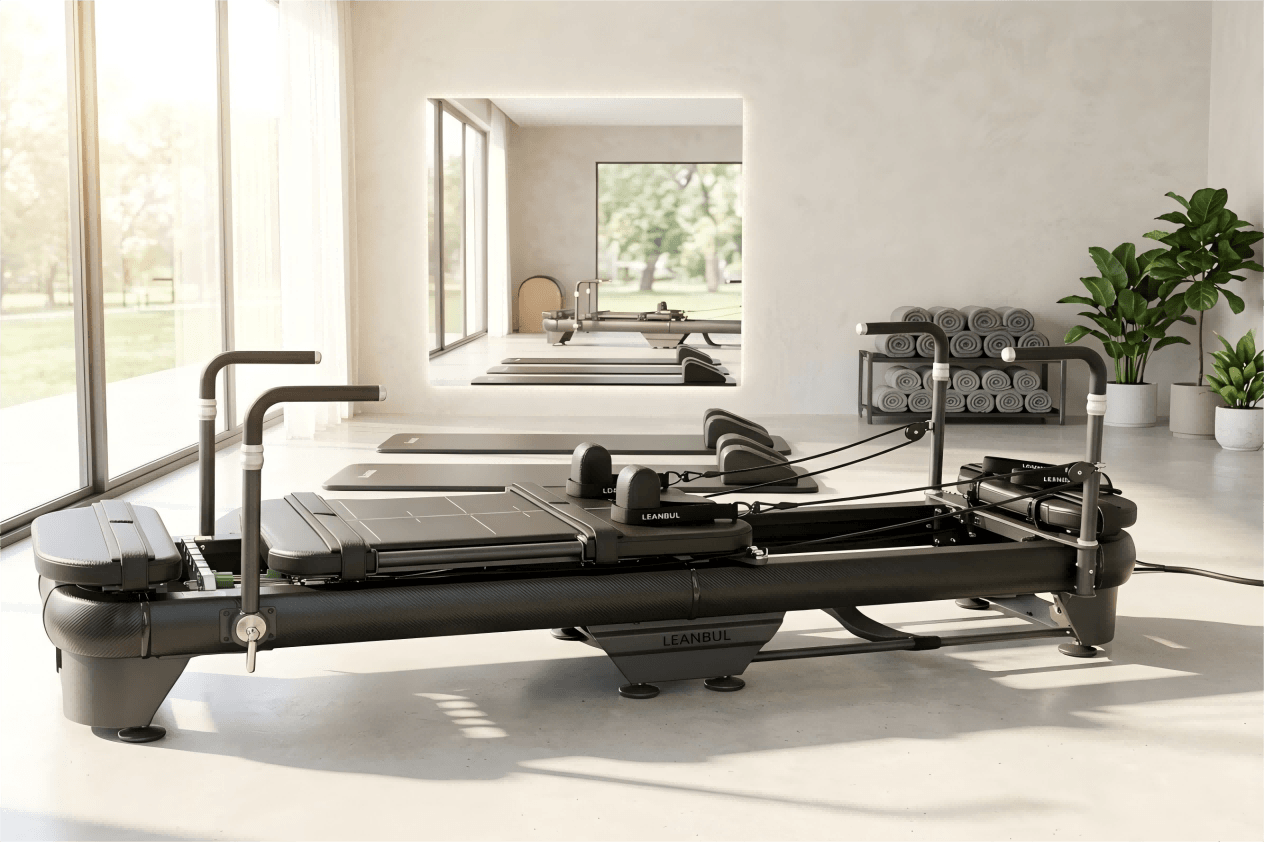
- The machine is the product. In a boutique studio, clients can see the equipment from the moment they walk in. The reformer’s glide, its noise level, and its appearance are part of the experience you’re selling.
- Class revenue depends on machine uptime. A boutique running 8 reformers needs all 8 working. One machine down is one less client per class, every class, until it’s fixed.
This is why the biggest mistake new boutique owners make is buying home-grade or second-tier reformers to save money. A €1,000 saving per machine disappears the first time a spring fails mid-class.
How many reformers does a boutique studio need?
The right number depends on your class model, not on square meters:
- Solo / private training studio: 1–3 reformers. Equipment cost is low, but each machine needs to be able to handle daily private sessions.
- Small-group boutique (the standard model): 4–8 reformers. Most European boutiques start with 6. This supports classes of 4–6 clients with room for privates between classes.
- Larger studio with mixed formats: 8–12 reformers, often with one or two towers or chairs as accessories.
A practical rule: size for your smallest profitable class, not your dream class. A 6-reformer studio can run 6-person classes, 4-person classes with 2 machines free for privates, or 3v3 training sessions. A 4-reformer studio can only run 4-person classes — and if one machine is down, you’re running 3-person classes at 4-person prices.
Commercial vs home reformers: what clients actually feel
Clients in a boutique studio feel the difference between a commercial and a home reformer within one session, even if they can’t name it. The differences that matter:
- Glide quality. Commercial reformers use precision bearings and rails that keep the carriage moving smoothly and quietly for years. Home reformers use lighter components that develop friction, noise, and uneven glide within months of daily use.
- Frame stability. A commercial frame doesn’t flex under load. When a client pushes through the footbar or straps, the machine stays planted. Flex in the frame reads as instability and undermines confidence in the equipment — and your studio.
- Noise. In a small studio, a squeaky reformer is audible in every class. Quiet operation is a premium feature clients notice immediately.
- Spring system. Commercial springs deliver consistent resistance across their range and last 1–2 years under daily studio use. Cheap springs lose tension unevenly, which changes the feel of exercises unpredictably.
For a boutique, the commercial-grade machine is not a luxury upgrade — it’s the minimum viable product. We covered the full commercial vs home trade-off and pricing in our European reformer cost guide.
Key specifications to check before you buy
When you’re comparing quotes from manufacturers, these are the specifications that separate a machine that lasts a decade from one that needs replacing in three years:
| Specification | Boutique-grade | What to check |
|---|---|---|
| Frame | Steel, welded, commercial-duty | Wall thickness and welds; ask for the spec sheet |
| Carriage bearings | Precision, sealed | Smooth, quiet glide on test |
| Spring system | 4–5 spring sets, replaceable | Spring colors and resistance chart; cost of replacement sets |
| Rope system | Commercial pulleys and ropes | Fraying resistance; replacement cost |
| Weight capacity | 150kg+ | Published spec; important for larger clients |
| Compliance | CE, EN ISO 20957 | Ask for the declaration of conformity |
| Warranty | 2–5 years frame, 1+ years parts | What’s covered, in writing |
One specification buyers often miss: replacement parts availability in Europe. A machine from a manufacturer without European distribution means weeks of shipping time and customs paperwork when a part fails. Ask where the manufacturer stocks parts and what the typical lead time is.
What a boutique reformer costs to own in Europe
The purchase price is only the first line of the cost story. Over five years, a boutique reformer costs:
- Purchase price: €3,500–€6,000 ex-VAT for commercial-grade (see our cost breakdown for the full picture).
- Springs: €120–€250 per full set, replaced every 1–2 years under daily use.
- Maintenance: €100–€300 per year for a professional service, depending on usage.
- Depreciation: well-built commercial reformers hold value for a decade or more — resale value is a genuine consideration if you ever close or upgrade (we wrote a full analysis of used vs new reformers for studios).
The good news: a quality commercial reformer amortized over 10 years costs roughly €0.50–€0.80 per class per machine at typical boutique utilization. That’s a rounding error against your class pricing — which is why the equipment decision should be driven by reliability and client experience, not sticker price.
Compliance and paperwork: the part insurers actually ask about
European boutique studios are businesses, and business insurance requires equipment compliance documentation. The two documents that matter:
- CE marking with a Declaration of Conformity. This confirms the machine meets EU safety requirements. We explain exactly what this involves in our CE certification guide for EU studios.
- EN ISO 20957 compliance. The European standard for fitness equipment, including reformers. Class S (studio) is the relevant classification for boutique use.
If a manufacturer can’t produce these documents, walk away. Not because the machine is necessarily unsafe, but because your insurer, your local authority, and your liability exposure will all ask about it eventually. It’s also the first thing a lawyer looks at if a client is ever injured.
Buying from a European manufacturer vs importing
For a boutique studio, buying from a European-based manufacturer simplifies everything:
- VAT and customs: purchasing from an EU manufacturer means no import duty and simpler VAT treatment. We broke down the full import and landed cost picture — the short version is that importing from outside the EU adds customs, freight insurance, and paperwork to every machine.
- Freight and lead times: European manufacturers deliver within the EU in days or weeks, not months. For a studio opening on a deadline, this matters enormously.
- Parts and support: a European-based manufacturer can supply replacement parts and service support without cross-border shipping delays.
- Warranty enforcement: a warranty is only worth something if you can enforce it. A manufacturer in the same region as you is a warranty you can actually use.
FAQ
How many reformers do I need to start a boutique pilates studio? Start with 4–8 depending on your class model. 6 is the standard starting point for small-group boutiques: it supports 6-person classes while leaving flexibility for privates. Never size below the smallest class you’ll actually run at full occupancy.
Are home reformers good enough for a boutique studio? No. Boutique reformers run 8–12 hours a day, and clients feel the difference in glide, noise, and stability. Home-grade machines wear out fast under studio load and undermine the premium experience you’re selling.
What’s the total cost of a reformer for a boutique studio? €3,500–€6,000 per machine ex-VAT for commercial-grade, plus springs (€120–€250 per set every 1–2 years) and annual maintenance. Over 10 years, that’s roughly €0.50–€0.80 per class per machine.
What paperwork do I need for boutique reformer equipment? CE marking with a Declaration of Conformity and EN ISO 20957 compliance documentation. Your insurer and local authority will ask for these; get them in writing before you pay.
Should I buy from a European manufacturer or import from outside the EU? For a boutique studio, a European-based manufacturer simplifies everything: no import duty, faster freight, local parts and support, and a warranty you can enforce. Importing saves money on paper but adds customs, shipping risk, and lead time.
What to Do Next
Opening or expanding a boutique studio in Europe? Leanbul is a Spain-based pilates reformer manufacturer serving studios and fitness chains across the EU. Every machine ships with CE marking, EN ISO 20957 documentation, and a warranty that’s enforced from Europe — and we deliver within the EU in days, not months. Browse the reformer collection, see our studio solutions, or contact us with your class model and machine count, and we’ll spec a fleet that fits your revenue plan.