Pilates Reformer Downtime: The Red-Tag Protocol and the Fleet Math That Keeps Classes Running
Pilates reformer downtime is rarely caused by the repair. It is caused by the two hours before anyone decides the machine is broken, and the six days after, while a €40 part travels across a border. Most studios lose more revenue to that gap than to the failure itself. The fix is boring and cheap: a red-tag rule that removes any suspect machine from the booking grid immediately, a stocked kit that turns a week into fifteen minutes, and a timetable that already knows which spot disappears first.
Do those three things and a snapped spring becomes a ten-minute inconvenience. Skip them and it becomes a refund, a bad review and a member who quietly stops booking.

Downtime has three components, and only one of them is the repair
Break a failure down and you find it is not one event:
- Detection time. How long the machine runs degraded before someone writes it up. In a staffed studio this is usually short. In one running self-guided hours, it can be days, because the person who notices is a member who does not want to complain.
- Parts time. The interval between “this needs a spring set” and the box arriving. This is the number that decides whether you lose classes. A part on the shelf is fifteen minutes. A part ordered from abroad is five to fifteen working days, and if it crosses a customs border, add a clearance.
- Decision time. Whether to repair, borrow, re-sequence or absorb. Studios without a rule debate this every time, usually between classes, usually badly.
Repair labour is the smallest of the three. That is why the useful question is not “how fast can we fix it” but “how fast do we know, and what is already in the cupboard”.
What actually fails on a commercial reformer
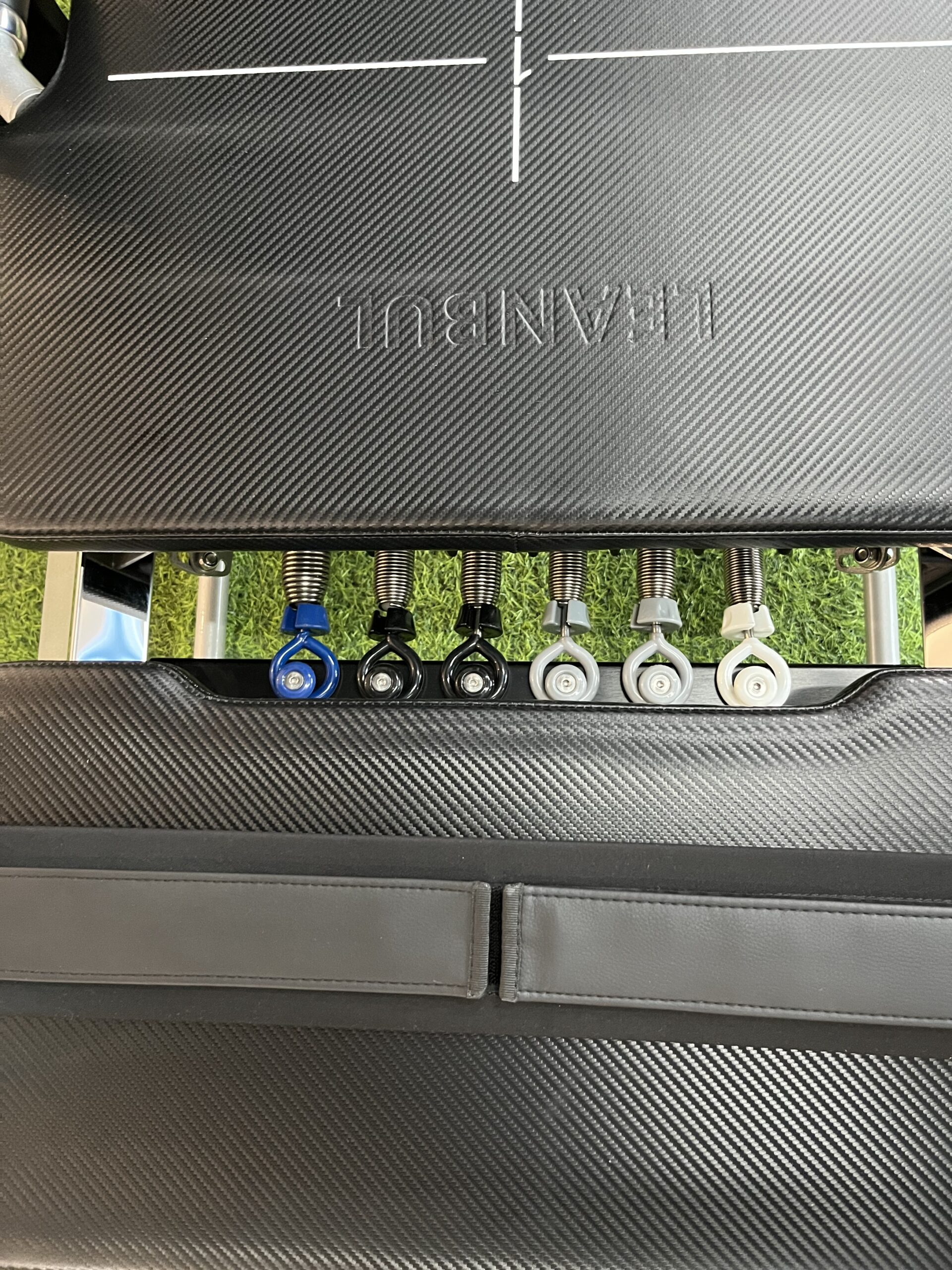
Running order, high to low, based on what wears out on machines doing 40-plus sessions a week. This is the table to put on the staff room wall.
| Failure | First symptom | Keep in service? | Part | Fix time with kit on shelf |
|---|---|---|---|---|
| Spring fatigue | Pull feels soft, uneven resistance, clients say the machine feels “different” | Yes, short term, if you drop to a lower spring count and log it | Spring set | 10 minutes |
| Spring failure | Kinked coil, gap opening in the coil, a snap mid-class | No | Spring set | 10 minutes |
| Rope or strap fray | Fuzzing at the pulley, a strand lifted | No until replaced | Rope and strap set | 15 minutes |
| Carriage wheel flat spot | Rattle or graunching on the glide, noise at one point of travel | No. Continued use scores the track | Wheel and bearing kit | 20 to 40 minutes |
| Track contamination | Grinding that comes and goes, worse after a humid week | Yes, clean it | None | 5 minutes |
| Footbar lock play | Bar shifts under load, or will not lock on the first attempt | No | Lock mechanism or gas strut | Depends on design |
| Upholstery seam split | Seam opening at the shoulder rest or carriage edge | Yes, until foam starts to break down | Cover, then foam | 1 to 3 days |
| Loose frame bolt | Creak that changes with load, a click on the push | No until torqued and checked | None, or bolt and washer | 20 minutes |
| Frame or weld damage | Visible crack, or a machine that moves under load | No. Take it out and keep it out | Structural | Replace, not repair |
Two things about this table are worth internalising. First, everything that takes a machine out of service mid-class is in the top four rows, and all four are cheap parts. Second, the expensive failure is not the snap. It is the flat-spotted wheel that nobody reported, running on a scored track for three months.
The red-tag protocol
A rule that works with part-time staff, freelancers and self-guided hours has to be short enough to remember at 07:05 with a full class waiting.
- Any doubt takes the machine out. Not “I’ll mention it to the owner later”. The instructor pulls the machine and moves the client to a spare, or reduces class size by one. Nobody diagnoses under time pressure.
- Tag it visibly. A physical tag on the footbar, plus the machine blocked in the booking system. Two systems, because one of them will be forgotten. A laminated card and a hook by the door costs nothing.
- Write three lines. Which machine, what it did, who saw it. Date and time. Photos for anything involving springs, ropes or wheels. This log is also the document your insurer will ask for if a claim follows an injury.
- Triage the same day, not the same class. Someone with authority looks at the tag before the end of the day and makes one of three calls: fix now, order part, retire the machine.
- Nothing comes back without a sign-off. Whoever clears the tag initials the log. A machine that quietly reappears in the grid is how the same fault injures a second person.
The failure mode of this protocol is predictable: it works beautifully for a month, then a busy Tuesday happens, the tag goes back in the drawer, and the machine is in service again by Thursday. The only defence is that clearing a tag requires a name.
The maths that justifies the spare kit
Take a ten-machine studio running eight classes a day at €25 a spot, 80% filled.
| Item | Number |
|---|---|
| Machine-sessions per day across the fleet | 80 |
| Revenue per machine-day at 80% fill | €160 |
| Cost of a spring set | €120 to €250 |
| Revenue lost per machine, 10-day parts wait | €1,600 |
| Revenue lost per machine, 6-week import wait | €6,700 |
| Spare kit covering springs, ropes, wheels for the fleet | Roughly the price of one machine |
One machine down does not cost you the whole €160 a day, because you re-sequence and squeeze clients into other slots. It costs you one seat in every class: eight classes at €25 is €200 of capacity a day, and at 80% fill about €160. Either way the comparison is the same. A ten-day wait costs five to ten times the part. A six-week wait costs a used car.
This is why the kit should be bought with the fleet, on the same invoice, in the same shipment. It arrives crated with the machines, it is not a separate purchase order anyone has to approve later, and it does not cross a border on its own. Our spare parts guide for European studios lists what goes in it, item by item.
Which machine breaks first
Wear is not distributed evenly across a fleet, and the pattern is not random. It follows bookings.
Pull the session count per machine from your booking software. The machine with the highest count takes the most load and should be inspected first, every time. In most studios it is the same two machines all year, usually the ones nearest the door or the ones under the best light, because members develop preferences and the booking system reinforces them. That is not fair wear. It is concentrated wear, and it can be managed.
Three cheap countermeasures:
- Rotate the spring positions, not just the springs. Even wear across the spring bar matters more than even wear across machines.
- Rebalance the grid periodically. If your software allows member-chosen machines, switch to assigned machines for one month a quarter. It feels worse to members and better to the fleet.
- Inspect by booking rank. Top two machines weekly, the rest fortnightly. Same staff time, better coverage.
What to put in the supply contract
Downtime is decided at the point of purchase, months before anything breaks. Six clauses do most of the work:
- A named technical contact and a stated response time. Not a general inbox. One working day to a diagnosis is a reasonable ask from a European manufacturer; anything vaguer means you are emailing customer service and hoping.
- Parts shipped from EU stock, with a published parts list and prices at the time of order. This is the clause that separates a serious supplier from a reseller. If the parts list is not available before you buy, that tells you what the after-sales file will look like.
- A spare kit included or priced into the order. Itemised, not “we’ll sort you out”.
- Warranty that excludes wear items but states it plainly. Springs, ropes and upholstery are consumables. Any supplier claiming otherwise is either new to this or lying, and you will find out at the claim.
- A downtime credit or warranty extension for machines that spend more than a stated number of days out of service. Rare, but askable, and it puts a cost on slow response.
- The technical file you need for insurance. Declaration of conformity with the part and class, the maintenance schedule, torque settings, and the parts diagram. Get it at delivery, not at claim time.
We wrote about the wider set of terms in the supply contract guide, and the maintenance side is covered in the European maintenance guide. This piece is only about the failure window.
The insurance conversation
Most studio policies cover public liability, contents and business interruption in some form. What they rarely do out of the box is pay for a machine that fails mechanically, because that is equipment breakdown cover, a separate section that many brokers in southern Europe do not offer by default. Where it exists, it usually covers sudden and accidental failure and excludes anything that can be described as wear, gradual deterioration or lack of maintenance.
So the sequence is: ask whether equipment breakdown is included, ask whether business interruption extends to it, and then read the exclusions against your own maintenance log. If your log has gaps, an underwriter can argue the failure was gradual and foreseeable. The log is not paperwork. It is the claim.
Timing: the failure always lands in the worst week
Two windows carry disproportionate risk. January, when the resolution crowd arrives and every machine runs every slot. September, when the schedule restarts at full density after a quiet August.
Both share a property: no slack. A machine goes down in a week when there is nowhere to move the class, and that is the week you find out whether the kit is on the shelf. Book the annual inspection in the quiet month before each peak, not during it. Springs measured, ropes checked, wheels inspected, footbar locks cycled, bolts torqued, and everything logged with a date. Then the peak arrives with the fleet already proven.
There is also a slow version of this that costs more than any single failure. Springs that have lost 15 to 20% of their tension do not fail, they just feel wrong at 500 hours of use, which at eight to ten classes a day arrives in six to eight weeks. Members cannot say why the machine feels worse than the one at the studio across town, only that it does. You lose them one renewal at a time and never attribute it to the equipment.
FAQ
How long can a reformer be out of service before I should replace it instead of repair it?
If the part is under €300 and the frame, track and carriage are sound, repair. Anything structural, or any repair that needs the machine shipped back to the manufacturer, is usually the moment to compare against the cost of a replacement rather than fix it. As a working rule, a repair costing more than a quarter of the machine’s replacement value, on a machine over seven years old, is an exit signal rather than a fix.
Is a snapped spring covered by warranty?
Almost never, and it should not be. Springs are consumables with a defined service life; the failure is wear, not defect. What you should expect from a supplier is a correct replacement interval in the manual, springs sold individually or in sets at a published price, and a spec that is honest about how load affects life. Under heavier strength-style programming, the same spring that lasts eighteen months in a classical programme may need replacing every eight.
Should I keep a spare reformer?
For most studios, no. A spare machine is 15 to 20% more capital for something that sits idle, and it ties up floor space you are paying rent on. Buy the parts kit, keep one machine out of the booking grid as a swing unit at peak times, and put the saved capital into a second spring set and a proper inspection schedule. If you run eight or more machines, or you operate unstaffed hours where nobody can re-sequence a class, the calculation flips and a seventh or ninth machine starts to earn its keep.
How do I run a class with one machine down?
Reduce the class by one spot and tell the affected members before they arrive, with a first-refusal on the next available slot. Do not silently overfill the remaining machines; that is how a second failure happens. If the room is running at high utilisation, the honest move is to cancel the earliest affected class rather than degrade three of them.
Does my insurance cover a broken reformer?
Probably not under a standard policy. Mechanical failure needs equipment breakdown cover, which is a separate section, and business interruption has to be extended to it. Check three things: whether the section exists, whether wear and gradual deterioration are excluded, and whether your maintenance records would survive an adjuster reading them. Ask your broker for the answer in writing.
Specifying a fleet that survives its own timetable
We build commercial reformers in Spain and ship them across Europe with the CE declaration of conformity, EN ISO 20957-1 class S documentation, a printed maintenance schedule, a torque table and an itemised spare parts list. When we quote a fleet we quote the kit with it, because a machine that waits ten days for a spring has already cost more than the spring.
Send us your timetable, your machine count and how many sessions each machine runs per week, and we will tell you which parts you will actually wear out and how often. Start with the K30 commercial reformer for high-volume rooms, the K38 premium reformer for boutique floors, or the compact K10 where space is tight. The full pilates studio solutions range covers mixed layouts, and you can contact us for a fleet quote with the spares included.
