Accessible Pilates Studios: What Actually Makes a Reformer Room Usable
A studio is not accessible because someone built a ramp. It is accessible when a wheelchair user can get through the door unassisted, change in a room that fits them, get onto the carriage without being lifted by two people, and take a class taught by someone who knows what to change. In a reformer room the bottleneck is almost always the transfer: the 35 to 45 centimetres between a wheelchair seat and the top of the carriage.
That single dimension is why so many studios advertise inclusive classes and then quietly turn people away. The entrance was fixed. The machine was not.
The commercial case is not sentimental. In 2024, 23.9% of people aged 16 or over in the EU reported a disability, defined by Eurostat as some or severe long-standing limitation in usual activities. That is 17.2% with some limitation and 6.7% with a severe one. The share rises steeply with age: 72.3% among people aged 85 and over, against 7.1% among 16 to 24 year olds. Country figures run from 12.7% in Bulgaria and 14.5% in Italy up to 41.2% in Latvia.
Read that against your own timetable. If your classes are built around 30 to 45 year olds, you are serving the age band with the lowest disability rate in the population and calling it the whole market.
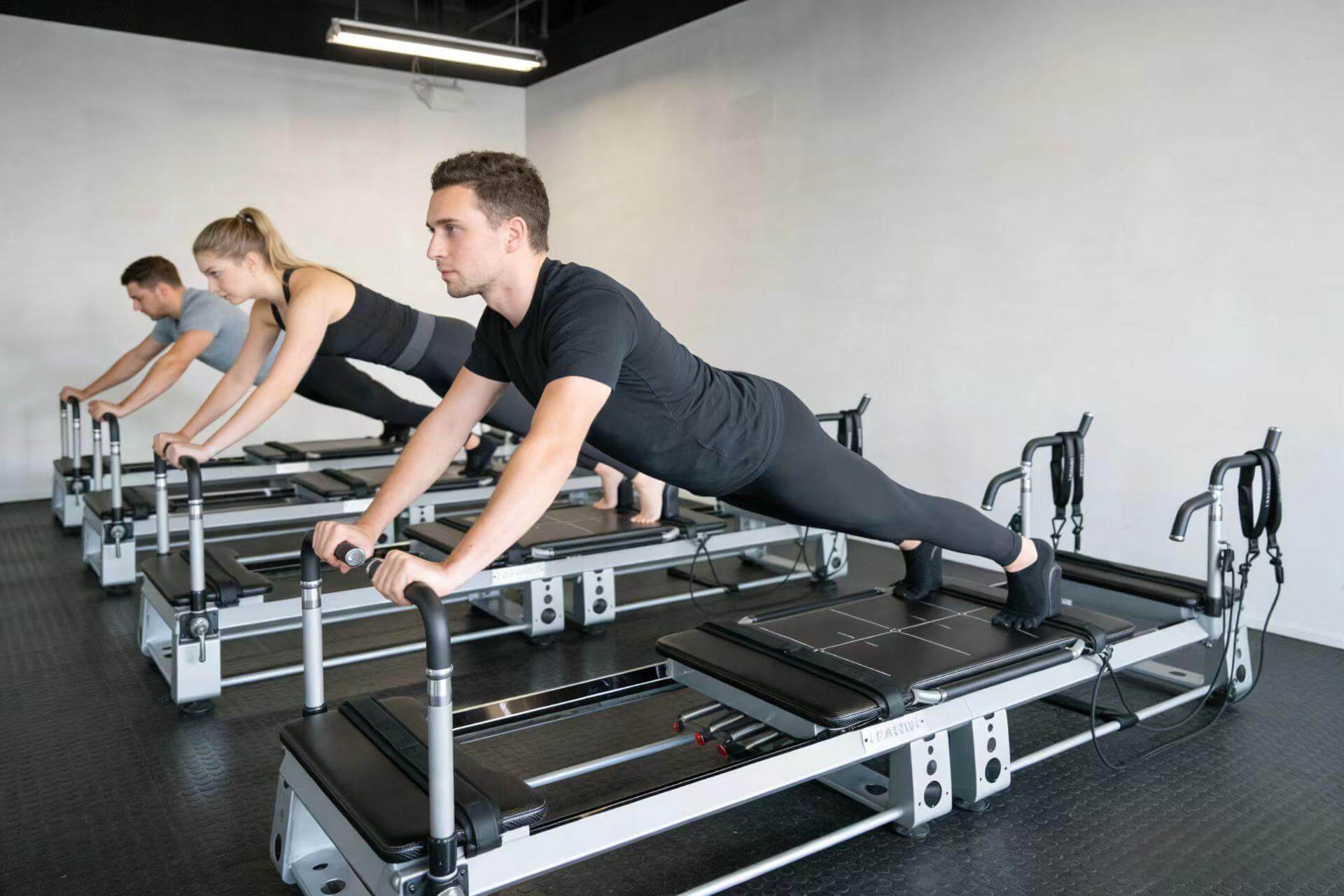
Who the room is actually failing, and why
“Accessible” gets used as one thing. It is at least six, and they fail in different places.
| Client group | What the room has to provide | Where studios usually fail |
|---|---|---|
| Wheelchair or mobility-aid users | Step-free route, WC that fits a chair, transfer height matched to their chair, lateral space beside the carriage | Carriage too high or too low, no space to park a chair beside the machine |
| Chronic pain, fatigue, MS, EDS, long Covid | Shorter sessions, lying options, ability to stop without disrupting the class | 55-minute formats with no exit, no rest position taught |
| Post-surgical, post-natal, cardiac rehab graduates | Progressive loading, close supervision, confidence to return | Told to “start with the beginner class” and left there |
| Older adults (65+) | Secure entry and exit from the carriage, hand support, slower transitions | Timetable at 07:00 and 19:00 only, no daytime slots |
| Larger bodies | Rated user mass above the standard 120 to 150 kg, wider carriage, longer straps | Machine rated at the limit, staff guessing instead of checking the plate |
| Neurodivergent clients, hearing or vision impairment | Predictable class structure, visual demonstration, quiet hours, clear verbal cues | Music-led instruction, no written sequence, no advance information about the room |
One of these groups will pay full price for a good class. Several of them will pay a premium for a 1:1, because the alternative is not doing it.
The four gates
Accessibility in a studio is sequential. A client gets through all four or the fifth thing does not matter. Most fit-out budgets get spent on gate one and none on gate three.
| Gate | What to measure | Typical failure in European units |
|---|---|---|
| 1. The route in | Clear door opening, threshold height, step-free path from street or lift, distance from drop-off to door | 90 cm door with a 3 cm threshold; lift too small for a chair plus a helper |
| 2. Circulation inside | Manoeuvring space, turning circle, aisle width between machines | 8 machines fitted to a plan that has no aisle wide enough to pass a chair |
| 3. Changing and WC | Accessible WC, bench, privacy, no level change | “Accessible” WC used as storage, or on another floor |
| 4. The machine | Transfer height, side clearance, rated user mass, removable shoulder rests, reachable footbar and straps | Machine chosen for price and class count, never for transfer |
National building codes differ in detail, but most European transpositions lean on the same reference documents: EN 17210 on accessibility and usability of the built environment, and ISO 21542. In practice that means a clear door opening somewhere around 800 to 900 mm and a manoeuvring circle near 1,500 mm. Check your own national code rather than a blog, including mine.
The one you can still fix after signing the lease is gate four, and it is the one that costs least.
Transfer height is the specification that decides everything
Frame height is usually sold as a styling choice. It is the difference between a client training with you for years and a client who tries once.
Balanced Body publishes three frame heights for its Studio Reformer, and their own product notes are unusually honest about what each is for:
| Frame height | Published positioning | What it changes in practice |
|---|---|---|
| 14 in / 36 cm | The most common height, facilitates all exercises | Best all-rounder; harder transfer for clients with limited hip mobility or weak arms |
| 18 in / 46 cm | Positioned for less mobile and older users; described as good accessibility for wheelchair transfers | Reduces the drop from chair seat to carriage; standing and lunge work still possible |
| 24 in / 61 cm | Clinical ergonomics for manual adjustment and support | Easiest working height for a therapist’s hands and back; too high for standing work on the frame |
The same company lists the Studio Reformer at 235 × 67 × 38 cm overall and 68 kg. A reformer is not furniture you move around on a whim; whatever height you buy is the height you live with.
Three practical consequences follow.
Do not buy a single height for a mixed client base. If you already run six machines at 14 inches and one client cannot transfer, ordering one 18-inch frame is a smaller decision than a ramp, a lift, or losing the client. Many manufacturers build the same model in more than one frame height, or offer risers; ask before assuming you have to change brands.
Frame height is not carriage top height. The number that matters for a transfer is the carriage surface at rest, plus how far it sinks when loaded. Ask for both, in writing.
Space beside the machine is part of the specification. A wheelchair needs to park parallel to the carriage with room for a transfer board and a helper. If your layout packs stations at 2.0 m², the accessible station has to be at the end of the row.
Rated user mass, and the conversation nobody wants to have
Every commercial machine carries a rated maximum user mass, and under EN ISO 20957-1 the marking on the machine has to state it, along with the class. Studio machines commonly sit between 120 and 150 kg. Some are lower.
If a client is above the rated figure, that is not a “let’s see how it goes” moment. It is a warranty question, an insurance question and a safety question, in that order. Two honest options exist: buy a machine rated higher, or refer the client elsewhere with a recommendation you can stand behind. Guessing is the only bad option, and it is the one most studios take because nobody wants to say the number out loud.
Cheap imports fail quietly here. A machine sold as commercial with no declaration of conformity, no class marking and no stated maximum user mass gives you nothing to show an insurer if a carriage fails under load.
What the machine cannot fix
Buying a lower frame does not make a studio inclusive. Three things sit outside the equipment budget and matter more.
Instructor competence. Teaching a client with a spinal cord injury, a prolapse, a replaced hip or a vestibular condition is a different skill from teaching a general class, and most reformer certifications do not cover it at that depth. Studios that do this well usually have one instructor who has taken the extra training and who owns the adaptive sessions, rather than spreading the work across a rota.
Format. An adaptive client in a six-person class gets a fraction of the attention and spends half the session waiting. Duet and 1:1 formats work because spring load, settings and pace can change per person, which is also why they cost more.
Intake. A standard PAR-Q does not ask what you need to know: which side is weaker, whether transfers are independent, whether the client can get down to the floor and back up, what aids they use, whether they may need to leave mid-session. Ask in writing before they arrive, and keep the answers where the instructor will see them.
Where EU law actually bites, and where it does not
Two different legal tracks get confused in this conversation.
Buildings and services to the public are governed by national codes and anti-discrimination law. The UN Convention on the Rights of Persons with Disabilities, which the EU concluded in 2010 and every member state is party to, requires measures that let disabled people take part in mainstream sporting activity. How that lands in practice is national: ramp requirements, accessible WCs and reasonable adjustment duties differ by country, and so do the penalties.
Digital and product accessibility is where the European Accessibility Act, Directive (EU) 2019/882, applies. It became applicable on 28 June 2025 and covers specific products and services, including e-commerce, banking, transport, e-books and audiovisual media. If you sell class packs through a website that takes payment, that booking flow is the closest thing in your business to covered e-commerce.
Three details most studio owners have not been told:
- The microenterprise exemption is real but narrow. A service provider with fewer than 10 employees and an annual turnover or balance sheet total of no more than €2 million is exempt from the service accessibility requirements. The moment you cross either threshold, the exemption disappears, with no grace period.
- There is a transition on products used to deliver services. Products lawfully used before 28 June 2025 may keep being used until 28 June 2030. Self-service terminals already in use get longer, up to the end of their economic life and a maximum of 20 years.
- Kiosks count. Studios moving toward self-guided hours with a check-in terminal should read the terminal rules before ordering hardware, not after.
Then there is EN 17229:2026, the new European standard for fitness club operation. It sets requirements for how a club is run and supervised, how equipment is selected and positioned, and what competence trainers need. It is voluntary, and it is the document an insurer or a corporate client is most likely to ask about when they ask whether your studio is “properly run”.
What retrofit actually costs
Retrofitting a finished studio costs more than people expect. Indicative 2026 contractor ranges, before VAT:
| Item | Typical range | Note |
|---|---|---|
| Threshold ramp or platform lift | €400 to €4,000 | Small thresholds are cheap; level changes of 30 cm or more are not |
| Door widening (non-structural partition) | €800 to €2,500 | Load-bearing walls change the number completely |
| Accessible WC conversion | €3,000 to €9,000 | Wet room, grab rails, outward door, drainage |
| Contrast marking, lighting, signage | €150 to €600 | Cheapest item on the list, and the one clients notice first |
| One additional low-transfer machine | Machine price | Often cheaper than the building work, and it solves the actual problem |
The pattern is consistent. The building work costs more than the equipment, and the equipment solves more of the client’s problem. With the last €6,000 of a fit-out, buy the machine and fix the threshold, in that order.
Five questions to put to a reformer supplier
- What frame heights does this model come in, and what is the carriage top height at rest and under a 100 kg load?
- What is the rated maximum user mass, and where is it marked on the machine?
- Can you send the declaration of conformity and the EN ISO 20957-1 test report, with the testing body named?
- How much clear floor space do you require on the long side for a transfer, not just for exercise?
- If I need one machine in a different height six months from now, is the frame the same and are the parts interchangeable?
A supplier who cannot answer the first three in writing is telling you something useful.
The cheapest accessibility decision in the whole fit-out
Leave one station at the end of the row with 1.5 m of clear floor on its long side, put the lowest-transfer machine there, and do not let it become the storage corner. Then price one weekly duet or 1:1 slot for the clients who need it, and describe the session on your booking page in plain language: what the room looks like, how the transfer works, whether the instructor will help.
That is a smaller decision than a lift, and it converts a group of clients most studios in your city have already decided not to serve.
Where the equipment decision fits
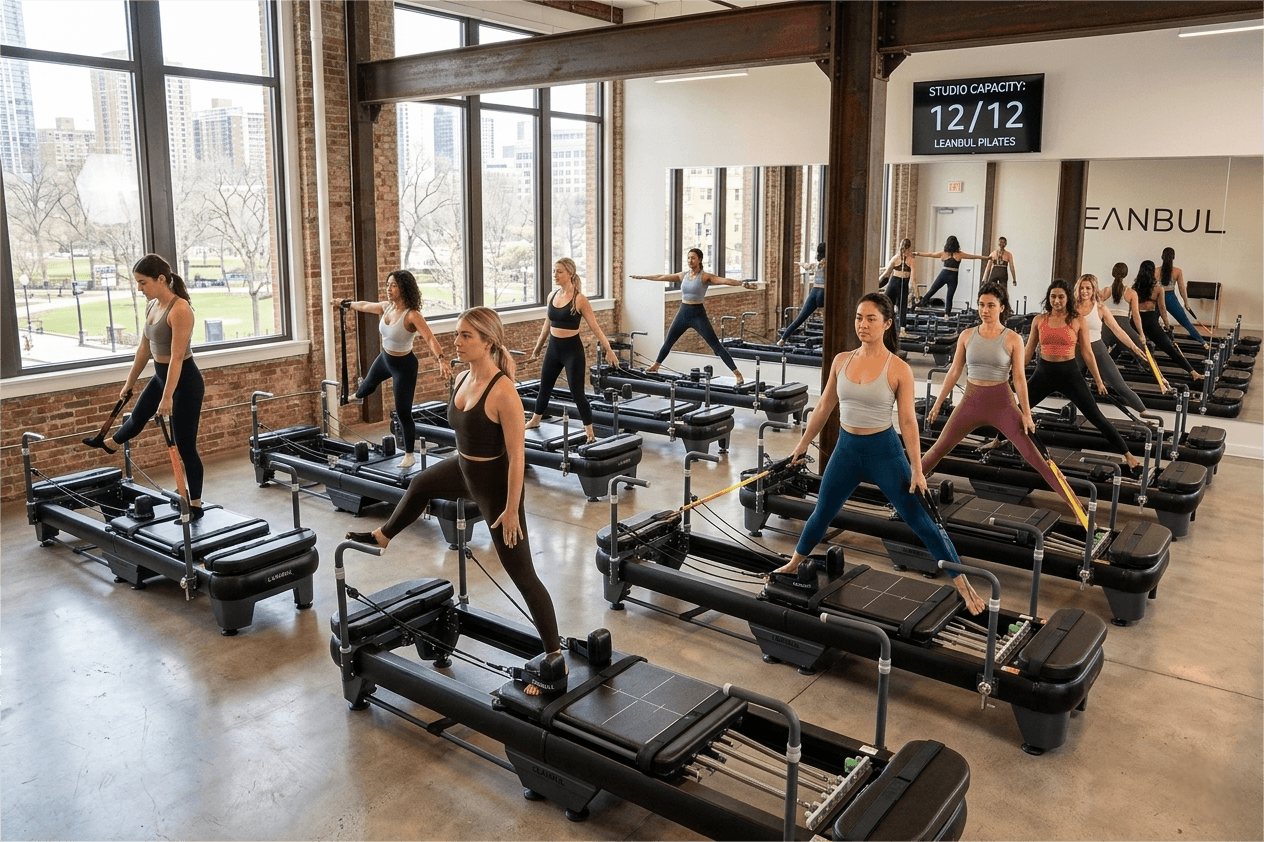
If you are specifying a room for a mixed client base, the sensible approach is one machine height for the standard stations and a second, lower-transfer build for the accessible station. Our K30 studio reformer is the machine most European studios start with, and the K38 premium reformer is what we supply where class volume is heavier and the frame has to take more cycles. Both are built as EN ISO 20957 Class S commercial machines with the rated user mass marked on the frame, and the Pilates studio solutions page shows layouts with a transfer-side aisle rather than the usual even grid.
We are a Spain-based manufacturer and we deliver across the EU with CE marking, a declaration of conformity and documentation in the destination language. If you send us a floor plan and tell us who your clients actually are, we will tell you which stations can take a transfer and which ones cannot. Start from the contact page.
Frequently asked questions
What is the most important measurement for an accessible reformer studio? The carriage top height at rest, and the clear floor space on the long side of the machine. Entrance width gets the attention, but the transfer is where most clients are actually stopped.
Is an 18-inch frame worth the extra cost? If you have clients with limited hip mobility, wheelchair users, or a significant number of older clients, yes. An 18-inch frame makes the transfer easier while still allowing standing work. A 24-inch clinical frame is easier still for the instructor’s back, but it makes standing and lunge work on the frame impractical.
Does the European Accessibility Act apply to a small pilates studio? Possibly, and it depends on what you sell rather than how big your room is. The Act covers specific products and services, mainly digital. Service providers with fewer than 10 employees and turnover or a balance sheet total of no more than €2 million are exempt from the service requirements, and the exemption ends the moment you cross either threshold. National anti-discrimination and building law applies regardless.
Can I run adaptive classes on standard machines? Yes for many clients, with setup changes: fewer springs, a lighter carriage, a footbar position that suits the range available, and a rest position taught in the first five minutes. Clients who cannot transfer safely onto a standard-height carriage need a different machine, not a different cue.
What should I ask before buying a machine for larger clients? The rated maximum user mass, in writing, and where it appears on the machine. Commercial machines commonly sit between 120 and 150 kg. If a supplier will not state the figure or send the test report behind it, you have no way to check whether the claim is real.
