Pilates Reformers for Residential Wellness Amenities in Europe: A Guide for Build-to-Rent and Multifamily Operators
A Pilates reformer for residential amenities works differently from one in a studio. Nobody teaches on it, it sits in a shared room, and the people using it are residents rather than paying class members. That changes what you should buy. You want a machine that is safe unsupervised, quiet, low-maintenance and priced for a handful of daily users, not a fleet of commercial workhorses running twelve classes a day.
For build-to-rent and multifamily operators in Europe, a small reformer corner can be one of the higher-return amenities per square metre you can add. This guide covers why the demand is there, what to specify, what it costs, and the compliance and insurance details that catch operators out.
Why Residential Operators Are Adding Reformers
Two things are happening at once. Wellness real estate has become the fastest-growing part of the wellness economy. The Global Wellness Institute valued the sector at $548 billion globally in 2026, on track to pass $1 trillion by 2029. At the same time, the amenity race in European rental housing has moved past the plain gym. Developers are being told, bluntly, that generic clubrooms and minimalist gyms no longer earn their floor space.
Reformer Pilates fits that gap well. It is low-impact, appeals across ages, and reads as premium rather than generic. In the US multifamily market, properties with a strong amenity package have been shown to command rent premiums of roughly 5 to 20 percent and to lease up around 5 percent faster than comparable buildings with fewer features. Reformer Pilates is the kind of destination amenity that turns a room people walk past into one they use.
Europe’s build-to-rent market is still small next to the US, but it is compounding. Mordor Intelligence puts it at around $7 billion in 2025, growing to roughly $7.5 billion in 2026 and $10.5 billion by 2031, about 7 percent a year. As the sector matures, amenity quality becomes a differentiator, and reformers are moving onto the specification list.
Pilates Reformer for Residential Amenities: What to Specify
The most common mistake is buying studio-grade machines for a building amenity, or amenity-grade machines for something that will actually be run hard. Know which one you are building.
| Factor | Residential amenity | Commercial studio |
|---|---|---|
| Daily use | A few hours, unsupervised | 8 to 15 classes a day, supervised |
| Users | Untrained residents | Instructors and trained clients |
| Priorities | Safety, quiet operation, looks, durability | Throughput, adjustable resistance, serviceability |
| Typical fleet | 2 to 6 reformers | 6 to 16 reformers |
| Machine class | Light commercial | EN ISO 20957 Class S commercial |
| Wartung | Quarterly checks | Schedule-based, springs every 1 to 2 years |
The distinction matters for two reasons: money and safety. A commercial workhorse is more machine than an amenity needs, and a home-grade machine used by residents of all sizes and abilities will wear out early and may not carry the safety documentation your insurer wants.
Four things matter more than any accessory in an unsupervised room.
- Stability and safety. A wide, stable frame that cannot tip, a carriage that stays on its track under uneven loading, and a footbar that locks firmly. Check the weight capacity against the tallest and heaviest residents you expect.
- Quiet operation. This is the amenity’s most underrated feature. A noisy carriage in a residential building generates complaints. Ask about sealed bearings and wheel material, and test one machine on a hard floor before you order ten.
- Low maintenance. Untrained users are hard on equipment. Standard, replaceable springs, ropes and wheels matter more here than any add-on.
- Aesthetics. In a residential amenity, the machine is part of the interior. Colour and finish are legitimate specification criteria, not vanity.
How Many Reformers Does a Residential Amenity Need?
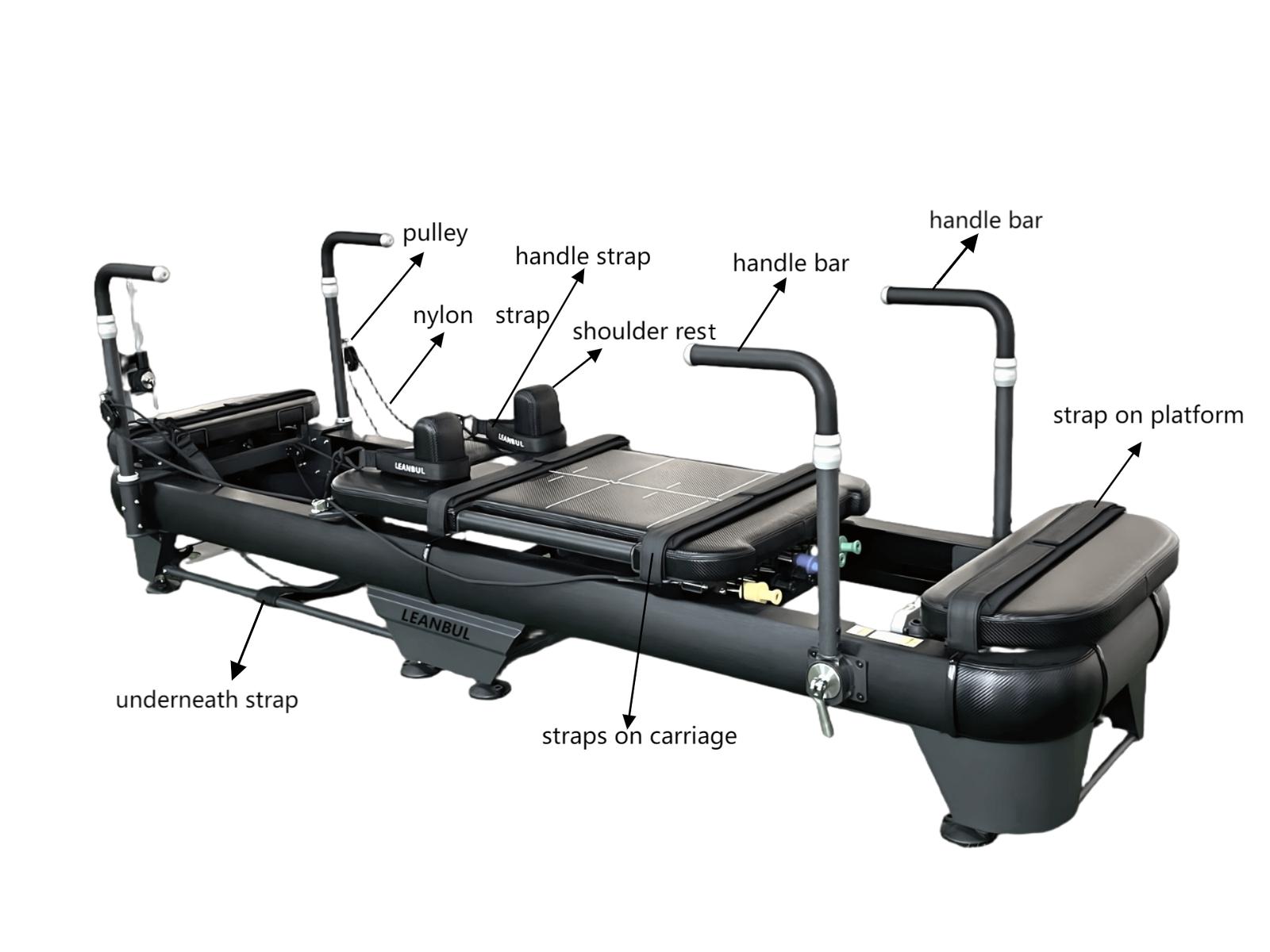
Space is the constraint. A reformer is roughly 2.3 to 2.5 m long, and you need about a metre of clearance on the working sides for safe mounting and dismounting. In practice, plan around 3 m by 1.5 m per machine as a working footprint, more if you want a walkway.
For context, commercial operators installing boutique reformer studios inside gyms fit 8 to 16 machines into 60 to 160 m². A residential amenity is usually smaller and unstaffed, so the sensible range is lower.
| Building size | Suggested reformers | Approximate floor area |
|---|---|---|
| Small scheme or co-living | 1 to 2 | 8 to 12 m² |
| Mid-size apartment building | 2 to 3 | 12 to 18 m² |
| Large build-to-rent scheme | 4 to 6 | 20 to 35 m² |
| Private residential club | 6 to 10 | 35 to 60 m² |
Put the reformer room next to, or inside, the existing gym and stretching area. It uses the power, ventilation and floor you have already paid for, and residents find it while they are already in the wellness zone.
What It Costs
| Item | Typical range (ex-VAT) | Notes |
|---|---|---|
| Reformer (light commercial) | €1,900 to €3,500 per unit | Manufacturer-direct, small fleet |
| Reformer (full commercial) | €2,800 to €6,500 per unit | Only if the room runs as a studio |
| Flooring or matting | €500 to €2,000 | Protects the floor and cuts noise |
| Mirrors, screen, storage | €1,000 to €5,000 | Optional but common |
| Setup and delivery | €250 to €700 per machine | Intra-EU freight |
| Annual maintenance | €80 to €250 per machine | Springs, ropes, checks |
For a mid-size building with three reformers, a realistic all-in figure is roughly €8,000 to €14,000, excluding building works. That is a modest line against the rent premium a well-used wellness floor can support.
Compliance, Safety and Insurance
These are the parts operators most often miss, and none are optional in the EU.
- CE marking and EN ISO 20957. Equipment sold into the EU must be CE-marked against the relevant standard. For fitness equipment the key family is EN ISO 20957, with Class S for commercial and Class H for home use. Know which class you are buying and keep the documentation.
- GPSR. Under Regulation (EU) 2023/988, the General Product Safety Regulation, safety obligations follow the product through the market. As the operator placing equipment in a shared space, you need a traceable manufacturer and the right paperwork.
- Insurance. Tell your insurer the equipment is unsupervised. A claim after an accident on a reformer nobody was supervising is where policies get tested. Our European insurance guide covers the questions to ask.
- Supervision and signage. A printed guide, a QR code linking to instructional videos, and clear rules on age and health conditions reduce risk and help claims.
- Maintenance log. Record every inspection. It is the cheapest evidence you can produce after an incident.
Maintenance for an Unsupervised Room
Untrained users will not feel a spring going soft, so the building has to check for them.
- Inspect springs quarterly and replace them as a set when tension drops or coils look tired.
- Check carriage wheels, ropes and footbar locks every quarter.
- Wipe upholstery weekly with a vinyl-safe cleaner.
- Keep a small spare-parts stock. A broken reformer that sits unused for a month is worse than no reformer at all.
Our maintenance guide for Europe has a fuller schedule.
Buying in Europe
Because a building amenity is usually a small order of two to six machines, the buying decision differs from a studio fleet. You want a manufacturer who can supply a small, consistent batch, deliver it inside the EU without customs friction, and still be around to supply a replacement spring in three years.
That is the practical argument for buying from a European manufacturer rather than importing. Intra-EU delivery means no import duty, no customs clearance and a lead time measured in weeks. Our delivery guide sets out what to expect.
FAQ
Is a Pilates reformer a good residential amenity? For many buildings, yes. It is premium, low-impact, appeals across ages, and can lift the value of an existing wellness floor. The catch is that it needs a safe, unsupervised setting and a proper maintenance routine.
How many reformers does a residential building need? Most residential amenities work well with two to six. A small scheme may only need one or two. The limit is space and expected usage, not aspiration.
Do I need a commercial reformer for a building amenity? Not always. A light-commercial machine rated for a few hours of daily use is often the better fit. A full commercial Class S machine only makes sense if the room will be run as a paid studio.
What standards apply to a reformer in an EU residential building? Equipment must be CE-marked against EN ISO 20957 for fitness equipment, and the General Product Safety Regulation (EU) 2023/988 applies to products placed on the EU market. Keep the manufacturer’s documentation and a maintenance log.
Who is liable if a resident is injured on an unsupervised reformer? Liability is shared between the building operator and the equipment manufacturer depending on the circumstances, which is exactly why insurance, signage and a compliant, traceable machine matter. Confirm cover with your insurer before installation.
Next Step
If you are specifying a wellness floor for a residential scheme, decide early whether the room will be an amenity or a working studio. It changes the machine, the budget and the service plan. Leanbul is a Spain-based Pilates reformer manufacturer serving studios, gyms, rehab centres, hotels and property operators across Europe. The K30 commercial reformer and the K10 compact reformer are both common choices for smaller amenity spaces, and the K38 premium reformer suits premium club rooms. Browse the full collection or contact us with your building size and expected usage.