How to Open a Pilates Studio in Hungary in 2026: Legal Steps, VAT, Costs and Equipment
On paper Hungary is one of the cheapest places in the EU to start a pilates studio. A sole proprietorship costs nothing to register, the corporate tax rate is the lowest in the union at 9%, and there is no minimum capital if you go in alone. The trap is the tax regime, not the setup fee. The flat-rate KATA system that made Hungarian freelancing famous no longer fits a studio that invoices companies, and owners often find that out after they’ve chosen it.
Here are the legal steps, the tax choices, the premises rules and the equipment decisions for opening a pilates studio in Hungary in 2026, with the figures in forints and euros so you can sanity-check a budget.
Choose a legal form first
The choice between a sole proprietorship and a limited company drives everything that follows: liability, tax options, admin and how much capital you must tie up.
| Egyéni vállalkozás (sole proprietor) | Kft (limited company) | |
|---|---|---|
| Minimum capital | None | HUF 3,000,000 (~€7,500) |
| Liability | Unlimited; personal assets exposed | Limited to the capital contribution |
| Registration | Free, via the Client Gate (Ügyfélkapu) / NAV | Electronic, via the Court of Registration (Cégbíróság) |
| Typical registration speed | Immediate notice of commencement | Often 1 working day |
| Corporate/income tax | Personal; 15% income tax or a flat-rate regime | 9% corporate tax, the lowest in the EU |
| Bookkeeping | Simplest under a flat-rate regime | Full accounting required |
A single-member Kft is allowed, foreign ownership is unrestricted, and the HUF 3 million is subscribed capital rather than money that disappears, but it’s real money to lock up before you open, and it comes with mandatory accounting costs. A sole proprietorship is the cheaper way to test a concept, at the price of unlimited personal liability. For a studio taking on a multi-year lease and a fleet of machines, that liability point is the one to think hardest about.
Register with NAV, then decide how you’re taxed
Sole proprietors file a notice of commencement of operation, which can be done free through the Client Gate or in person at NAV, the tax authority. You then pick a tax regime, and this is the decision that separates a good first year from an expensive one.
The famous option is KATA, the flat-rate tax for sole proprietors. In 2026 it costs HUF 50,000 a month (HUF 75,000 for higher social-security cover) and covers income tax, pension and health contributions in one payment. It sounds ideal for a small studio. It usually isn’t, because of the eligibility rule.
KATA is open only to full-time sole proprietors whose revenue comes from private individuals. Any invoice to a company disqualifies you for the entire tax year. That single sentence rules out a studio that teaches corporate groups, sells class packs to businesses, or, in Hungary specifically, gets paid through the AYCM employee-benefit card scheme. The revenue cap is HUF 18 million a year, and anything above it is taxed at 40%.
So for a studio that will invoice companies, the realistic alternatives are:
- Átalányadózás (flat-rate taxation): a deemed-cost regime that suits qualifying activities up to roughly HUF 36 million of revenue. Worth evaluating if your cost base is low and your activity qualifies.
- Standard sole-proprietor taxation: 15% personal income tax on profit plus social contributions of around 31.5%.
- A Kft: 9% corporate tax, with the option of KIVA or other regimes depending on the company’s structure.
The honest summary is that KATA is not the studio owner’s regime any more, and anyone who tells you otherwise is thinking of the pre-2022 rules. There is talk of expanding KATA from 2027 to allow company clients at a higher monthly rate, but as of now it is a proposal, not law. Do not build a business plan on it.
VAT: 27%, and the exemption you have to weigh
Hungary’s standard VAT rate is 27%, the highest in the EU, with reduced rates of 18% and 5%. A small-business exemption threshold applies, and from 1 January 2026 it rose to HUF 20 million. Below it you are not obliged to charge or reclaim VAT.
For most small service businesses, staying inside the exemption is the simple answer. For a studio buying equipment it isn’t obvious at all. Six commercial reformers at €1,900–3,500 each is roughly HUF 4.5–8.4 million of kit, and the 27% input VAT on that is a substantial sum you can only reclaim if you are VAT-registered. Voluntary registration is the lever: you start charging 27% on classes, but you get the equipment VAT back. Whether that trade is worth it depends on how much equipment you’re buying versus how much you’re selling, and it’s a question for an accountant with your actual numbers, not a rule of thumb.
One reassuring point on the buying side. Purchase from another EU manufacturer and the seller charges no Hungarian VAT. You account for it under the reverse charge and deduct it in the same period. No customs, no import duty, no clearance agent. It also means the machine arrives as an intra-EU acquisition rather than an import, which keeps the paperwork light.
The other taxes nobody mentions at the start
Two costs tend to get forgotten in first-year budgets.
Local business tax (iparűzési adó) is charged by the municipality at up to 2%, and you pay it even in the slower early months. Budget for it from month one.
Social contributions. A sole proprietor under the standard regime pays contributions on a base that has little to do with how much the studio actually earned, so a slow quarter still costs money. The 2026 minimum wage is HUF 322,800 a month, which is the anchor the contribution minimums hang off. Under a Kft, employer contributions apply to salaries instead, which is one reason small studios often keep the founder on a sole-proprietorship structure for personal teaching and run the studio through a company.
Premises, permits and the music licence
Budapest rents are the cheapest of any major capital in this part of Europe, which is the quiet advantage of opening here.
| Item | Typical 2026 figure |
|---|---|
| Prime Budapest office rent | ~€25.5/m²/month |
| Class A Budapest office rent | ~€17.1/m²/month |
| Central shopping-street retail | €130–150/m²/month |
| Studio footprint (6 reformers + reception) | ~90–130 m² |
Those rent levels come from Hungary’s central bank and Colliers’ Budapest office data for early 2026. A reformer studio doesn’t need prime office space or a shopping-street frontage, so secondary districts and converted retail units are the realistic market. Two things to check before signing, whichever space you take: that the change of use to fitness/leisure is permitted by the district (kerület), and that the building can carry the floor loading and noise a class timetable produces. A professional lease review is cheap compared with moving out.
If you play recorded music in class, you need a public-performance licence from Artisjus, the Hungarian rights body, plus the relevant performers’ rights cover. It’s a small line item that carries real penalties if ignored.
What it costs to set up
A indicative budget for a six-reformer boutique in Budapest, in forints. Regional cities are cheaper on rent and fit-out.
| Item | Indicative cost (HUF) |
|---|---|
| Sole-proprietor registration | Free |
| Kft formation (if chosen) | ~3,000,000 capital + fees |
| Accounting | 15,000–40,000/month |
| Deposit + first rent (≈3 months) | 1,500,000–4,000,000 |
| Fit-out and equipment | 6,000,000–14,000,000 |
| Four to six commercial reformers | 3,000,000–8,400,000 |
| Insurance, licences, launch marketing | 1,000,000–3,000,000 |
At around 400 forint to the euro, that’s a total investment of roughly €30,000–70,000 for a full boutique build, or well under that if you start with three machines in a smaller space. The reformer spend is the single biggest line, and the one where a cheap machine that needs replacing in five years costs more than a commercial machine that lasts fifteen. A young studio can’t absorb both the downtime and the repurchase while it’s still building a client base.
Equipment: specify Class S, buy inside the EU
A studio running supervised classes is a commercial operation, and the commercial specification is straightforward: machines built and documented to EN ISO 20957 Class S, with a declaration of conformity on file. The newer EN 17229:2026 fitness-club framework also touches on equipment selection and supervision, and insurers increasingly ask for the documentation. We covered that in our guide to EN 17229.
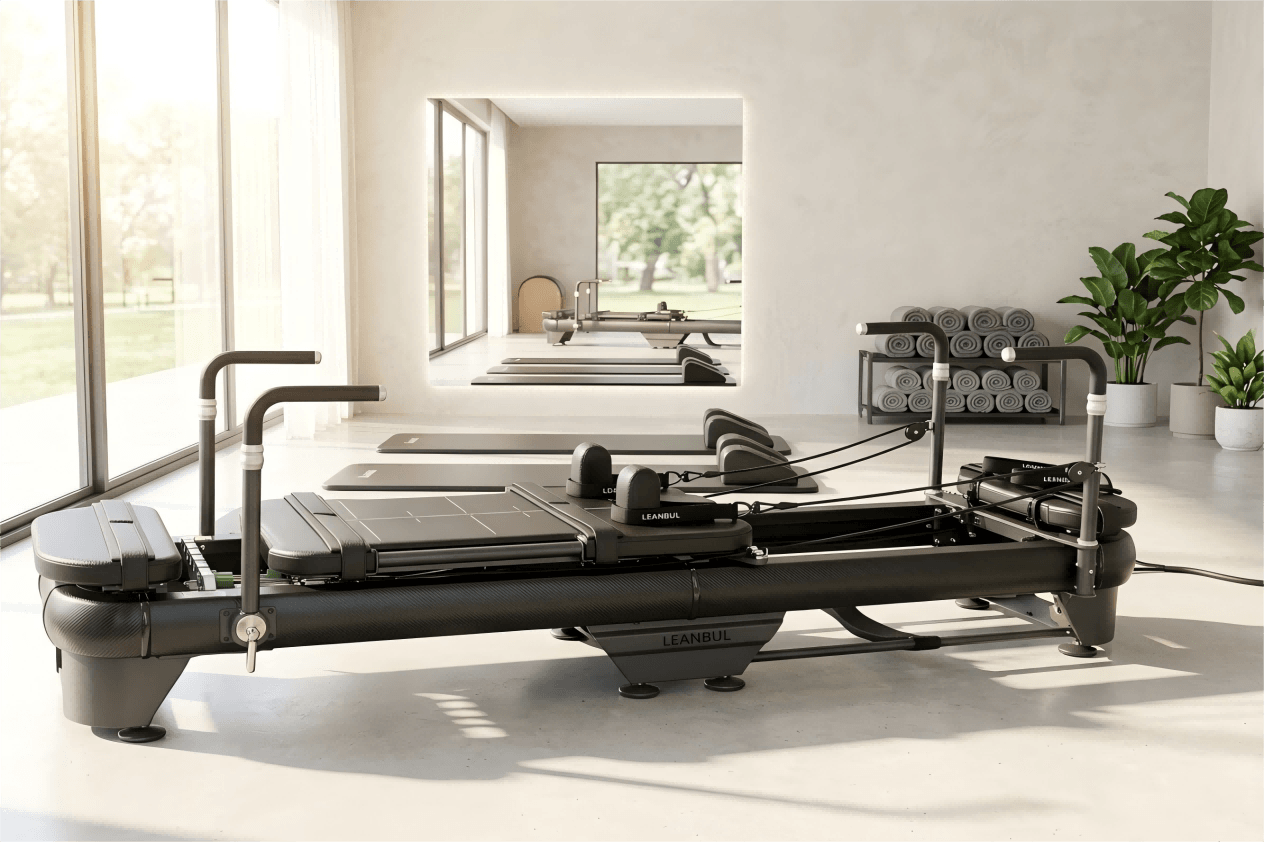
The equipment profile that works in Budapest is a compact commercial machine, because most of the new studios are small-group and space is the binding constraint. Budget about 3 m × 1.5 m per reformer plus circulation, and note that a home-rated machine pushed into daily class use is both a safety question and an insurance question. Six machines suit a 90–130 m² boutique; the collection shows the range, and the K10 compact reformer fits the smaller city-centre rooms.
Team, qualifications and insurance
Hungary’s fitness market rewards studios with credible instructors, and the reformer skillset is more demanding than mat. Building a roster means finding instructors who can run group reformer work safely and adjust resistance for mixed abilities, and paying enough to keep them, since instructor supply is a common constraint across Central Europe.
On insurance, three covers matter: business liability for the premises and visitors, contents/equipment cover valued at replacement cost rather than purchase price, and professional cover for the teaching itself. If you employ staff, employer’s liability is not optional.
FAQ
Can a foreigner open a pilates studio in Hungary? Yes. Foreign ownership of a Kft is unrestricted and no Hungarian residence is required, though you will need valid identification. A sole proprietorship requires tax registration with NAV.
Do I need a licence to teach Pilates in Hungary? There is no single Pilates licence, but the sector sits inside Hungary’s sport framework and clients expect recognised certification. Confirm current requirements for supervised sport and exercise activity with your local sports administration, and keep first-aid cover on site.
Should I choose KATA for my studio? Only if you teach private individuals exclusively and stay under HUF 18 million a year. If you invoice companies or take employee-benefit card payments, KATA is not available, and you should look at flat-rate taxation or a Kft instead.
What VAT applies to opening a studio in Hungary? Standard VAT is 27%, with an exemption threshold of HUF 20 million from 2026. Voluntary VAT registration lets you reclaim input VAT on equipment, which matters if you’re buying a fleet of reformers.
How much does it cost to open a pilates studio in Hungary? A six-reformer boutique in Budapest typically lands between €30,000 and €70,000 once you account for fit-out, deposit, equipment and launch marketing. Starting smaller markedly lowers that figure.
Opening well, not just cheaply
Hungary’s appeal to a new studio owner is real: no capital requirement to start, the lowest corporate tax in Europe, cheap capital-city rent, and a reformer market that is still forming rather than being fought over. The risk is entirely in the details: picking a tax regime that disqualifies itself the moment you invoice a company, or a machine that wasn’t built for daily classes. Get those two wrong and the low entry cost stops mattering.
Leanbul is a Spain-based manufacturer of commercial reformers. We ship across the EU without customs friction, document every machine to the standards European studios are held to, and quote in euros. See the full collection, explore Pilates studio solutions, or get in touch and we’ll price a Hungarian studio fit-out for you.
