Pilates Reformers for Holiday Rentals and Villas in Europe: What Property Owners Need to Know Before Buying
A pilates reformer is one of the strongest amenity upgrades a premium holiday rental in Europe can make — but only if you buy the right machine for guests who will use it without supervision, abuse it without meaning to, and judge your property on whether it works when they arrive. The short version: buy a commercial-grade reformer, not a home machine; expect strangers to treat it harder than you would; and set up the safety and maintenance basics before the first guest books. This guide is written for villa owners, holiday-let investors and property managers across Europe — the Costa del Sol and the Balearics, the Algarve, the Riviera, the Amalfi coast, the Greek islands — where wellness amenities now separate premium listings from the rest.
We are a Spain-based manufacturer of commercial reformers, and a growing share of our enquiries come from property owners rather than studios. This article is our honest read of that market: where a reformer earns its place in a holiday home, which of our machines fit which property, and the operating details most first-time buyers never consider until a guest gets hurt or a spring rusts in salt air.
Why a Reformer Belongs in a Premium Holiday Rental
Short-stay demand in Europe keeps climbing. Eurostat’s monitoring of the major platforms — Airbnb, Booking and Expedia — recorded 144.3 million guest nights in the EU in the first quarter of 2026, up 9.7% on the same quarter of 2025, with the sharpest growth in markets like Malta (+30.5%), Slovenia, Cyprus and Croatia. Vacation-rental property managers report the same shift we see in studio bookings: guests filter for wellness, and the properties that advertise it win the comparison.
A reformer does something a treadmill or spin bike cannot. It is photogenic, it signals a serious wellness offer rather than a token gym corner, and it is genuinely usable by a wide range of guests — from beginners doing gentle sessions to experienced practitioners who will not book a villa without one. Property management company Vacasa’s guide to luxury vacation rental amenities lists the pilates reformer among the top-tier equipment that elevates a home gym offering. Listings with a real reformer room photograph better, rank better in amenity filters, and give owners a defensible reason to charge more per night.
The First Rule: This Is Commercial Duty, Even in a Home
Here is the mistake that gets property owners into trouble. The machine will sit in a private villa, so the natural instinct is to buy a home reformer — cheaper, prettier, sold for residential use. That instinct is wrong, for three reasons:
- Guests are not owners. A home reformer is engineered for one person’s regular use, typically the person who bought it. A holiday machine is used by a different body every week — heavier guests, taller guests, first-timers who have never seen a reformer, children who treat it as playground equipment.
- Nobody is supervising. In a studio, a teacher watches every session and notices when a spring feels wrong. In a villa, the machine is used alone, at 9pm, by someone who has no idea what a worn spring feels like.
- The duty class is set by use, not location. European standard EN ISO 20957-1 classes training equipment by duty: Class S for studio and commercial use, Class H for home. A rental machine used by a stream of paying guests is functionally commercial, and your liability follows the use, not the room it stands in.
This is not scaremongering. Home-duty machines in unsupervised guest environments are exactly the scenario where a host’s insurance gets complicated after an incident — we wrote a full guide to pilates studio insurance in Europe covering how equipment class and compliance affect claims, and the same logic applies to a villa with paying guests. A Class S machine costs more. It is also the difference between an insurer defending you and an insurer walking away.
Which Pilates Reformer to Buy for Your Holiday Rental Property
Our range maps cleanly onto property types, which makes the buying decision simpler than it looks:
| Property type | Recommended machine | Why |
|---|---|---|
| Apartment or compact villa room | Leanbul K10 | Shortest footprint of the range, built to commercial spec; fits a converted bedroom or terrace room and handles continuous guest use |
| Standard villa with a dedicated gym room | Leanbul K30 | The workhorse: aluminum frame, precision springs, built for daily commercial sessions; the default choice for most owners |
| Luxury villa or resort-grade property | Leanbul K38 | Premium spec for the front-of-house room where guests photograph and review; heavier, quieter, more refined feel |
Two engineering points matter more in a coastal holiday setting than in an inland studio. First, salt air corrodes. Coastal properties from Marbella to Mallorca sit in humid, saline environments, and that is brutal on wood frames and untreated steel. Our machines use aluminum frames and corrosion-resistant components precisely because the Mediterranean coast is home turf for us. Second, noise travels. If the machine sits in an apartment or near a terrace shared with neighbours, a smooth carriage system and quality bearings keep sessions quiet — worth checking before you buy, since “reformer noise” complaints are a real friction point in residential buildings.
What Guests Actually Need From the Machine
Set the machine up for unsupervised first-timers and it will serve everyone. The practical checklist:
- Basic set-up only. Keep the footbar and ropes in their standard positions. Advanced accessories invite advanced mistakes.
- A QR code on the machine linking to a 10-minute introduction video (most reformer brands have suitable content; your own filmed tour of the machine works even better).
- A printed one-page guide in the guest book: how to get on and off, the two or three safest beginner exercises, and a clear note to stop if anything feels wrong.
- Weight and health screening in the house rules. Reformers have published weight limits; a polite line in the booking terms protects you.
- A waiver note in the rental agreement acknowledging that the guest uses the equipment at their own risk. It will not stop every claim, but it sets expectations and helps your insurer.
None of this is over-engineering. A reformer is the most technical piece of equipment most guests will ever use unsupervised. Treating it like a treadmill — plug in and go — is how small problems become incidents.
Operating Costs and Maintenance Between Bookings
A commercial reformer’s whole design philosophy is maintainability. Springs, ropes and bearings are wear items; they are meant to be inspected and replaced, and that is where your ongoing cost sits. Budget for it the way you budget for the pool pump:
- Inspect before every season and ideally between peak bookings — springs for stretching and rust, ropes for fraying, carriage glide for smoothness
- Replace springs when they show wear; a full set is a modest cost compared with a lost booking or a claim
- Clean after each guest — the carriage pad and straps are contact surfaces; a simple disinfectant wipe routine takes two minutes
- Salt-air coastal rule: wipe down metal parts more often in humid months, and keep the machine indoors rather than on an open terrace
If the property is a business — and holiday lets usually are — the reformer is a business asset: VAT on the purchase is reclaimable in most EU countries when you are VAT-registered, and the machine depreciates like any equipment. Keep the invoice. It is also your proof of purchase for insurance and warranty. Our delivery guide for Europe covers lead times and freight for villa addresses — rural deliveries and narrow access roads are a conversation worth having before you order, not after.
The Honest Return-on-Investment Question
We will not sell you a reformer on invented occupancy maths. What we can say from the market data and our own enquiries: wellness amenities are now a standard filter in premium short-stay searches, reformer-equipped properties are a small and growing supply, and the properties that have one tend to use it as a rate and review differentiator rather than a cost centre. A mid-range commercial machine costs about what a premium villa charges for three or four high-season nights. If the amenity helps you win even a handful of those nights a year — or defend your rate against the villa next door — it has paid for itself.
What we will say plainly is that the machine must earn its keep for a decade, not a season. That means buying commercial-grade, maintaining it between guests, and choosing a manufacturer that will still supply springs and parts in five years. We wrote about exactly that in our reformer warranty guide for Europe; for a rental asset with no in-house maintenance team, parts availability is the whole game.
FAQ
Should I buy a home reformer or a commercial one for my villa?
A commercial one, rated Class S under EN ISO 20957-1. Guests are unsupervised, unfamiliar with the equipment, and different every week. A home-duty machine is not engineered for that, and your liability follows the actual use. The price gap is smaller than the risk gap.
Can guests hurt themselves on a reformer?
Yes, like any fitness equipment — mostly from getting on and off and attempting unfamiliar exercises. Set the machine to basic configuration, provide a short intro video via QR code, put a weight-limit note in the house rules, and add a line to the rental agreement. That combination removes most of the risk that is actually yours to manage.
Does a reformer need maintenance between guests?
Minimal but real: a quick visual check of springs and straps, a wipe-down of the carriage and straps after each stay, and a proper inspection before each season. Springs are wear items and should be replaced when they show signs of stretching or rust. In coastal properties, wipe metal parts down more often — salt air is the enemy.
Can I reclaim VAT on a reformer for my holiday rental?
In most EU countries, yes, if the property is let as a business and you are VAT-registered — the machine is business equipment. Keep the invoice; it is also your warranty and insurance document. Rules vary by country, so confirm with your accountant.
Will a reformer fit in a standard villa room?
Usually, with the compact models. A standard reformer is around 2.4 m long, and you should allow roughly 3 m of clear length and 1.2–1.4 m of width per station so guests can mount and dismount safely — that fits most villa rooms and larger apartment bedrooms. Our smallest commercial machine, the K10, was designed for tight rooms. Measure the space and the access route before ordering; delivery to villa addresses can need planning for narrow lanes and stairs.
What to Do Before You Buy
A short checklist for property owners, in order:
- Measure the room and the access route — machine length plus clearance, and whether the machine can actually get to the room
- Decide the duty class first: commercial, Class S, CE marked with full documentation
- Check the coastal factor: aluminum frame and corrosion-resistant parts if the property is near the sea
- Confirm parts availability and warranty terms before ordering, not when you need a spring in July
- Tell your insurer about the equipment and add the waiver line to your rental terms
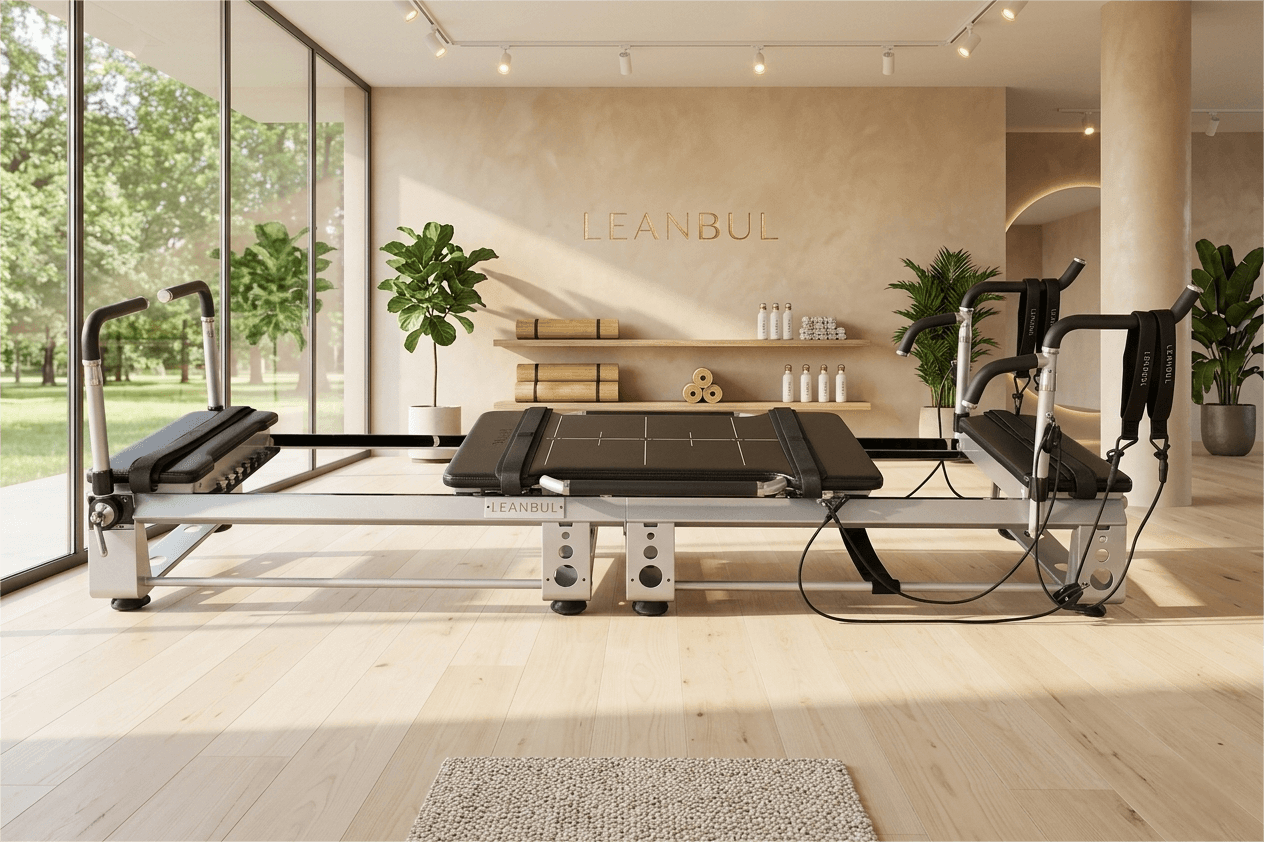
We build our reformers in Spain for exactly this kind of use — the K10 compact for villa rooms, the K30 e K38 for dedicated gym spaces — with the compliance file, warranty and spare-parts support that a rental asset depends on. If you are equipping a property, get in touch and tell us about the space: we will recommend a machine and walk through delivery to your door anywhere in the EU.