The Pilates Market in Slovakia in 2026: Growth, Studio Trends and Equipment Demand
Slovakia’s reformer scene is small, euro-denominated, and almost entirely concentrated in Bratislava — and the studios leading it buy Western brands. That combination is the whole story if you are selling equipment here: a shallow national market with one genuinely competitive city, and a buyer base that has already decided what a good reformer looks like.
Here is what the pilates market in slovakia looks like in 2026, what a class costs in Bratislava, how the MultiSport card changes the economics, and what it means for anyone buying equipment for a studio.

A small euro-zone market with a capital-city bias
Slovakia has around 5.4 million people, and the Bratislava region alone holds roughly 700,000 of them. That concentration matters more here than in Czechia or Austria, because premium reformer pricing depends on the white-collar and higher-income client base that clusters in the capital.
At European level the sector keeps growing. EuropeActive and Deloitte’s European Health & Fitness Market Report 2026, covering 2025, put the continent at 75.5 million club members, 67,515 clubs and €39.1 billion in revenue, with membership up 5.8% and revenue up 9.1% year on year. Slovakia does not appear among the headline countries — Germany, the UK and Spain carry those — and national fitness statistics here are patchier than in its neighbours, so treat any single Slovakia-wide penetration figure with caution. The useful reading is directional: a market growing from a lower base than Western Europe.
The structural fact that matters most for purchasing is the currency. Slovakia uses the euro. A Slovak studio signing a euro quote from a euro-area manufacturer carries no exchange-rate risk between order and invoice, which is not true for buyers in Poland or Czechia.
The studios setting the pace
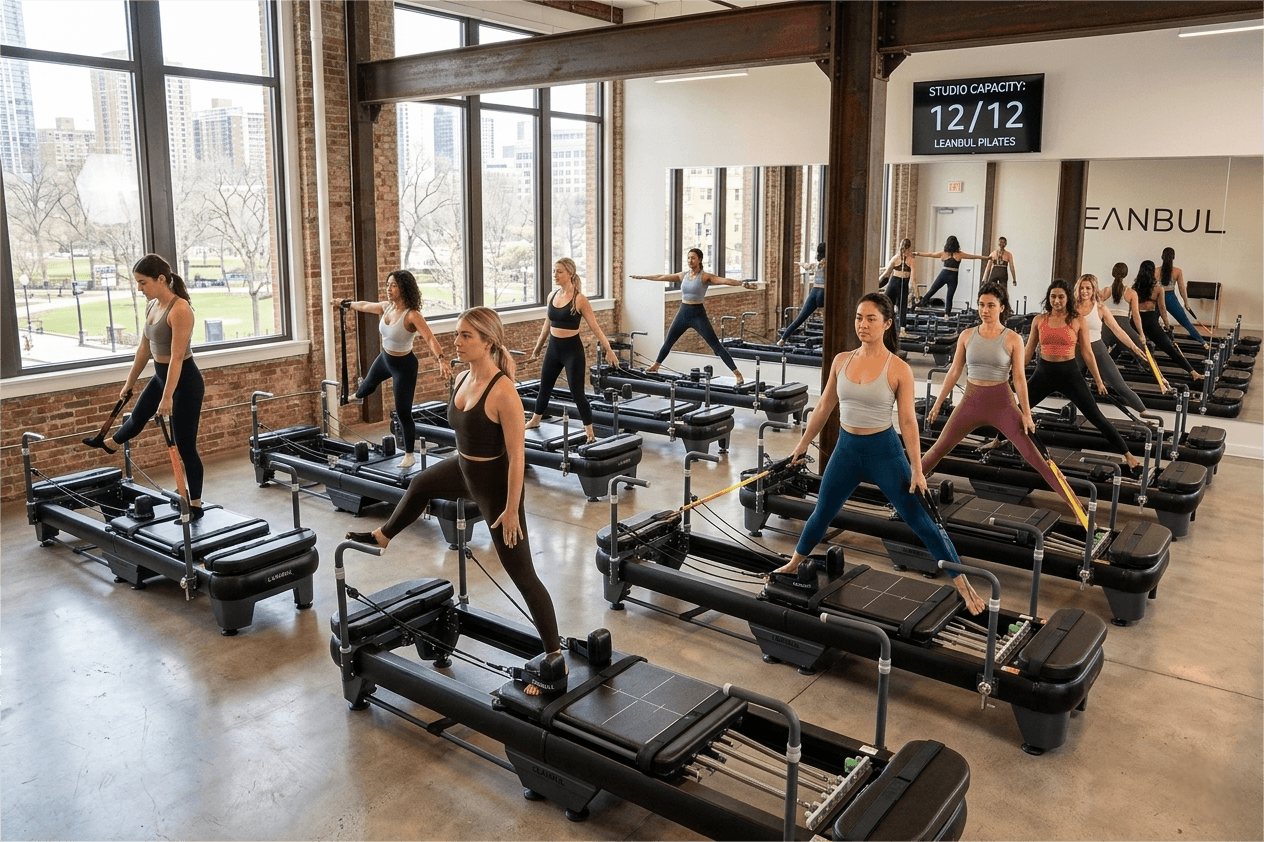
Re:forma, at Sky Park on Továrenská in central Bratislava, calls itself the first dynamic reformer studio in the city and runs ten Balanced Body Allegro 2 machines. When a boutique builds its whole proposition around a well-known imported brand, it tells you the Slovak reformer customer is brand-aware rather than purely price-led.
Flexity Studio, in Petržalka, runs five reformers fitted with half-cadillac towers, plus five combo chairs, a ladder barrel and a ped-o-pull, and it accepts the MultiSport benefit card without a surcharge on its mat and barre classes. That card detail matters, and we come back to it below.
AURA health club prices a reformer class at €35 for 50 minutes, capped at seven places. Pilates Reformer Bratislava, on Černyševského, runs mat classes at €10 a visit, sells a ten-visit pass at €80, offers a €6 rate for students with an ISIC card, and keeps a physiotherapist involved in its programme. Newer entrants such as Luma Studio Haus are widening the boutique tier.
Two patterns stand out. Independent boutiques built this category; the big full-service gym chains have not pushed reformer zones the way German or French chains have, so the format here is still mostly a specialist product. And the benchmark studios bought established Western machines, which raises the bar for any manufacturer trying to win a Bratislava account on price alone.
What a reformer class costs in Bratislava
Pricing sits firmly inside the euro zone and below Western European capitals, though not cheap in local wage terms.
| Studio | Published price (2026) | Format |
|---|---|---|
| AURA health club | €35 per reformer class | 50 minutes, 7 places per class |
| Flexity Studio | Mat class €14; packs from €11.75 per class | Boutique; MultiSport accepted on mat/barre |
| Pilates Reformer Bratislava | Mat €10 a visit; €80 for a 10-visit pass; €6 with ISIC | Mat-led studio with physiotherapy input |
| Re:forma | Premium boutique pricing | Dynamic reformer classes on Balanced Body Allegro 2 |
Group reformer classes in Bratislava broadly land in the €20–35 band depending on studio, time and instructor, with mat work priced well below at €10–14 a session. Private sessions run higher. The pattern is a two-tier city: a mat-first market that is still convincing clients to move up to the reformer, alongside a smaller premium tier that already charges for it.
The MultiSport card factor
One feature of the Slovak market has no direct equivalent in most of Western Europe, and it changes how a studio fills a room. Employee benefit cards — MultiSport from Benefit Systems is the dominant one — are widely accepted across Bratislava, and they reimburse the studio at an agreed rate per visit rather than letting the studio price the class freely.
For a new studio the card network is a fast way to put bodies on machines and build habit, because it reaches corporate clients who would not otherwise book. The trade-off is yield: card-funded visits settle at a fixed rate, so they support utilisation more than margin. A studio that leans heavily on cards and prices everything at card rates ends up with a full timetable and a thin balance sheet. The disciplined approach is to treat cards as a utilisation floor and keep direct memberships and private sessions as the margin.
The studio economics that decide the purchase
| Lever | Typical picture in Slovakia (2026) | Why it matters |
|---|---|---|
| Rent | Prime Bratislava office space around €21.50 per m² per month; secondary districts lower | Rent is the fixed cost that punishes a half-full room |
| Class price | roughly €20–35 per group reformer class | Sets revenue per slot |
| Machine footprint | about 3 m × 1.5 m per reformer plus circulation | Caps how many machines a given rent bill can carry |
| Equipment | factory-direct commercial reformer in the €1,900–3,500 band | Determines payback time and replacement cycle |
The rent figure comes from Bratislava office-market data for the first quarter of 2026, which put prime rent at €21.50 per square metre per month after a 2.5% quarterly rise. A reformer studio does not need prime office space, so the secondary districts are the realistic reference — but a central address still carries weight with the premium clientele, so the choice is a genuine cost-versus-positioning decision.
The same rule as everywhere in Central Europe applies: a cheap reformer that needs replacing after five years costs more than a commercial machine that lasts fifteen, because a young studio cannot absorb both the downtime and the re-purchase while it is still building its client base.
VAT and buying inside the EU
Slovak standard VAT is 23%, with reduced rates of 19% and 5%. A studio registers for VAT once turnover passes €50,000 in the previous calendar year, or €62,500 within the current year, and may register voluntarily before that to reclaim input VAT on equipment. Six commercial reformers at €1,900–3,500 each is a meaningful input cost, so the voluntary-registration maths is worth running; PwC’s Slovak tax summary sets out the current rates.
One quirk from the 2026 consolidation package is worth checking with an accountant: Slovakia moved fitness-centre entrance fees into the 5% super-reduced VAT band, an unusually low rate for the sector. Whether a given studio’s class pricing qualifies depends on how the service is classified, so do not assume it applies.
On the buying side, Slovakia is in the single market. A reformer bought from a manufacturer in Spain crosses the border with no customs clearance and no import duty, and the VAT is handled by reverse charge on the buyer’s own Slovak return. Combined with the euro, that removes both the customs friction and the currency exposure that complicate purchases for a Czech or Polish studio.
What this means for reformer demand
Three things follow for a studio or gym buying in Slovakia.
The boutique tier is still forming, not just replacing. Western Europe is largely a replacement market in 2026. Bratislava still has genuinely new reformer demand, alongside the ordinary replacement cycle.
Class S commercial specification is the baseline. A studio running supervised classes is a commercial operation, which means machines built and documented to EN ISO 20957 Class S with a declaration of conformity on file. The newer fitness-club framework in EN 17229:2026 also covers equipment selection and supervision; we covered it in our guide to EN 17229.
Buying inside the EU beats importing from further away. No customs, no duty, reverse-charge VAT — and, unlike its neighbours, no currency risk.
For layout, budget about 3 metres by 1.5 metres per machine plus circulation. A six-reformer boutique with a small reception and storage usually lands between 90 and 130 square metres. Our collection sets out the range, and the K30 commercial reformer is the machine most small-footprint studios start with.
Geography decides the competition
Bratislava dominates, and its competitive map is shaped by more than its own population. The city sits about an hour from Vienna, so a studio here competes for both premium clients and experienced instructors against a much larger and wealthier market across the border. That cuts two ways: it raises the standard, and it makes retaining good instructors harder.
Košice is the clear second market, with a large student population and a smaller but real boutique tier. Žilina, Nitra, Trnava and Prešov have thin reformer supply, where a single well-run studio can own the local market — but the pool of clients willing to pay premium reformer prices is smaller. Slovakia rewards a studio that picks its city deliberately.
FAQ
Is the Pilates market in Slovakia growing? It is growing, but from a low base and unevenly. Bratislava’s boutique reformer scene is expanding while the big gym chains have mostly stayed out of the format, so new demand is concentrated in the capital and a few regional cities.
How much does a reformer class cost in Bratislava? Group reformer classes mostly run from about €20 to €35, with mat classes at €10–14. Private sessions cost more. The MultiSport benefit card is accepted at many studios and settles at an agreed rate per visit.
Is Slovakia a good place to open a Pilates studio? It can be, especially in Bratislava, where demand is proven and the euro removes currency risk. The caution is market size: with roughly 5.4 million people, a studio outside the capital may find the pool of premium clients thin, so pricing and utilisation have to be disciplined.
Do Slovak studios need CE-marked reformers? Yes. A reformer placed on the EU market carries CE marking and a declaration of conformity, and a commercial studio should specify machines rated to EN ISO 20957 Class S. Insurers and the EN 17229 fitness-club framework both push in this direction.
What VAT applies when a Slovak studio buys a reformer from another EU country? None is charged by the seller; the Slovak buyer accounts for VAT under the reverse-charge mechanism and reports it on the Slovak return. There is no customs clearance and no import duty for an intra-EU purchase, and because Slovakia uses the euro there is no currency exposure either.
Building the case
Slovakia is a market of one strong city and a handful of secondary ones, and it rewards a studio that treats it that way. The premium tier in Bratislava is competitive and brand-aware; everywhere else is still open. Leanbul is a Spain-based manufacturer of commercial reformers. We ship across the EU without customs friction, document every machine to the standards European studios are held to, and quote in euros. See the full collection, explore Pilates studio solutions, or get in touch and we will price a Slovak studio fit-out for you.
