Hot Pilates Reformer: What a Heated Room Does to the Machine
Hot pilates started as mat work in a warm room. In 2026 it increasingly means reformers standing in 32–35 °C at 50% humidity, with twelve clients sweating on them six times a day. That combination changes what you should buy. A hot pilates reformer is not a standard commercial reformer with a heater in the corner: the springs, the fasteners, the upholstery and the warranty all take a different kind of load, and most quotes you receive were written for a normal studio at 21 °C.
This is the specification side of running a heated reformer room, written from a manufacturer’s bench in Spain. It covers the numbers your room needs to hit, what heat and salt actually do to a machine, and the lines to put in an RFQ before you sign.

What “hot” means in numbers
“Heated” covers everything from a warm 26 °C room to a 40 °C Bikram-style box. The equipment burden scales with the number, so pin your target down first.
| Format | Room temperature | Relative humidity | Class length |
|---|---|---|---|
| Warm reformer | 26–30 °C | 40–55% | 45–55 min |
| Hot reformer (most European studios) | 32–35 °C | 40–60% | 45–60 min |
| Hot yoga / Bikram settings | 38–42 °C | 40–50% | 90 min |
Studios that publish their settings mostly sit between 85 °F and 100 °F (29–38 °C) with humidity around 40–50%. European operators tend to land lower than American ones, at 32–35 °C, because most of these rooms are retrofitted commercial units rather than purpose-built hot rooms. That is a sensible place to be. Above 35 °C you are asking for hot yoga’s equipment problems without hot yoga’s ticket price.
Two humidity facts are worth keeping on the same page:
- Below roughly 40% relative humidity, wooden frames and their joints dry out and move.
- Above roughly 60%, unprotected steel starts to corrode, and sweat stops evaporating off upholstery between classes.
The window is narrow, which is why heated rooms need humidity control rather than just heat.
Ventilation is where heated reformer rooms fail
A hot room full of moving bodies produces heat, moisture and CO2 at the same time. Three numbers decide whether the room works.
Outdoor air per person. In Spain, the RITE (RD 1027/2007, IT 1.1.4.2) sets minimum outdoor airflow by indoor air category. Gyms and similar activity spaces are usually classified IDA 3, which is 8 dm³/s per person, about 28.8 m³/h. IDA 2, used for offices and classrooms, is 12.5 dm³/s. Workplace rules add a floor of 30 m³/h per sedentary worker and 50 m³/h for everyone else, and you design to whichever number is higher. A heated room should not be designed to the IDA 3 minimum. It should be designed to the IDA 2 figure, because a client at 34 °C is not a client at 21 °C.
Moisture removal. Twelve people sweating in a hot room put a continuous moisture load into the air. Heating air increases how much water it can hold, so it lowers relative humidity on paper while the water stays in the room. The practical consequence: the room needs cooling and dehumidification running at the same time as heating. A heater sized for January and a split AC sized for July, never on together, is the single most common mistake in these fit-outs.
CO2 as the cheap check. A CO2 logger costing €100–200 tells you more about ventilation than any commissioning report. If readings climb past roughly 1,000–1,200 ppm during a full class, the room is under-ventilated whatever the design document says. Test in week one, with a full class, doors closed.
One more European detail: RITE requires heat recovery once mechanical extract passes 0.5 m³/s, about 1,800 m³/h. A heated studio can reach that. Without recovery you are paying twice for the same heat, once to make it and once to throw it out of the window.
For comparison, ASHRAE 62.1 in the US rates a health club or aerobics room at 10 L/s per person plus 0.3 L/s per m². For twelve clients in a 120 m² room that is about 156 L/s, or 560 m³/h of outdoor air. European minimums often come out lower than that. Take the higher of the two if you are designing from scratch.
What heat and sweat actually do to a reformer
Heat alone is mostly harmless to a well-built machine. Salt plus heat plus time is what damages equipment, and a hot room delivers all three every day.
Springs
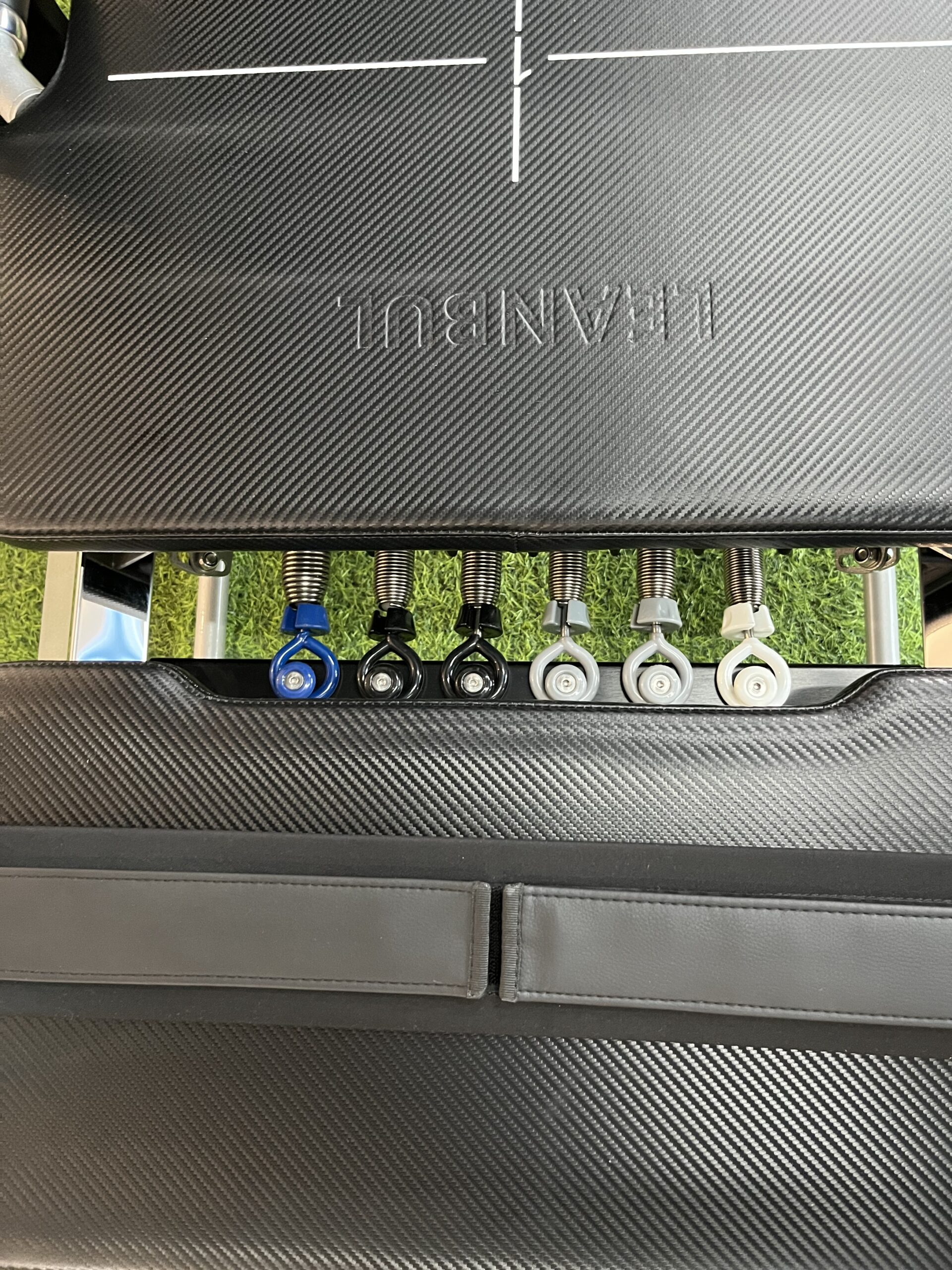
Springs are the first thing to go, and in a heated room they go faster. Sweat lands on the coils, the water evaporates, the salt stays. Salt on steel wire starts pitting, and pitting is where fatigue cracks begin. A commercial spring set is normally planned on a two-year or 3,000-hour cycle. In a hot room, treat 18 months as the planning figure and inspect quarterly: look for rust blooms at the hook ends, notches on the wire, and any spring that pulls noticeably shorter than its neighbours.
What to ask a supplier, in writing:
- Wire material and finish (oil-tempered with powder coat, nickel-plated, or stainless)
- Rate per spring in N/mm, or force in newtons at a stated extension
- Whether springs carry any warranty at all, and for how long
- Price and availability of a replacement set, per size
Frames
Aluminium is dimensionally stable in heat. Wood is not. A wooden frame in a 35 °C room at 60% relative humidity will take up moisture around the joints, and joints are where a reformer either stays silent for ten years or starts clicking in month eight. Neither material is “better” in the abstract; what matters is whether the frame was designed for the climate it lives in.
Then there is condensation. Metal that sits at room temperature, hit by 18 °C supply air, forms water. In a hot room the air conditioning is running while the room is hot, so cold surfaces get wet repeatedly. Rails, springs, and any bare steel fastener are the components that suffer.
Bearings and rails
Sweat mist plus dust makes a grinding paste. In a normal studio sealed carriage bearings are a nice-to-have. In a heated room they are the difference between a carriage that still glides in year four and one that rumbles. Ask for the bearing designation and seal type, not the phrase “smooth ride”. Ask how the rail is finished, and whether the finish is anodised or painted, because a painted rail in a humid room chips and then corrodes under the chip.
Upholstery and foam
Sweat is the enemy here, not temperature. Open-cell foam soaks it up and then holds it, and a machine that smells like a gym towel in month three is a machine clients avoid. Closed-cell foam with a wipeable covering is the specification you want. PVC-based covering handles sweat and disinfectant better than leather or suede, which is why most hot-room operators choose it despite the feel.
Seams matter as much as the material. Stitched channels wick moisture into the foam. Ask whether the covering is sealed at the edges or stitched through.
Screens and sensors
If the machine has a display or movement sensors, a 35 °C, 60% humidity room is a different reliability class from a 21 °C studio. Check the rated operating temperature and humidity in the manual, and check how the electronics are sealed. Mechanical reformers do not have this problem, which is one honest argument for keeping heated rooms simple.
The spec sheet for a heated room
| Item | What to put in the RFQ | Why it matters in heat |
|---|---|---|
| Usage class | EN ISO 20957-1:2024 Class S, with declaration of conformity | Class S is the commercial class; the standard’s endurance test runs 100,000 cycles versus 12,000 for Class H |
| Max user mass | Stated on the machine marking and in the manual | Marking is a standard requirement, and it is the number your insurer will read |
| Spring set | Material, finish, rate per spring, replacement price, warranty position | Springs are the fastest wear item in a humid room |
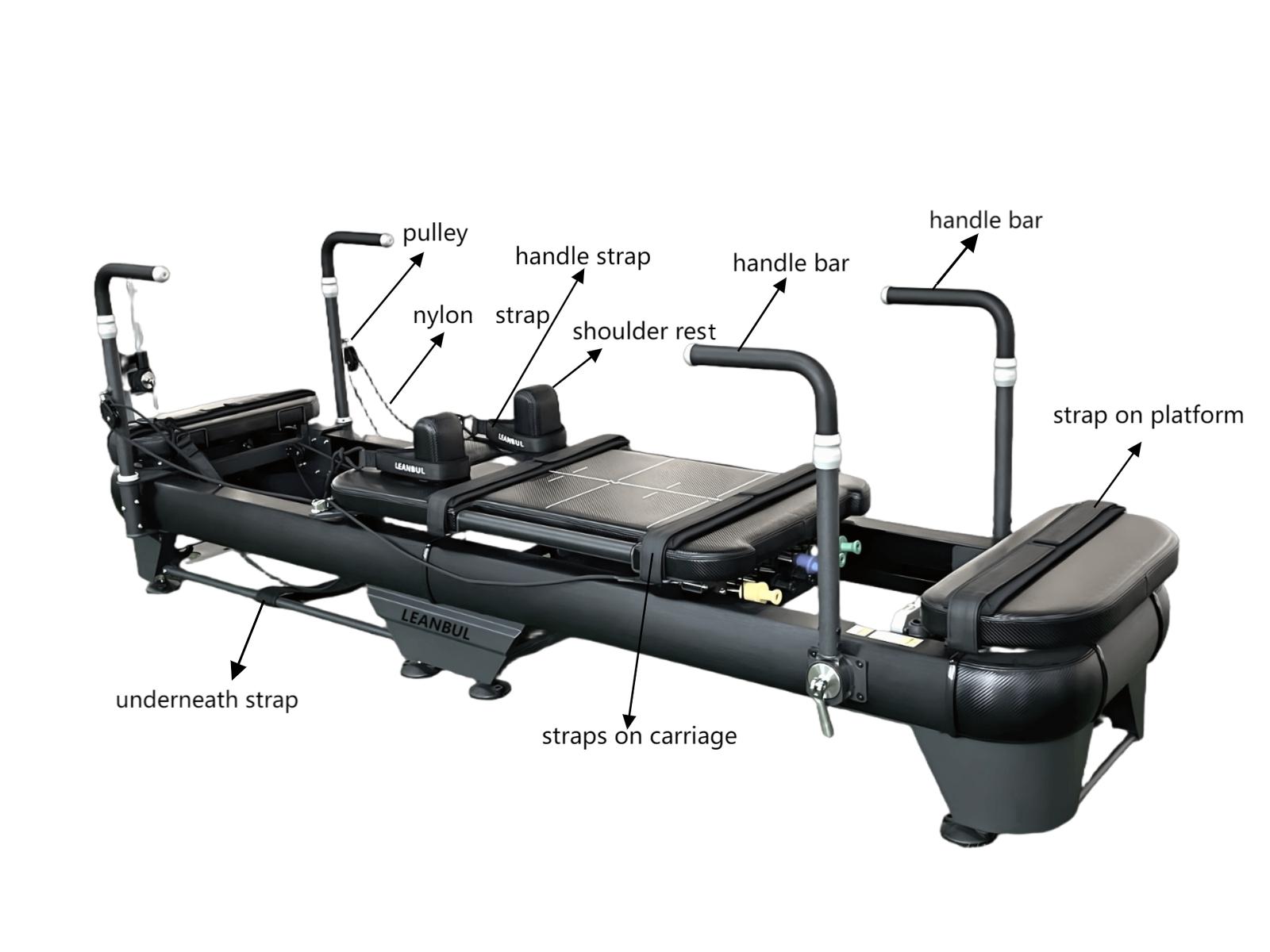
| Rail and carriage | Rail finish, wheel count, bearing designation and sealing | Salt and dust destroy unsealed bearings first |
| Frame | Material, finish, joint construction | Wood moves, aluminium does not; the joint decides noise |
| Upholstery | Closed-cell foam, covering type, seam construction | Sweat absorption and smell, not cosmetics |
| Warranty | Written confirmation that heated-room use is inside the warranty | Corrosion is often excluded as environmental damage |
| Spare parts | Priced list of springs, wheels, straps, foam pads, with availability | A machine you cannot service is a machine you replace |
That last row is the one buyers skip. A reformer is a consumable-heavy product: springs, straps, wheels, pads. Ask for the spare parts list with prices and lead times before you order twelve units, not after the first spring breaks.
Layout and operations in a hot room
The room changes how you run the floor, not just what you buy.
- Spacing. Plan roughly 3 m by 1.5 m of working area per machine, then add circulation space. In a heated room, cramped layouts feel worse than the thermometer suggests.
- Air path. Do not let supply air blow directly on the first row of clients. Mixed air at low velocity, extracted high, is the pattern that keeps temperature even and clients comfortable.
- Mirrors. A mirror wall in the supply air path fogs during class. Keep the diffusers off the glass.
- Turnover. Ten minutes between classes is not enough for the room to recover if the door opens twice per class. Either accept a 2–3 °C drop or schedule the gap.
- Cleaning. Wipe upholstery between classes with a quaternary disinfectant, and clean rails and springs weekly with a dry cloth. Do not oil springs. Oil attracts dust, hides corrosion, and transfers to hands and clothing.
- Water. Nothing stored on the floor beside the machines. In a humid room, cardboard, bags and mats on the floor stay damp.
Get the warranty in writing before you order
Most reformer warranties exclude corrosion, misuse and “environmental damage”. In a heated room, a manufacturer can argue that 34 °C and 60% humidity is environmental. Sort that out before the order, not after a claim.
Ask for one sentence on the order confirmation: heated-room use up to a stated temperature and humidity is within the warranty, and springs are covered for X months as wear items. A supplier who will not write that sentence is telling you something useful.
If the answer is “we’ve never been asked”, that is also an answer. It usually means the machine was designed for a 21 °C studio and nobody has tested it in your conditions.
FAQ
Can I use any commercial reformer in a hot pilates room? No. The machine needs to be Class S commercial, and even then, the warranty may exclude humid environments. Check the warranty wording before you buy, and check that springs, upholstery and bearings are specified for moisture. A home-rated machine in a heated studio is a claim waiting to happen.
What temperature should a hot reformer class run at? Most European studios run 32–35 °C at 40–55% relative humidity. That is enough to warm tissue and produce a distinct hot-room feel without pushing equipment into hot yoga territory. Above 38 °C you inherit hot yoga’s moisture and condensation problems.
Does heat damage aluminium reformers? The aluminium itself, no. Heat plus salt attacks springs, bare steel fasteners and any unsealed bearing, and it speeds up corrosion wherever the finish is chipped. Aluminium frames are the lower-maintenance choice in humid rooms, provided the hardware is specified properly.
How often should springs be replaced in a heated studio? Plan on 18 months and inspect quarterly. A normal commercial room runs to about two years or 3,000 hours, whichever comes first. Salt exposure shortens that, and a spring that has lost 10% of its rate makes every class inconsistent.
Do I need a dehumidifier or just air conditioning? You need moisture removal and heat at the same time, which usually means a unit that can cool and dehumidify while the room is held at temperature. Heating alone lowers relative humidity on the gauge but leaves the water in the room.
Specifying for heat
If you are fitting out a heated reformer room in Europe, the machine is one line of the budget and the room is the rest. Get the ventilation and humidity right, and a standard commercial reformer will last. Get them wrong, and the best machine on the market will corrode in three years.
Our K30 commercial reformer and K38 premium reformer are built in Spain with anodised aluminium rails, sealed carriage bearings and closed-cell upholstery, and we will put the heated-room warranty position in writing with the quote. For multi-room and multi-site projects, pilates studio solutions covers room planning, delivery and installation across the EU. Send us your room dimensions, target temperature and class size through the contact page and we will tell you what the ventilation needs to move, and which machine spec fits it.
