Pilates Studio Fit-Out Costs in Europe: What the Build Really Costs per m² in 2026
A pilates studio fit-out in Europe costs €300 to €800 per m² for a full renovation of an empty commercial unit, and €100 to €250 per m² for a cosmetic refresh of a space that already has services. For a 120 m² room with six reformers, that is roughly €36,000 to €90,000 of building work before a single machine arrives.
Those are the numbers contractors quote in Spain, where we build and where we see the invoices. Northern European markets usually come in higher for the same package, mostly on labour.
Most studio-planning guides bury this in a “build-out” line and move on to equipment. That is backwards. The build sets your opening date, your ceiling height, your access route and your floor. Get it wrong and you will be buying machines to fit a room instead of fitting a room to machines.
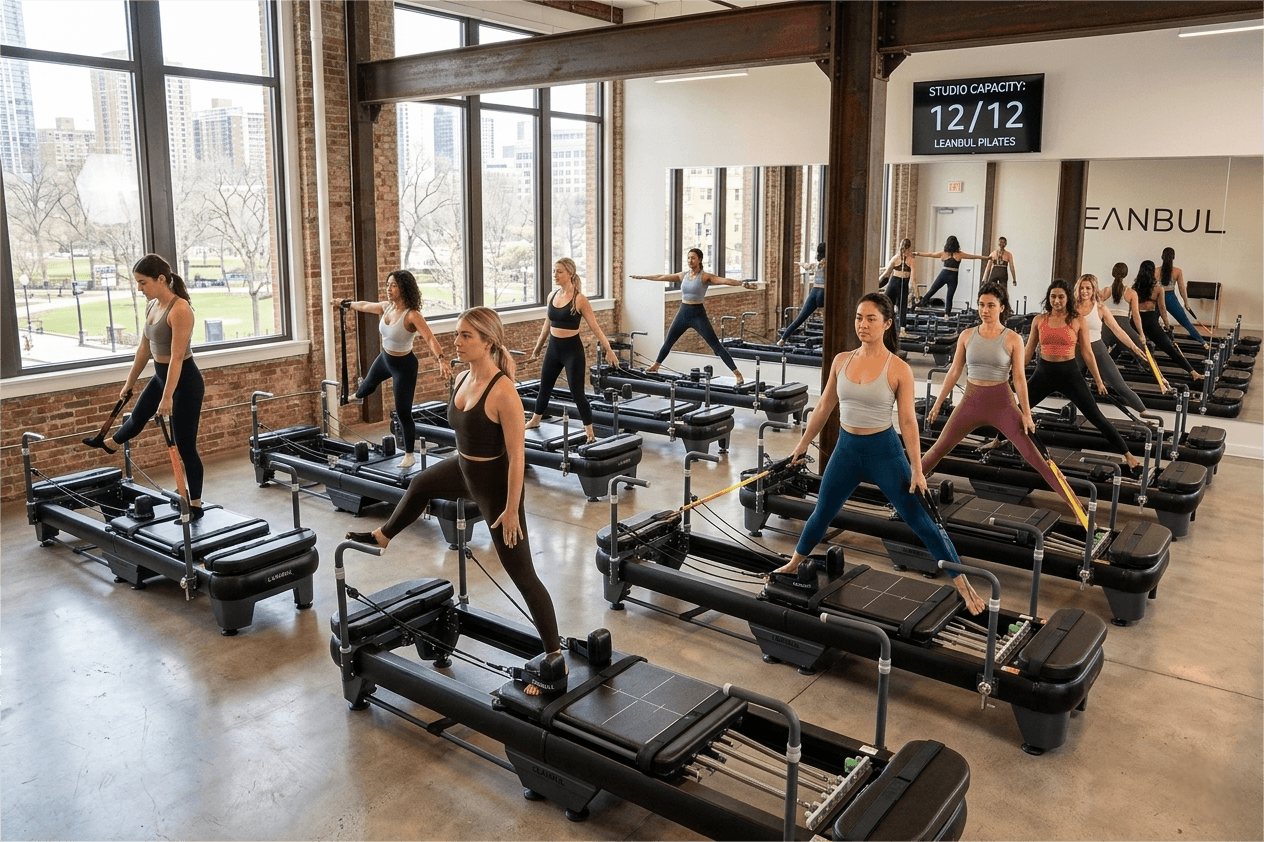
Why “fit-out cost per m²” is not one number
Three rooms of the same size can differ by a factor of four, and none of the contractors are lying.
- State of the unit. A former retail space with a working WC, three-phase power and a level floor needs paint, flooring and mirrors. A raw shell needs everything, including drainage.
- Services you inherit. If the HVAC was sized for a shop with eight people standing at a counter, it was not sized for eight people training hard. Replacing it is the single most expensive surprise.
- Access. A ground-floor unit with a 2 m door costs less to work in than a second-floor space where every bag of screed goes up a stairwell.
- Acoustic constraints. A studio under residential flats needs a floating floor and a suspended ceiling. A standalone unit on an industrial estate does not.
So treat per-m² figures as a sanity check, not a budget. The line items below are what actually add up.
What each work package costs
Ranges are 2026, net of VAT, for a 100 to 150 m² unit in Spain. They are indicative: get three quotes.
| Work package | €/m² or lump sum | Notes |
|---|---|---|
| Demolition and waste removal | €15–35/m² | Higher if there is a mezzanine or old tiling to lift |
| Electrical, including new board | €40–80/m² | Reformer rooms need sockets at the walls, not just overhead lighting |
| HVAC and ventilation | €60–120/m² | The most commonly under-budgeted line in a reformer studio |
| Plumbing (new WC, shower, kitchenette) | €3,000–8,000 | Per wet room, not per m² |
| Sports flooring, installed | €35–70/m² | Vinyl or rubber, seamless, slip-rated |
| Mirrors, installed | €80–150/m² of mirror | Full-wall mirrors on at least one long side |
| Acoustic insulation | €50–90/m² | Party walls and ceiling; roughly €12,000 for a 200 m² commercial unit in Spanish contractor data |
| Ceiling, lighting and electrics finish | €40–80/m² | Linear or track lighting, dimmable if you teach by mood |
| Paint, joinery, reception millwork | €40–90/m² | Reception is a lump sum in practice, €3,000–10,000 |
| Signage, accessibility, permits | €3,000–8,000 | Accessibility compliance is not optional in the EU |
Add those up and you get three realistic tiers for a 120 m² room:
| Tier | What it covers | Total (120 m²) | Per m² |
|---|---|---|---|
| Cosmetic refresh | Paint, flooring, mirrors, lighting, minor electrical | €12,000–30,000 | €100–250 |
| Standard fit-out | New flooring, mirrors, HVAC upgrade, electrical, acoustics | €36,000–60,000 | €300–500 |
| Full integral build | Raw shell to finished studio, all services new | €60,000–110,000 | €500–900 |
Spanish contractor guides put integral commercial renovation at €300 to €700 per m², with averages around €550. Our standard tier sits inside that. Our full-build tier sits at the top of it, which tells you something useful: a pilates studio is not an unusually expensive build. It is a normal commercial renovation with two or three specialist requirements bolted on.
The reformer-specific requirements that move the budget
This is the part generic fit-out guides miss, because they are written for shops and offices.
| Requirement | Why it matters | What to check before you sign the lease |
|---|---|---|
| Floor flatness and rigidity | A machine that rocks wears its rails and drives clients mad | Walk the floor, check for spring in timber joists, ask for a suspended-floor assessment upstairs |
| Floor finish | Carpet and loose rugs move under a carriage | Seamless vinyl or rubber, laid flat, no underlay with give |
| Ceiling height | Footbar up, jumpboard on, tower attached | Measure at the highest point of use, not the lowest |
| Mirror height | Clients are horizontal, not standing | Mirrors should run close to floor level on at least one long wall |
| Ventilation and heat | Eight bodies doing controlled resistance work generate real heat | Ask what the air-change rate is, and whether the unit can take a bigger unit on the roof |
| Structure-borne noise | Carriage vibration travels through slabs and annoys neighbours | Floating floor over acoustic underlay if anyone lives above or below |
| Access route | A reformer arrives as a 2.4 m pallet weighing 60–80 kg | Door widths, lift dimensions, stair turns, and whether the pallet fits at all |
| Power and data | Smart reformers, vacuum, sound system, booking tablet | Sockets on at least two walls, not one |
Two of these have caused real problems for studios we supply. The access route is the more common one: a machine that fits the room but not the lift is a machine that gets craned through a window. The other is ceiling height under a tower or a jumpboard, which is easy to check and embarrassing to discover at installation.
How long the build takes, and where equipment slots in
A standard fit-out in an existing unit runs 12 to 20 weeks from signed lease to first class. A raw shell with new services runs longer.
| Phase | Weeks | What happens |
|---|---|---|
| Design, permits, contractor tender | 3–8 | Licences and community approval can stall here; start early |
| Demolition and strip-out | 1–2 | Waste removal, asbestos check in older buildings |
| MEP first fix (electrical, HVAC, plumbing) | 2–4 | The noisiest, slowest part |
| Acoustic treatment and ceilings | 1–2 | Do this before flooring, not after |
| Flooring and mirrors | 1–2 | Floor needs 24–72 hours to settle before machines land |
| Finishes, reception, signage | 2–3 | Snagging list time |
| Equipment delivery and installation | 1 | Half a day per four to six machines |
| Soft opening and staff training | 1 | Run test classes before you sell them |
The sequencing mistake that costs the most money is ordering equipment in the final month. A European manufacturer’s lead time for a six-reformer order is typically 6 to 12 weeks depending on finish and configuration, so the order should go in around the time the MEP first fix starts, not when the paint is drying.
Deliver too early and the machines sit in a corner collecting dust and getting knocked by trades. Deliver too late and you are paying rent on a finished room you cannot open. Aim for delivery in the week after flooring, which means ordering roughly three months before your target opening.
The budget nobody shows you: the second invoice
Fit-out quotes cover the building. They rarely cover the things that turn a room into a business:
- Equipment: six commercial reformers at €1,900 to €3,500 each, plus a Cadillac, chairs, barrels, boxes and props if you teach a full apparatus programme.
- Working capital: three to six months of rent, wages and marketing before the schedule fills.
- Insurance: public liability and contents, priced partly on the equipment value you declare.
- Compliance: EN ISO 20957 Class S equipment with a declaration of conformity, and from 2026 the EN 17229 fitness-club framework if you operate as a club. Our guide to EN 17229:2026 covers what that changes for operators.
- VAT timing: construction VAT is recoverable if you are VAT-registered, but you pay it first and reclaim later. On a €60,000 fit-out that is a five-figure cash-flow gap.
For a 120 m² six-reformer studio in Spain, a realistic all-in opening budget lands between €90,000 and €180,000: €36,000 to €60,000 of fit-out, €12,000 to €21,000 of equipment, deposit and first months of rent, plus working capital. The building is usually the smaller half.

Five decisions to make before the contractor starts
- Machine count first, layout second, lease third. Six reformers in 90 to 130 m² works. Eight in 90 m² does not, whatever the agent says.
- Check the access route with the actual pallet dimensions. Not the machine’s footprint. The pallet.
- Decide mirror wall and equipment wall before electrical first fix. Moving sockets after tiling is a €2,000 mistake.
- Specify the HVAC for people, not for a shop. Reformer classes are warm, and warm rooms lose clients in July.
- Book the equipment order against the build programme. Delivery date, not order date, is what you are planning.
Where we fit in
We’re a Spain-based manufacturer, so we see both sides of this: studios asking us to quote machines for a room that isn’t finished, and contractors who have never installed a reformer before. Our pilates studio solutions page covers fleet sizing and layout for rooms from four to twelve machines, and our K30 commercial reformer is the model most European studios start with, partly because it is a simple machine to install and service.
If you are at the lease stage, send us the floor plan. We’ll tell you how many machines actually fit, what the access route needs to look like, and when to order so the delivery lands the week after your floor does. Contact us here.
FAQ
How much does it cost to fit out a pilates studio in Europe? Between €100 and €250 per m² for a cosmetic refresh and €300 to €800 per m² for a full renovation, depending on the state of the unit and the services you inherit. A 120 m² six-reformer studio typically spends €36,000 to €90,000 on building work.
Do I need planning permission to open a pilates studio? Usually a change-of-use or activity licence rather than full planning permission, and it depends on the unit’s existing classification. In Spain this is the licencia de actividad or comunicación previa at municipal level. Budget time for it, because it is the phase that stalls most openings.
How long does a pilates studio fit-out take? Twelve to twenty weeks in an existing unit with working services, longer in a raw shell. Permits take three to eight weeks of that, and equipment lead time runs in parallel, so order machines around the time the electrical first fix begins.
Can I reclaim VAT on a studio fit-out? If you are VAT-registered and the studio is a business activity, construction and equipment VAT is generally recoverable, though partial exemption rules apply if you also run VAT-exempt education. You pay it up front and reclaim later, so budget the cash flow.
How many reformers fit in 100 m²? Six comfortably, with reception and storage, if the room is a sensible shape. Each machine needs roughly 3 m by 1.5 m plus circulation, and you need 15 to 25 m² of non-training space for entry, storage and a WC.
