
Pilates Reformer Canary Islands Delivery: IGIC, Customs and the Bits a Mainland Quote Misses
A studio in Santa Cruz de Tenerife orders six reformers. The quote from the mainland says €2,300 per machine plus 21% IVA. The invoice arrives at 0% IVA, the freight is nearly double the peninsula rate, and three weeks later the buyer gets a bill from a customs agent for 7% IGIC plus a handling fee. Nobody did anything wrong. The quote was simply written for a different territory.
Short version: the Canary Islands sit inside the EU customs union but outside the EU VAT area. Spanish IVA does not apply there. The buyer pays IGIC instead, on import, and a customs declaration (DUA) is filed even though no duty is due on EU-origin goods. The Balearics are the opposite case: full Spanish 21% IVA, same as Madrid. If you are pricing a reformer for any Spanish island, that distinction decides the real landed cost more than the machine price does.
Every Spanish island territory, in one table
| Territory | Sales tax at destination | In the EU customs union? | Duty on EU-origin goods | Paperwork |
|---|---|---|---|---|
| Mainland Spain, Balearics | IVA 21% | Yes | None | Standard invoice |
| Canary Islands | IGIC, general rate 7% | Yes | None | DUA + IGIC settlement |
| Ceuta | IPSI (local rates) | No | Yes, common customs tariff | DUA + IPSI |
| Melilla | IPSI (local rates) | No | Yes, common customs tariff | DUA + IPSI |
| Madeira (PT) | Portuguese VAT, reduced regional rates | Yes | None | Standard intra-EU invoice |
| Azores (PT) | Portuguese VAT, reduced regional rates | Yes | None | Standard intra-EU invoice |
Two things surprise buyers every time.
First, the Balearics are not special. Mallorca, Menorca, Ibiza and Formentera are inside the Spanish VAT area and pay 21% like Barcelona. The only difference is a ferry leg.
Second, the Canaries are not a third country. They are in the EU customs territory — the VAT Directive lists them under Article 6(1) as a territory where the directive does not apply, and it makes that explicit: territories forming part of the customs territory. So CE marking, the EN ISO 20957-1 classification, the GPSR obligations and the declaration of conformity all apply exactly as they do in Valencia. Only the tax changes. I have seen suppliers try to sell island customers “export grade” machines with lighter paperwork. That is not a thing.
Ceuta and Melilla are the genuinely awkward ones. They sit outside both the VAT area and the customs union, which means a real import: duty at the common tariff, IPSI on top, and a customs agent who needs the commercial invoice, packing list, freight documents and the product’s classification before the machine moves.
Why “plus 21% IVA” is the wrong line on an island quote
When a reformer leaves the peninsula for the Canaries, the sale is treated as a dispatch out of the VAT area. The seller invoices without IVA — zero-rated, not exempt in the “charity” sense — provided the paperwork proves the goods left. The buyer, not the seller, is the importer for IGIC purposes.
That flips who does what:
- Seller: invoices at 0%, ships, and keeps the proof. Missing proof is how a zero-rated sale becomes a 21% liability five years later in an audit.
- Buyer: registers as importer, pays IGIC at the general 7% rate, and files the DUA through a customs agent or a freight forwarder who does it daily.
- Freight forwarder: books the ferry leg, prepares the DUA, advances the IGIC if you ask them to, and charges for both.
IGIC is not a dead cost for a studio. If you are IGIC-registered and charge IGIC on classes, the IGIC you pay on equipment is deductible the same way IVA is on the mainland. A studio that is not registered — or a private buyer fitting out a villa gym — eats the 7% outright.
On a €14,000 order, that is €980. Not fatal. But it is not in the quote either, and it lands in the same month as the installation invoice.
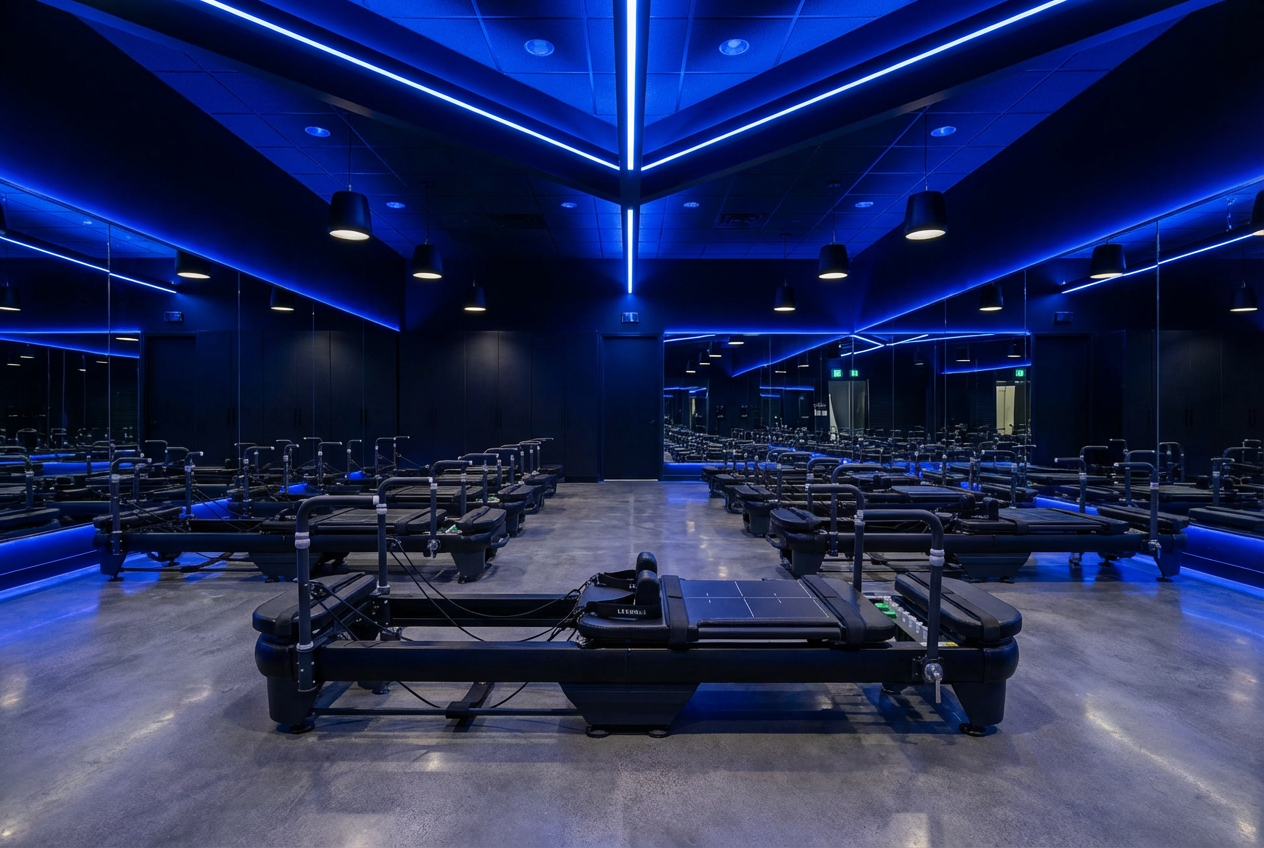
Freight is two legs, and the second one is the problem
Peninsula-to-island freight is not a longer version of a domestic delivery. It is a different job.
A pallet leaving our works in Valencia goes by road to a port consolidation depot, waits for a sailing, crosses to Las Palmas or Santa Cruz de Tenerife, gets unloaded onto a terminal, and then needs a local vehicle with a tail lift. Realistic door-to-door for groupage: five to nine days, and the last two days are the ones nobody controls.
What pushes the price and the delay:
- Groupage consolidation — island sailings are less frequent than mainland trunk routes. Miss the cut-off and you lose a week, not a day.
- Volume, not weight — a crated reformer is roughly 2.4 to 2.5 m long on a pallet and 90 to 140 kg. You pay for the length.
- Tail lift and the last 50 metres — old town centres in La Laguna, parts of Las Palmas and the steep access roads above Los Cristianos are not articulated-lorry territory. A 7.5-tonne truck with a tail lift, or a smaller van with two people, is a separate line item.
- Season — June to September, ferry capacity goes to tourists and perishables. Book earlier than you would on the mainland.
- Storage — if the studio is not ready, an island terminal is an expensive place to store six crates.
The cheapest island delivery I have seen was planned around a single sailing with everything on one pallet group, unloaded by the studio’s own staff with a rented pallet truck. The most expensive involved three separate shipments because the fit-out slipped. Freight does not scale down well on islands.
Salt air is a spec decision, not a maintenance habit
A reformer 400 metres from the Atlantic lives a different life from one in Madrid. Salt aerosol plus 70% relative humidity is an aggressive combination for anything with a spring, a bearing or a bare steel fastener.
What actually holds up:
- Anodised aluminium frame rather than painted steel. Coating damage on painted steel is where corrosion starts, and island air finds every chip.
- Stainless or passivated spring anchors. Springs themselves are consumable — they get replaced on schedule anyway — but the hooks and eyes they hang from are not, and they are the first thing to pit.
- Sealed carriage bearings and polymer wheels. Grit and salt both attack open bearings. A carriage that starts rumbling in year two is usually a bearing that lost its grease in year one.
- Closed-cell foam under the vinyl. Open-cell foam soaks up sweat and humid air and turns into a corrosion cell against the frame. In a coastal studio this matters more than the vinyl itself.
The humidity side of this is worth its own read — we covered the physics in hot pilates humidity, and the same dew-point logic applies to an unairconditioned island studio that cools down overnight.
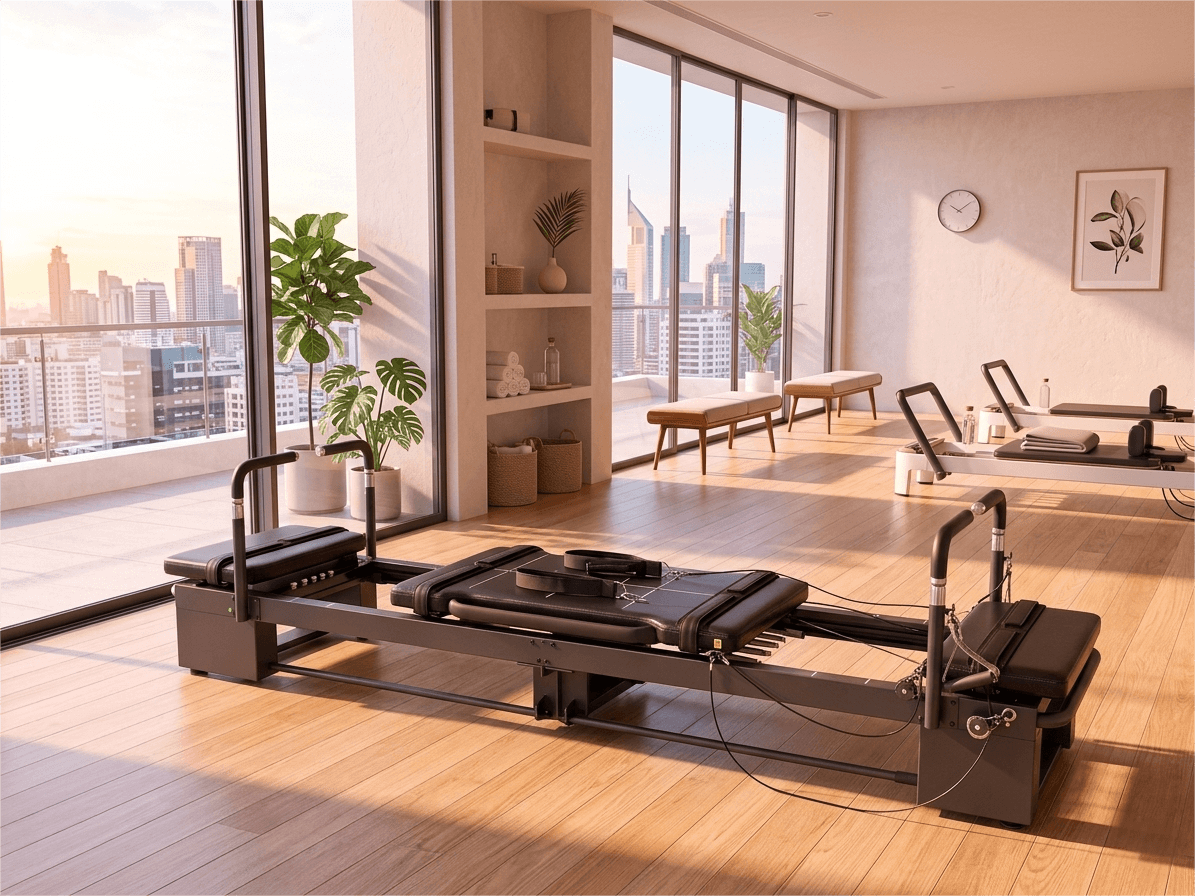
Who fixes it in year four?
This is the part island buyers underestimate, and it has nothing to do with tax.
Mainland service is a van and a day. Island service is a flight, a hire car and a night in a hotel, or a local technician who has never opened your model. Either way it costs more, and it takes longer.
Three clauses to negotiate before you sign:
- Response time measured from the first working day, not from the day the technician lands. “Within 72 hours on the islands” and “within 72 hours in Spain” are different promises.
- A spare parts kit included in the original order. Springs, a set of ropes or straps, carriage wheels, and the two or three fasteners that always go missing. Air-freighting one bracket later costs more than the whole kit.
- Written confirmation that remote diagnosis is supported. Video call, serial numbers, and a technician who will walk your instructor through a carriage swap. Studios that can do this do not lose a week of classes over a worn wheel.
If your supplier cannot name a service partner, a parts stock or a named technician, that is your answer. Most of the big international brands have no owned service presence on the islands; they lean on regional distributors and whatever freight can be arranged that week.
A worked example: six reformers to Tenerife
Indicative numbers, 2026, six commercial machines, delivered and installed in a 110 m² studio in the north of Tenerife:
| Line | Amount |
|---|---|
| 6 × commercial reformer, ex-works Valencia | €13,800 |
| Road to port + groupage + ferry + island delivery | €900–1,400 |
| DUA, customs agent fee, terminal handling | €150–300 |
| Tail lift / small vehicle for last-mile | €0–250 |
| IGIC at 7% on goods + freight | approx. €1,050 |
| Installation and commissioning | €600–900 |
| **Landed and installed** | **approx. €16,500–17,700** |
Per machine, that is roughly €2,750–2,950 against a headline €2,300. The gap is freight, tax and the last mile — not margin. Any island quote that shows only the machine price and 21% IVA is either wrong or has the freight hidden somewhere.
The same exercise for a Balearic studio is simpler: 21% IVA, one ferry leg, two to four days, no DUA. Budget €250–450 per machine for freight if you are shipping six at once.

Ten questions before you sign an island order
- Is the price ex-works, DAP port, or DAP your door — and who unloads?
- Is IGIC shown, estimated, or ignored?
- Who files the DUA, and who advances the IGIC?
- Which sailing, and what happens if we miss it?
- Does the crate fit through the door, the lift and the stair turn?
- Is there a tail lift on the final vehicle, and is that included?
- What is the corrosion spec on frame, anchors, bearings and foam?
- What spare parts ship with the order rather than after it?
- Who is the named service partner, and what is the response time on the island?
- What proof of dispatch will you keep for your own VAT file?
If a supplier answers all ten without hesitating, the price is probably honest. If they answer four and change the subject, the missing six will appear as invoices later.
FAQ
Do I pay Spanish IVA on a reformer sent to the Canary Islands? No. The Canary Islands are outside the EU VAT area, so Spanish IVA does not apply. The seller invoices at 0% against proof of dispatch, and the buyer pays IGIC — general rate 7% — as importer.
Is the Canary Islands a third country for product compliance? No. It is part of the EU customs territory. CE marking, the EN ISO 20957-1 machine classification, the declaration of conformity and GPSR obligations apply exactly as on the mainland. Your machine should be identical.
Are the Balearics the same? No. Mallorca, Menorca, Ibiza and Formentera are inside the Spanish VAT area: 21% IVA, no DUA, no IGIC. You still pay for a ferry leg, and summer capacity is tight.
What about Ceuta and Melilla? Those are outside the customs union as well as the VAT area, so duty applies on top of IPSI, and the paperwork is a genuine import. Get a customs agent involved before you agree a delivery date.
Can I claim the IGIC back? If you are IGIC-registered and charge IGIC on your classes, yes — it is deductible in the same way IVA is for a mainland studio. Private buyers and non-registered operators cannot.
How long does delivery take? Five to nine days door to door for groupage from the peninsula, plus whatever the studio fit-out adds. Plan around a specific sailing rather than a promised number of days.
We build reformers in Spain and ship them to the peninsula, the Balearics and the Canaries on a regular basis, so the paperwork on our side is routine rather than experimental. If you are fitting out a studio in Tenerife, Gran Canaria or Palma and want a quote that shows the island lines separately instead of hiding them, send us the room plan and the machine count and we will price it the way it actually arrives. The K30 commercial reformer is the usual starting point for studio fleets; the K38 is what most premium island studios pick when the room is a selling point. Full studio fit-out options are on the studio solutions page.
