How to Open a Pilates Studio in Spain in 2026: Legal Steps, Costs and Equipment
Thinking of opening a pilates studio in Spain? The honest summary: there is no single national licence for pilates studios, the paperwork is municipal, and the equipment is your biggest line item. Most new owners underestimate the licencia de apertura waiting time and overestimate how fast they fill classes. This guide walks through the legal structure, town-hall licensing, insurance, equipment choices and a realistic 2026 budget — written from the perspective of a Spain-based manufacturer that equips studios across the country.
Spain’s market is growing faster than most of Europe: health club membership reached roughly 7.1 million in 2025, up 8.3% year on year, according to the EuropeActive/Deloitte European Health & Fitness Market Report. Reformer studios are still thin on the ground in most Spanish cities compared with London or Paris, which is exactly why so many instructors are looking at opening their own space right now.
The Legal Structure First: Autónomo vs Sociedad Limitada
Before you look at a single reformer, decide how the business will be registered. In Spain you have two realistic options for a studio.
Autónomo (self-employed). The cheapest way to start. No minimum capital, no notary, and you can register your activity with Hacienda and Seguridad Social in days. The catch: unlimited personal liability, and your social security quota (RETA) is now calculated from your real net income across 15 brackets — roughly €88 to €607 per month in 2026, according to current autónomo cost breakdowns, once the first-year reduced rate ends. If the studio is small, you teach most classes yourself, and you own little else, this works.
Sociedad Limitada (SL). The Spanish equivalent of a UK Ltd or German GmbH, and the default choice once you hire staff or sign a commercial lease in your own name. Under the Ley Crea y Crece, share capital can be as low as €1, though most advisors still recommend the classic €3,000. Realistic formation cost is €1,500–€4,000 including notary, commercial registry and legal help, per Spanish law firm Costaluz Lawyers’ 2026 company guide. Corporate tax is 25%, dropping to 15% for the first two years on the first €300,000 of profit.
| Decision | Autónomo | Sociedad Limitada (SL) |
|---|---|---|
| Minimum capital | None | €1 legally (€3,000 typical) |
| Formation cost | ~€100–300 (registration + gestor) | €1,500–€4,000 (notary, registry, legal) |
| Personal liability | Unlimited | Limited to company assets |
| Profit tax | IRPF, progressive 19–47% | Corporate 25% (15% first two years) |
| Social security | RETA on real net income, ~€88–607/month | Administrador quota, ~€370/month |
| Best for | Solo instructor, micro studio | Studio with staff, commercial lease, growth plans |
A gestor (accountant) will cost €50–100 per month and is worth every euro — they file your quarterly IVA (VAT) returns, your income tax and your workers’ paperwork. Budget for one from day one.
The Licencia de Apertura: the Step Everyone Underestimates
Every pilates studio in Spain needs municipal authorisation to operate. In most towns this is the licencia de apertura, issued by your ayuntamiento (town hall). Some municipalities let lower-risk activities start on a declaración responsable — you file the paperwork and open immediately, subject to inspection — but fitness activities are often treated as actividades clasificadas, which can require a technical project (proyecto técnico) signed by an architect or technical architect covering occupancy limits, accessibility, ventilation and noise insulation.
Three practical warnings from studio owners who have been through it:
- Check the property’s permitted use before signing the lease. A local comercial may not be zoned for sports use. Your gestor or a local architect can confirm with the town hall, and the landlord should state it in writing. Reversing a lease after the licence is refused is expensive.
- Budget for the técnico and the wait. Licensing fees themselves are modest, but the technical project and any required soundproofing work can add thousands. Town-hall processing times vary wildly — from a few weeks to six months in busy cities. Start the process before you order furniture.
- Factor in neighbours. Noise complaints kill more small studios than bad cash flow. Insulation under reformers and a sprung or padded floor protect both your licence and your relationship with the building.
Two Spanish specifics people forget: if you play music in class, you need a licence from SGAE (or use a platform that covers public performance rights), and if you collect client data — bookings, health forms, photos — you need a GDPR (RGPD in Spain) privacy policy and consent records. Both are cheap; both are commonly missed.
Insurance: Non-Negotiable, and It Checks Your Equipment
You need responsabilidad civil (public liability) insurance covering injury to clients and damage to third parties, plus employer’s liability once you hire. Many landlords and town halls require proof of cover before you open.
Here is the link most new owners miss: Spanish insurers increasingly ask what equipment you are putting in the room, and CE marking matters to them. A reformer that is not CE marked under the relevant standard is a liability gap on your policy — if a client is injured on an uncertified machine, the insurer has grounds to refuse the claim. The De Pilates Store (Netherlands), which sells to studios across the EU, makes exactly this point: CE marking on pilates equipment guarantees safety, insurance validity and professionalism. We cover the full detail in our pilates reformer CE certification guide, but the short version for Spain: buy machines tested to EN ISO 20957-1, Class S (studio/commercial), and ask the manufacturer for the Declaration of Conformity before you pay.
Equipment: How Many Reformers, and Which Class
The number of machines defines your business model, not the other way round. Three formats dominate in Spain:
| Studio format | Reformers | Typical investment (machines) | Revenue model |
|---|---|---|---|
| Private/semi-private micro studio | 2–4 | €8,000–€22,000 | €45–70/session, 1:1 and duets |
| Small boutique | 6–10 | €22,000–€50,000 | Class packs + memberships, groups of 6–8 |
| Group-format studio | 8–12+ | €30,000–€70,000 | High-volume membership, groups of 8–12 |
Pricing is the European reality, not the American one: a new commercial-grade reformer costs roughly €2,800–€6,500 per machine in 2026, with most studios paying €3,200–€5,000 — see our full European cost breakdown. Buy five or more machines directly from a manufacturer and the per-unit price typically drops to €1,900–€3,500.

For a first studio, resist the temptation to mix cheap home-grade machines with a couple of commercial ones. Mixed fleets behave differently under load, feel different under clients, and complicate your maintenance schedule. One fleet, one spec, one spring set. Our K30 commercial reformer is the workhorse for busy studios — aircraft-grade aluminium frame, precision spring resistance and an ultra-smooth rail system that holds up to continuous group use. Where the studio’s brand is premium or classical — think Salamanca or Chamberí in Madrid — the K38 premium reformer is the model owners put in the front row.
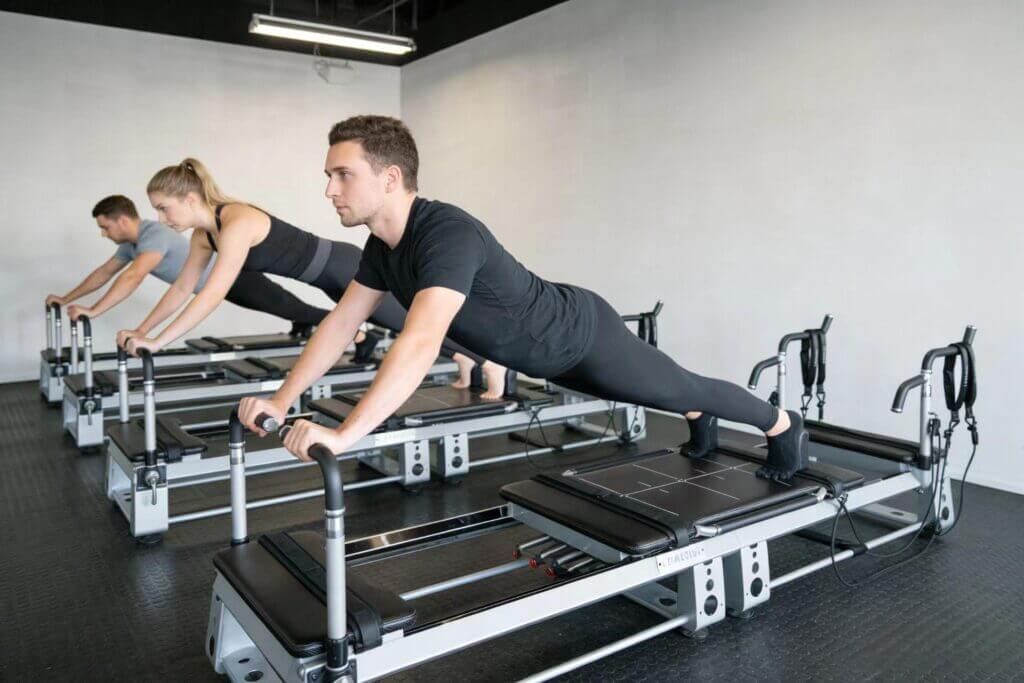
Capacity planning matters more than most people think. For group classes of eight, plan the room around eight machines plus teaching space; our studio capacity guide walks through the per-machine floor space and how many reformers fit a given square metre budget.
What It Costs to Open a Pilates Studio in Spain in 2026
Here is a planning budget built from the cost anchors above. Treat every line as a range, not a quote — Spanish costs swing hard between a pueblo and central Madrid.
| Cost item | Low | High | Notes |
|---|---|---|---|
| Legal formation (SL, notary + registry + legal) | €1,500 | €4,000 | Autónomo: under €300 |
| Technical project + licencia de apertura | €1,500 | €6,000 | Town hall fees + arquitecto + possible soundproofing |
| Deposit + aval on lease (2–3 months) | €6,000 | €18,000 | Market practice in Spanish cities |
| Fit-out (floor, mirrors, changing, lighting) | €8,000 | €35,000 | Heavy variation by building condition |
| Reformers (4–8 commercial units) | €15,000 | €40,000 | The line you should not cut |
| Accessories (boxes, mats, barrels, jump boards) | €2,000 | €6,000 | Buy with the fleet, not later |
| Insurance (first year) | €400 | €1,200 | Liability + employer’s cover |
| Software, marketing, launch | €2,000 | €8,000 | Booking system + launch campaign |
| Working capital (6 months) | €15,000 | €40,000 | Rent and wages before break-even |
The published benchmark from Spanish franchise operator PILAT3S puts a turnkey standalone studio at roughly €225,000–€275,000 including fees and equipment, while its boutique-in-gym model starts at around €10,000 initial outlay. Independent studios sit between those extremes: a six-reformer boutique in a mid-size city typically opens somewhere in the €60,000–€150,000 band, and a two-to-three machine micro studio can start for under €30,000.
Two Spanish tax points that work in your favour:
- You reclaim the IVA (21%) on your equipment purchase if you are registered for VAT and selling classes (also 21% standard rate, filed quarterly on form 303). Buying from an EU manufacturer means no customs duty and no import VAT gymnastics — the invoice is simply Spanish-VAT-eligible.
- Your social security quota (autónomo) is a real business cost, not pocket change. Budget the RETA payment monthly from day one, and remember the autumn regularisation: if your real profit ends up higher than the bracket you chose, Seguridad Social bills you the difference.
Teachers, Certification and Hiring
You do not need to be a certified instructor to own a studio in Spain — there is no national licence for ownership. But you need qualified teachers, and their credentials matter for insurance, for your reputation, and increasingly for clients who know the difference between a weekend course and a real certification (STOTT PILATES, Balanced Body, Polestar and the established schools all have presence in Spain).
Some autonomous communities regulate sports professionals through regional registries, so check with your comunidad autónoma before you hire — a qualified local instructor will know the answer in five minutes. And pay attention to employment contracts: Spain’s labour rules are strict about false self-employment (falsos autónomos). If teachers work set schedules in your studio, they are employees, not freelancers. Get this wrong and the fine arrives with interest.
The Realistic Timeline
| Phase | Duration | Notes |
|---|---|---|
| Legal entity + NIE (if foreign) | 1–4 weeks | Autónomo can be same-day; SL needs notary slot |
| Lease signed + licence application | 4–24 weeks | The most unpredictable step — start early |
| Fit-out | 4–10 weeks | Can run in parallel with licensing |
| Equipment order + EU delivery | 2–6 weeks | [EU freight guide](https://www.leanbulreformer.com/pilates-reformer-delivery-europe/) |
| Pre-launch marketing | 6–8 weeks before opening | Build the waitlist before the door opens |
Plan on four to nine months from decision to doors open, and most of that is licensing and fit-out, not equipment. Ordering your reformers from a Spain-based manufacturer shortens the equipment phase and removes border risk entirely — the machines are built here, delivered on EU pallets, and supported by a Spanish warranty and spare-parts stock rather than a transcontinental email chain. See our pilates studio solutions page for how we package fleets, or the full collection to compare models.
FAQ
How much does it cost to open a pilates studio in Spain? A micro studio with two to three machines can open for under €30,000; a six-reformer boutique typically lands between €60,000 and €150,000; a turnkey standalone at franchise standard runs €225,000–€275,000. Equipment is the biggest controllable line: €2,800–€6,500 per new commercial reformer, less at fleet volume.
Do I need a licence to open a pilates studio in Spain? Yes — a licencia de apertura from your town hall (or a declaración responsable where your municipality allows it). Fitness premises are often treated as classified activities requiring a technical project, so check the property’s permitted use before signing the lease and start the application early.
Do I need to be a certified pilates instructor to own a studio? Legally, no national certification is required to own one. You do need qualified instructors teaching, and credible certification protects you on insurance, hiring and reputation. Check whether your autonomous community requires sports professionals to register.
What equipment standards matter in Spain? Buy reformers CE marked to EN ISO 20957-1, Class S, and ask for the Declaration of Conformity. Insurers increasingly check this, and it protects you if a client is injured. Class H (home) machines have no place in a commercial studio.
The Bottom Line
Opening a pilates studio in Spain is a paperwork-first business: structure, licence, insurance, then machines. Get the first three right and the equipment decision becomes simple — one fleet, one spec, commercial class, sized to the revenue model you actually plan to run. When you are ready to price the machines, talk to us: we are a Spain-based manufacturer, we outfit studios from Madrid to Málaga, and we will tell you honestly how many reformers your floor plan and business plan justify. Get in touch for a fleet quote.