Pilates Reformers for Franchises and Multi-Studio Brands in Europe: A 2026 Fleet Buying Guide
If you run a pilates franchise or a multi-studio brand in Europe, equipment is your second-biggest cost after property — and your biggest consistency risk. A client who takes a class in Madrid and another in Berlin should feel the same machine under them, and the only way to guarantee that is a standardized, documented fleet bought on terms that work across countries. This guide covers how franchise and multi-location operators should buy reformers in Europe in 2026: what to standardize, how to structure the purchase, and what to negotiate with a manufacturer.
The timing is not accidental. Buying pilates reformers for franchises is the fastest-growing equipment channel in European reformer pilates right now. Club Pilates operates more than 1,200 studios across four continents and is actively selling international master franchise rights. Spain’s PILAT3S reported about 50 studios across nine regions in 2025, with plans to roughly double in 2026 and reach 150 worldwide by the end of 2027. FS8 sold master franchise rights for the UK, Europe and South Korea in March 2024. EuropeActive’s data shows the wider fitness industry consolidating — 67,515 clubs, 75.5 million members, and 27 M&A deals in 2025 alone.
We manufacture commercial reformers in Spain and supply studios, gym groups and multi-location operators across the EU. Fleet buying is different from single-studio buying in ways that catch even experienced operators out. Here is what changes.

Why Franchises Are Expanding in Europe Now
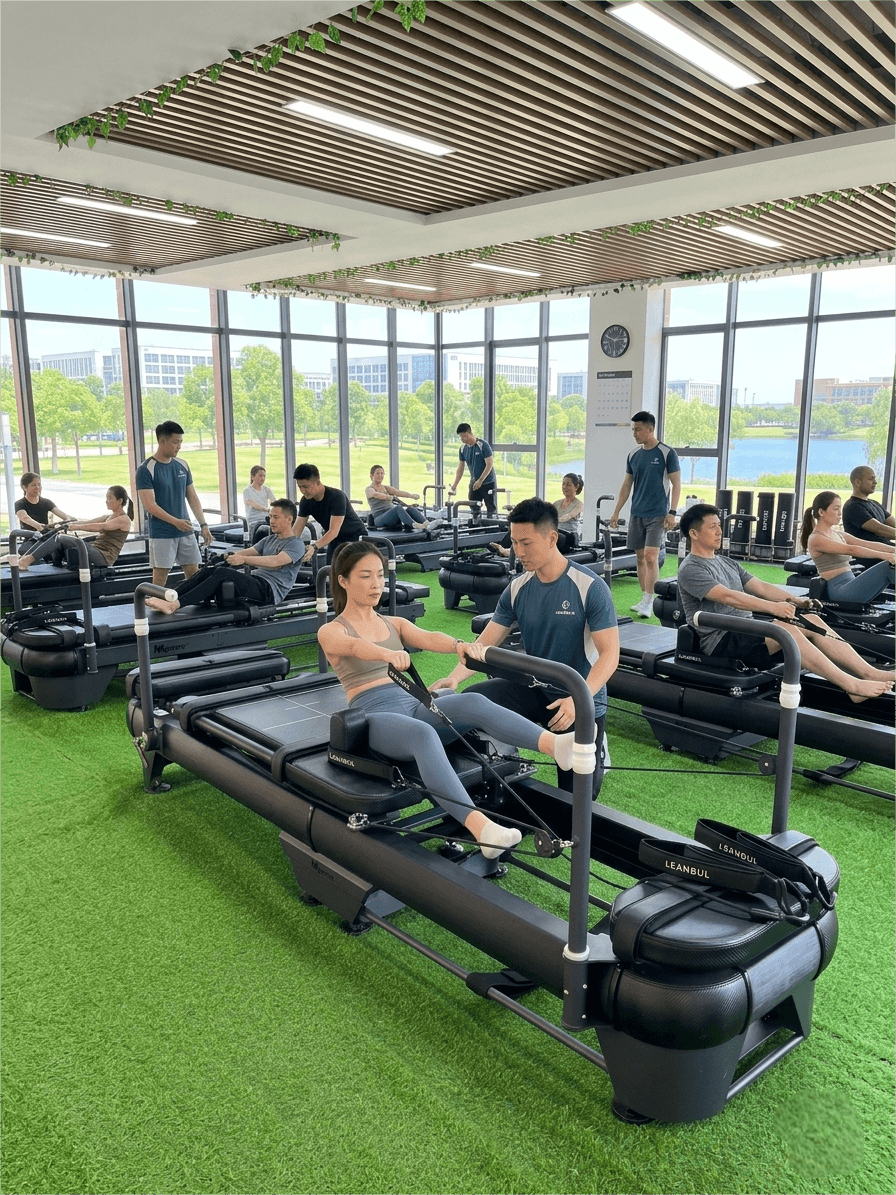
Reformer pilates has a business model problem that franchises solve. A single boutique studio caps its revenue at what its floor can hold — typically eight to twelve reformers and the classes they can run in a day. Adding machines means adding space, and in prime city locations that is expensive. Franchises and multi-unit operators scale the same operating playbook across locations, spreading brand marketing, instructor training and management overhead over many sites.
| Operator | Footprint | European status |
|---|---|---|
| Club Pilates (US) | 1,200+ studios, four continents | Selling master franchise and area development rights internationally |
| PILAT3S (Spain) | ~50 studios, nine regions; target 150 worldwide by end 2027 ([Tribute Brands](https://tribute-brands.com/press/a-new-perspective-on-fitness)) | Spanish-based; standalone and boutique-in-gym models |
| FS8 | Multiple countries | UK and Europe master franchise rights sold March 2024 |
| Studio Pilates (AU) | 20+ years operating | Studios in the UK and Germany among others |
The European angle matters for equipment. Franchise growth here is happening mostly through master franchise agreements — a local operator buys the rights and opens studios in their territory. That operator makes the equipment decisions, and they face a steep learning curve: they need machines that match the brand’s class format, comply with EU rules in every country they open, and arrive on a schedule tied to build-out dates that were committed months in advance.
The Equipment Problem at Fleet Scale
A single studio owner buys one or two machines and can afford to be flexible. A franchise operator cannot, for four reasons.
Client consistency. Your class experience is the product. If the reformers differ between sites — different spring resistance curves, different carriage feel, different footbar adjustment — the class changes even when the instructor’s cueing does not. Clients notice, and so do franchise inspectors.
Instructor mobility. Franchise instructors move between sites and regions. A standardized machine means a teacher trained in one studio can teach identically in another without re-learning the equipment. That shortens onboarding for new sites and makes instructor transfer practical.
Service and spares. A uniform fleet means one set of maintenance protocols, one spare parts kit per site, and one relationship with a supplier who can support the whole network. Mixed fleets multiply your admin and your stock-holding.
Asset value. A uniform, well-documented fleet holds its value if you ever sell sites or re-franchise them. A grab-bag of different machines is a liability in any sale or audit.
The same logic explains why most international reformer brands standardize on aluminum-frame commercial machines: identical performance across production batches, minimal maintenance, no humidity sensitivity across different climates. We laid out the full wood vs aluminum comparison for European buyers, but for multi-location brands the argument is close to one-sided.
Specifying Pilates Reformers for Franchises
Before you talk to any supplier, write the specification that applies to every machine in the network. A franchise spec sheet should fix these points:
- Model and grade. One machine model per class format, commercial grade, rated EN ISO 20957-1 Class S. No “good enough” downgrades for smaller markets.
- Resistance system. Springs with a defined color-coded progression, so a “light spring” means the same thing in every studio.
- Adjustability. Footbar positions, headrest, shoulder rests and ropes must fit the full range of client bodies — franchises serve beginners to advanced, 155 cm to 195 cm.
- Accessories and options. Jumpboard, tower, box, platform extender — decide per class format and standardize per site type, not per manager’s preference.
- Finish and branding. Frame color, upholstery and any logo treatment become part of your brand identity in the room.
- Documentation. CE declaration of conformity, EN ISO 20957-1 test reports and GPSR economic operator details for every machine, in every country you operate. We covered CE certification requirements and what the documents actually prove.
What to Standardize vs What Can Differ
| Decision | Standardize across the network | Can differ by site |
|---|---|---|
| Machine model | Yes — one model per class format | — |
| Resistance system and spring set | Yes | — |
| Maintenance schedule and spares kit | Yes | — |
| Compliance documentation pack | Yes | Per-country registration where required |
| Upholstery color | Yes | — |
| Jumpboard / tower options | Only if the class format demands it | Site type: standalone vs in-gym |
| Delivery and installation | Same process, phased per site | Dates follow build-out schedule |
The rule of thumb: anything the client touches or feels is standardized; anything invisible to the client can flex. A boutique-in-gym site in a partner gym may need a smaller footprint and quieter machines than a standalone flagship — that is a site-model decision, not a per-manager whim.

How to Structure the Buy: Master Agreement, Phased Rollout
Fleet purchases fail in two common ways: buying everything at once before a single site has proven its economics, and buying site-by-site with no network-level agreement. The structure that works is a master agreement with phased deliveries.
A master agreement fixes the commercial terms for the whole network — pricing tiers by volume, payment schedule, warranty conditions, spare parts commitments, compliance documentation — and lets each site release orders against it. This gives the operator network-level pricing and a single accountable supplier, without committing capital for studios that have not been signed yet.
Phased rollout also lets you test reality before scaling. Open the pilot site, measure real utilization and class demand, and only then release the orders for sites two and three. This is the advice we give every franchise operator, including the ones who do not follow it and later wish they had. It is the same discipline as the used vs new decision — buy for the demand you can prove, not the demand you hope for.
Logistics Across the EU
Multi-country rollouts change the logistics conversation. A single studio can absorb a delivery delay; a network opening three sites in three countries in the same quarter cannot. Points to pin down before signing:
- Delivery windows tied to build-out dates. Your contractor’s schedule depends on equipment arriving on a specific week. Agree firm windows per site, not “8–12 weeks”.
- EU freight and delivery terms. Freight is priced per kilo and per route; a fleet order across several countries is a negotiation in itself. Our EU delivery guide explains how intra-EU quotes work and what white-glove service should include.
- VAT and cross-border paperwork. B2B deliveries between EU countries typically use reverse-charge VAT, but you need the supplier to handle documentation correctly per country. Our import and VAT guide covers the mechanics.
- Storage risk. If a site slips, who holds the machines and at what cost? Agree it in writing. Equipment sitting in a warehouse for three months because a landlord delayed handover is a common, expensive surprise.
What to Negotiate With a Manufacturer
At fleet scale you are not buying machines, you are buying a supply relationship. Negotiate these seven items:
- Volume pricing tiers. Published prices are single-unit prices. From about five units you are buying at wholesale rates — manufacturer-direct pricing in Europe typically lands at €1,900–€3,500 per machine at that volume (see our European cost guide) — and at 10, 25 or 50 units the per-machine price should step down further. Agree the tiers before the first order.
- Payment schedule tied to deliveries. Pay per release against the master agreement, not per site in advance.
- Warranty as a network agreement. One warranty contract covering all sites with a single EU contact beats per-site claims. Our warranty guide lists what a fair manufacturer agreement includes, including how springs — wear items — are treated.
- Spare parts commitment. Agree a guaranteed spares kit per site and a restock SLA. A network with 20 sites cannot wait weeks for a spring set.
- Leasing or financing options. If the franchise structure prefers leasing over purchase, check that the manufacturer’s terms support it. We covered leasing and financing in Europe separately.
- Brand customization. Color, upholstery and logo treatments are possible on direct-manufacturer orders; confirm minimums and lead-time impact.
- Compliance pack per site. CE declaration, test reports and GPSR documentation for every machine delivered to every country — delivered with the machines, not on request.
Manufacturer or Retailer?
Multi-studio operators should buy direct from a manufacturer, and the reason is not just price. At fleet scale you need batch consistency — the same machine built the same way across production runs — which is exactly what a factory controls and a retailer cannot guarantee across different suppliers. You also need a single accountable counterparty for documentation, warranty and spares across countries. Retailers add real value on service and showroom experience for single buyers; a network operator with a spec sheet and a rollout schedule is better served by the factory that builds the machine.
Buying direct from a Spain-based manufacturer has a practical edge for European networks: production and EU stock inside the Union, deliveries and VAT handled across member states, warranty enforced from Europe, and support staff working in European time zones. That proximity is the whole value proposition — not a flag, just logistics.
FAQ
How many reformers does a franchise studio typically need?
Group-format studios typically run eight to twelve reformers per site, depending on class size and floor space. We break down the studio capacity math in a separate guide.
Do franchise studios need commercial-grade reformers?
Yes. Any machine used for paid classes must be CE marked and rated EN ISO 20957-1 Class S, with a declaration of conformity and test reports. For a network this is not one document but a documentation pack per machine per country.
Can we get our brand colors and logo on the reformers?
Yes, on direct manufacturer orders. Frame color, upholstery and logo treatments are standard customization options — confirm minimum order quantities and lead-time impact when you negotiate.
How long does a fleet order take to deliver across the EU?
It depends on volumes and destinations, which is why phased rollouts with firm delivery windows per site are the right structure. A Spain-based manufacturer with EU stock delivers materially faster than importing from outside the Union; our EU delivery guide gives realistic expectations.
Can one contract cover studios in several EU countries?
Yes. A master agreement with per-country releases, reverse-charge VAT handling and a single warranty contact is how multi-country networks should buy. Make sure the supplier has a European entity that can stand behind the contract in every country you operate.
Build Your Fleet With a Manufacturer Inside the EU
Leanbul is a Spain-based manufacturer of commercial pilates reformers, CE certified and rated EN ISO 20957-1 Class S, with EU-stocked spare parts and warranty support handled from Europe. We supply single studios and multi-country networks, with volume pricing, brand customization and phased delivery programs. Start with our studio solutions, compare the K30, K38 and K11 in the collection, or contact our team to structure a fleet agreement for your network.