Pilates Studio Lease in Europe: The Clauses That Decide Whether Your Reformer Fleet Fits
A pilates studio lease decides three things long before you buy a single reformer: whether the use is permitted at all, whether the floor and the neighbours will tolerate six machines running ten hours a day, and whether a 2.5-metre crated reformer can physically reach the room. Most first-time studio owners negotiate rent and term, sign, and discover the rest afterwards.
This guide covers the clauses worth fighting over, the measurements to take before you sign, and how lease terms differ across the European markets where most new studios open. It is written for people about to commit €40,000 or more to a space, not for lawyers.

The nine clauses that matter for a reformer studio
1. Permitted use
This is the clause that can end your business. A lease written for “retail” or “office” does not automatically allow group exercise classes, and a landlord who discovers twelve clients arriving every hour has grounds to act.
Ask for the use to be described explicitly and broadly: “operation of a pilates and fitness studio, including group and private reformer classes, instructor training, workshops, retail of related equipment and clothing, and ancillary online content production.” The last two matter more than they look. Retail is a margin line for many studios, and filming content is now normal practice that a narrow clause can technically prohibit.
If the building has other tenants, check whether your use needs landlord consent for each sub-activity, and get that consent in the lease rather than in an email.
2. Hours of operation and music
Two separate limits usually apply. The lease sets contractual hours; the planning permission or municipal licence sets legal hours, and the stricter one wins.
Before signing, confirm in writing:
- the permitted opening hours, including weekends
- whether early morning classes (06:30 is normal in this industry) are allowed
- whether music is permitted and at what level
- who holds the music licence. In every EU country, playing recorded music in classes requires a licence from the local collecting society, and it is your cost, not the landlord’s.
A lease that permits 09:00–20:00 kills the pre-work class that many studios rely on for the first year’s cash flow.
3. The noise clause
Landlords recycle the same wording: “the tenant shall not cause any noise or vibration which may be audible or perceptible in neighbouring premises.” Read literally, that forbids the business you are renting the space for.
Replace it with something measurable. A workable formulation: “the tenant shall comply with applicable building regulations for sound insulation and shall not cause noise levels in neighbouring premises exceeding those permitted under the applicable national and municipal standards.” Then the argument becomes about decibels and standards rather than about whether someone heard a thump.
This clause matters more in pilates than in most fitness formats because reformer impact travels through structure. We covered the technical side in our guide to pilates studio soundproofing.
4. Floor loading, floor construction and what is under you
Ask the landlord two questions in writing: what is the design imposed floor load in kN/m², and what is the floor build-up?
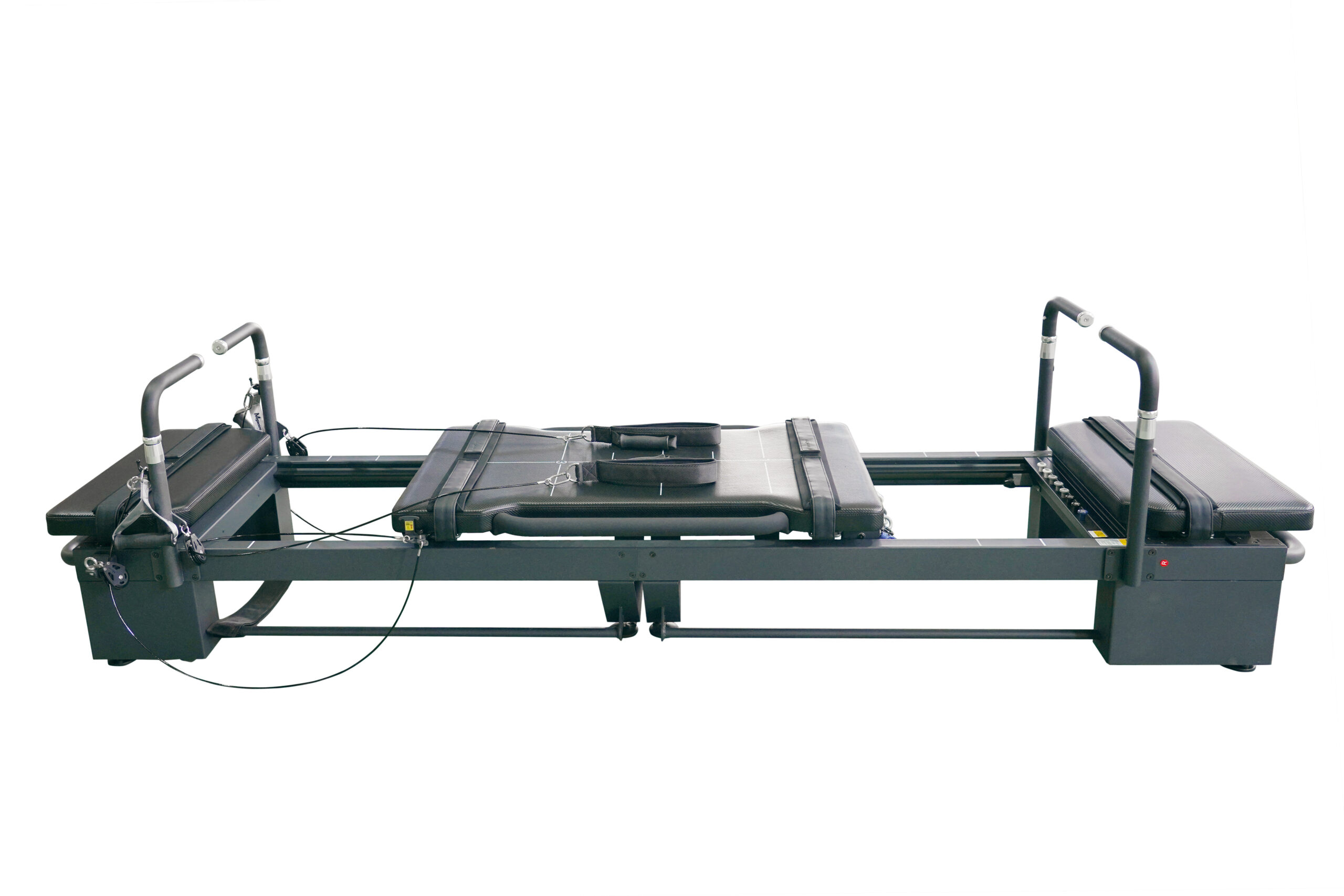
A loaded reformer is not heavy in the way a squat rack is. A machine plus client is roughly 150 kg spread over a 2.4 m footprint. The issue is dynamic impact and point loads at the feet, which matter on timber joists, raised access floors and mezzanine decks. On a concrete slab at ground level you can stop worrying. On a timber floor above a shop, you need a structural engineer before you need a fit-out contractor.
Also establish what sits below: another commercial unit, a car park, a restaurant kitchen, or flats. That single fact drives your acoustic budget more than any other.
5. Delivery access
Nobody checks this until the truck arrives. A crated commercial reformer is roughly 2.4–2.5 m long and 0.7–0.8 m wide, on a pallet, weighing 90–140 kg.
What to measure on your viewing, with a tape:
- clear width of the entrance door and any internal doors (900 mm is tight but workable; 800 mm is not)
- lift car dimensions and, critically, lift height. Typical European passenger lifts are around 1.1 × 1.4 m with 2.1–2.3 m of headroom, so a 2.5 m crate does not go in lying flat
- stair width and number of turns. A straight run with a wide landing is fine; a tight half-landing spiral is not
- distance from the kerb to the door, and whether a pallet truck can cross it
- any delivery time window imposed by the building or the municipality
If access fails, your options are a window hoist, a crane, or partial disassembly, and all three cost money and time. Better to know in week one. Our EU delivery guide sets out how deliveries are typically handled inside the single market.
6. Fit-out consent and landlord’s works
Most leases require written consent for alterations. Get the process defined: who approves drawings, within how many days, at whose cost, and whether consent can be unreasonably withheld.
Two pilates-specific points. Wall-mounted equipment such as ladders, towers and bars must be fixed to walls that can take the load, and never to a demising wall shared with a neighbour. And if you are installing a floating floor, it raises the finished level by 60–120 mm, which affects door thresholds, accessibility compliance and sometimes the landlord’s own door frames.
7. Reinstatement
Reinstatement clauses require you to return the premises to their original condition. For a studio that has spent €30,000 on flooring, mirrors and a floating floor, that is a demolition bill at exit.
Negotiate one of three outcomes, in order of preference: no reinstatement obligation; reinstatement limited to removing signage and making good; or a capped sum agreed now. Photograph the condition at handover, with a dated schedule of condition signed by both parties. Without it, you will be paying for the previous tenant’s damage.
8. Subletting and space-sharing
Empty hours are the biggest financial leak in a young studio. Renting the room to self-employed instructors, physios or Pilates teachers fills them, and it is a normal part of the business model in most European cities.
Check whether the lease permits subletting, sharing or licence arrangements, and on what terms. Many prohibit it outright or require consent. Ask for permission for “licence of the premises to self-employed instructors during hours when the tenant is not using them” at the outset. We wrote about the commercial mechanics in our guide to studio space-sharing in Europe.
9. Exit: break clause, deposit, guarantee, indexation
Four numbers decide how trapped you are:
- Break clause. A tenant-only break at year three, with three to six months’ notice. Notice conditions are where breaks fail: rent paid up, no outstanding breaches, vacant possession. Read them before you need them.
- Deposit. Spain requires two months’ rent as a legal deposit for non-residential use under article 36 of the Ley de Arrendamientos Urbanos. France and Italy commonly ask three. Belgium and the Netherlands often three to six.
- Personal guarantee. Landlords of new businesses frequently ask the founder to guarantee the rent personally. If you must give one, cap it in time (24 months) or amount.
- Indexation. Check the index, the frequency and whether it is capped. In Italy, indexation of commercial rent is limited by law to 75% of the FOI variation, and cannot be waived. In Belgium, indexation only applies if the lease expressly provides for it.
How lease terms differ across Europe
There is no European commercial lease law. Each country has its own default regime, and the differences are large enough to change your equipment financing plan.
| Country | Typical term | Deposit | Watch out for |
|---|---|---|---|
| Spain | Freely agreed; housing minimums do not apply | 2 months (legal, art. 36 LAU) | Municipal opening licence and activity classification |
| France | 9 years, 3/6/9 structure | ~3 months | Bail dérogatoire max 3 years with no renewal right; pas-de-porte |
| Italy | 6 + 6 years minimum (Legge 392/1978) | ~3 months | Statutory indexation at 75% of FOI; long commitment |
| Germany | 5–10 years fixed is common; indefinite leases need 9 months’ notice (§ 580a BGB) | ~3 months | Fixed-term leases are hard to exit; TA Lärm noise rules |
| Belgium | 9 years standard, exit at year 3 or 6 | 3–6 months | Indexation only if expressly written |
| Netherlands | 5 + 5 for retail-style premises; less protection for other commercial space | ~3 months | Protection depends on premises type |
| Austria | No statutory minimum; 5–10 years typical | ~3 months | Betriebsanlagengenehmigung may be required |
| Ireland, Poland, Czechia, Slovakia, Hungary, Romania, Greece | Freely negotiated | 2–6 months | No statutory minimum term; everything is in the contract |
Two practical consequences. In France, Italy and Belgium you are signing a nine or twelve year horizon, so a break clause matters more than the headline rent. In the freely negotiated markets, the lease is only as good as the drafting, and there is no statutory fallback if it is silent.
What to measure before you sign
Take a tape measure and a phone to the viewing. Fifteen minutes now saves a failed delivery later.
| Item | Target | Why |
|---|---|---|
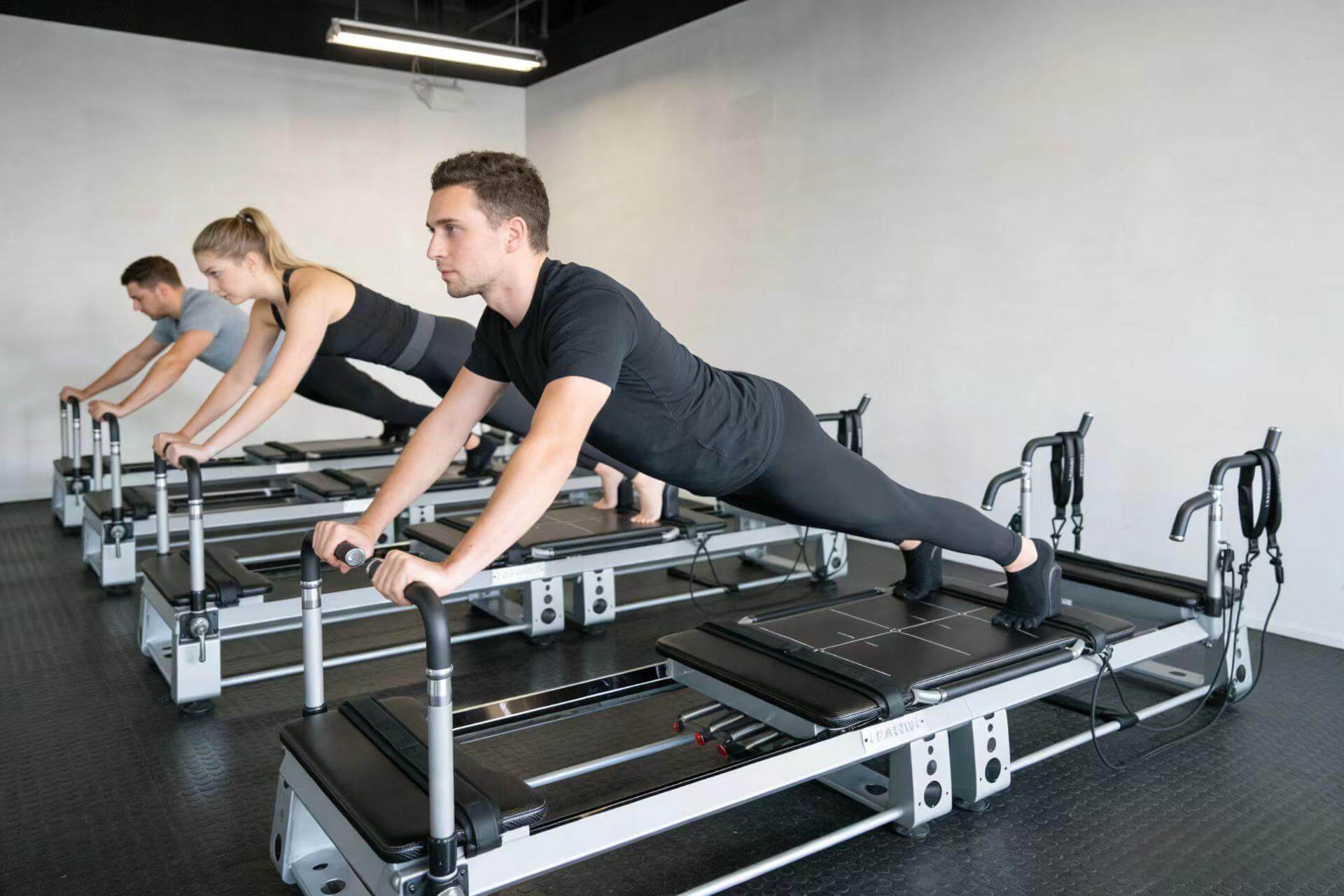
| Main studio area | 3 m × 1.5 m per machine, plus circulation | Six machines need roughly 90–130 m² including reception and storage |
| Ceiling height | 2.4 m minimum, 2.7 m+ for tower work | Tower and cadillac work needs headroom |
| Door clear width | ≥ 900 mm | Crated machine access |
| Lift | Check height, not just floor area | 2.5 m crate will not lie flat in a standard car |
| Stairs | Straight run, wide landings | Turns and half-landings block long loads |
| Floor | Concrete slab preferred; timber needs a structural check | Impact transmission and point loads |
| Below the studio | Identify the occupier | Drives acoustic specification and budget |
| Power | Sockets on at least two walls | Avoid trailing leads across the studio floor |
| Ventilation | Mechanical extract or openable glazing | Six clients in a closed room, ten classes a day |
| Storage | 4–6 m² for mats, props, spare springs | Otherwise the studio eats its own circulation space |
The real upfront number
Take a 110 m² unit at €18/m²/month, which is a mid-range figure for a secondary location in a western European city.
| Item | Cost |
|---|---|
| First month’s rent | €1,980 |
| Deposit, 2–3 months | €3,960–5,940 |
| Legal and agency fees | €1,500–4,000 |
| Fit-out, light to medium | €20,000–35,000 |
| Six commercial reformers, manufacturer direct | €11,400–21,000 |
| First stock, insurance, licensing, launch marketing | €4,000–8,000 |
| **Total before opening the doors** | **€42,000–75,000** |
The lease decides whether that money is recoverable. A nine-year commitment with no break, a personal guarantee and a reinstatement clause converts a failed location into a five-figure loss. A three-year break, no reinstatement and consent for space-sharing gives you an exit and a second income line. Same rent, very different risk.
For how the equipment side of that number behaves over time, including springs, service and resale, see our total cost of ownership model.
Frequently asked questions
Can a landlord refuse a pilates studio in a residential building?
Often yes, and it usually comes down to the lease’s permitted use and the building’s planning consent rather than to the activity itself. Some buildings have planning conditions limiting use to office or retail. Ask the landlord for the existing consent and check with the municipality before signing, not after.
Do I need planning permission to turn a shop into a studio?
In most European cities, a change of use from retail to a fitness studio requires some form of permit or prior declaration, and the requirements differ by country and municipality. Spain uses licencia de apertura or declaración responsable depending on the activity’s classification, Italy uses SCIA, the Netherlands uses an omgevingsvergunning check. Budget time for it: two to six months is normal in busy cities.
How much space do I need for six reformers?
Roughly 90–130 m² including reception, a small changing area and storage. The rule of thumb is a 3 m × 1.5 m working zone per machine with clear circulation behind each carriage, plus 4–6 m² of prop storage.
Is it better to lease a bigger space and sublet hours?
It can be, provided the lease allows it. Many studios cover 20–40% of rent by licensing the room to self-employed instructors during quiet hours. Without written permission, that income is a lease breach waiting to be discovered.
What happens if the floor cannot take a floating floor build-up?
You either reduce the acoustic specification to underlay and pads, accept a lower class count, or find another unit. If the building has flats directly below and the landlord will not consent to structural work, the honest answer is that the site is wrong for a reformer studio.
Getting the room and the fleet to agree
Most lease problems in this industry are really geometry and acoustics problems discovered too late. Our studio solutions team works from floor plans and photographs to confirm how many machines fit, how they should be laid out and what access the delivery will need. The K30 commercial reformer suits high-turnover group studios; the K38 premium reformer fits boutique rooms where the fleet is part of the brand; the K10 compact reformer exists for small footprints and secondary rooms.
We build in Spain and ship across the EU with no customs and no import VAT, which means a delivery date you can put in a fit-out programme. Send us the floor plan and the lease’s permitted hours through the contact page and we will tell you what fits before you sign.
