The Pilates Market in Bulgaria in 2026: Euro Adoption, Studio Trends and Equipment Demand
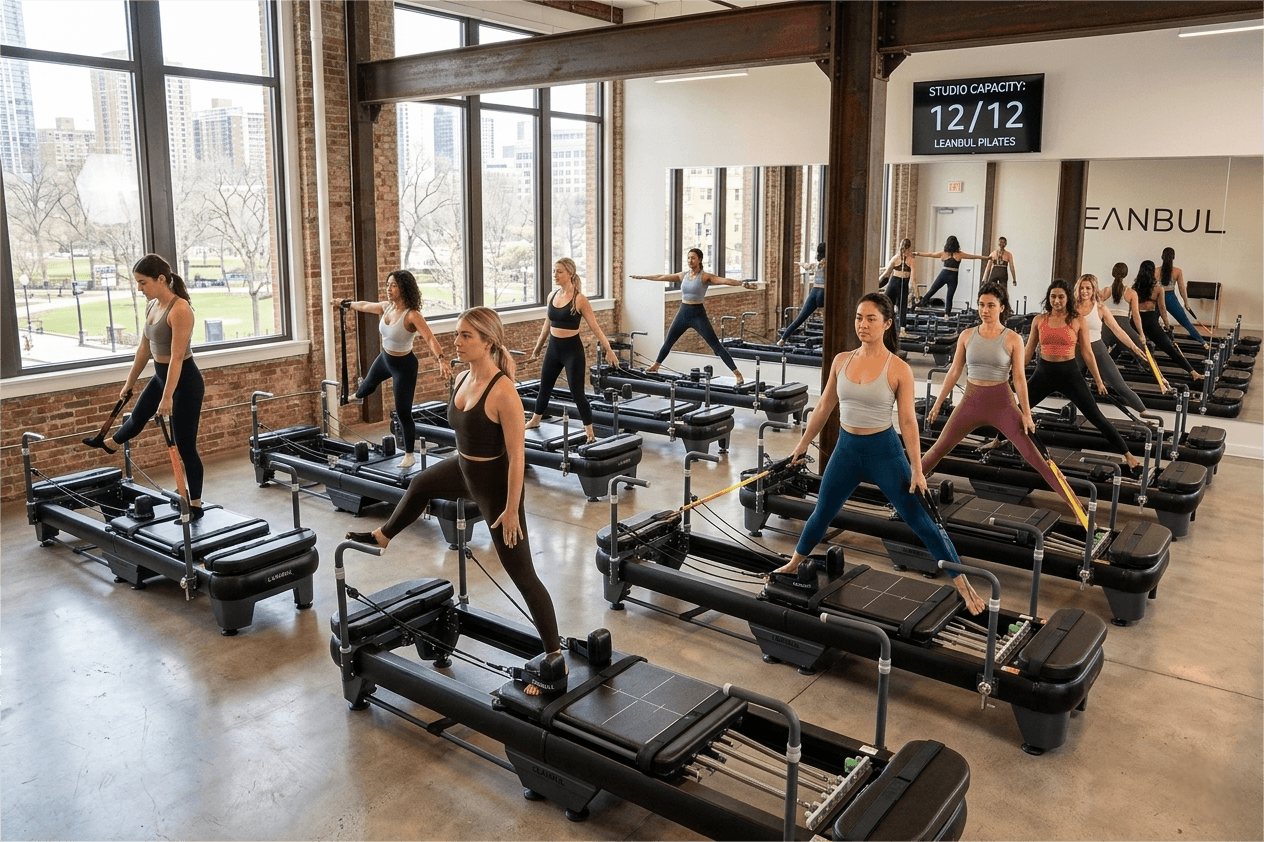
The pilates market in Bulgaria is one of the smallest in the EU by spend, and since 1 January 2026 it is also a euro market. Both facts matter if you are quoting equipment into it. Reformer sessions in Sofia sell for roughly €7 to €16 depending on the format, the rooms hold three to six machines rather than twelve, and the buyers are mostly first-time studio owners who have never signed an equipment contract before.
That combination makes Bulgaria unusual. It is not a market where you win by dropping a catalogue price by 5%. It is a market where the format decides the machine: a €7 screen-guided class and a €15 instructor-led class need different springs, different wear parts and different service economics.
This is what the market looks like from a manufacturer’s desk in Spain, with the numbers that actually decide purchases.
What changed on 1 January 2026
Bulgaria became the 21st member of the euro area, at the rate that had held under the currency board since 2020: 1 EUR = 1.95583 BGN. The lev and the euro circulated side by side for cash payments during January, and from 1 February the euro is the only legal currency in the country. Dual price display, which started in August 2025, runs until August 2026.
For a studio, the interesting part is not the banknotes. It is that every threshold in the tax code was converted at that fixed rate and now reads in euros:
| Item | 2026 value | Note |
|---|---|---|
| VAT standard rate | 20% | reduced rate 9% (hotel accommodation and a short list of goods/services) |
| Mandatory VAT registration threshold | €51,130 | taxable turnover per calendar year; 7-day deadline once crossed |
| EU distance sales threshold (OSS) | €10,000 | combined across member states |
| Corporate income tax | 10% | flat |
| Personal income tax | 10% | flat |
| Minimum wage | €620.20 | from 1 January 2026, up 12.6% |
| Self-employed minimum insurable income | €550.66 until 31 July, €620.20 from 1 August | maximum €2,300 |
| Self-employed contribution rate | 27.8% | 31.3% with voluntary unemployment cover |
The practical effect on equipment buying is simpler than the table. A Bulgarian studio can now read a Spanish, Italian and German quote in the same currency without doing arithmetic, and a euro loan matches euro revenue. If you are a supplier still publishing a lev price list, you are the only person in the room doing currency conversions.
One thing the euro did not change: purchasing power. Average gross pay was €1,444 a month in the second quarter of 2026, according to provisional national statistics office data, and €1,943 in Sofia-capital. A €15 reformer class costs about 1% of an average gross monthly salary. In Vienna the same class costs €28 to €38. That gap is the whole story of the market.
Who is actually teaching reformer classes
The mainstream gym layer in Bulgaria is consolidated and big-box. Pulse runs about 30 locations with more than 120 trainers and opened a 4,000 m² club in Plovdiv in May 2026. Next Level Club operates across Sofia, Pernik, Plovdiv, Varna and Burgas. Neither chain treats reformer as a core product the way a German or Dutch full-service club might; reformer lives in small studios instead.
Those studios look different from the Western European boutique template:
- Lava Lab (central Sofia) runs three reformers, by appointment only, with teachers certified through an international academy. Introductory offer: three classes in seven days for €47.
- UPREFORMER runs screen-guided reformer classes in Sofia, Plovdiv and Varna, 45 minutes, seven days a week, with two more Sofia sites announced. Its 30-visit membership is €199, or €6.63 per workout.
- Pilates Reformer 54 (Mladost 1) seats four people per room, 50-minute sessions, and carries a Cadillac and a chair alongside the reformers.
- Black Swan Pilates Studio in Sofia hosts BASI’s Mat & Reformer Flex programme, a $3,000 teacher-training course running in October 2026.
Two observations fall out of that list. First, the price leader in Bulgaria is not a franchise, it is a local screen-guided chain. Second, teacher training is being imported rather than built, which means the instructor supply is thin and expensive, and studios plan around few staff rather than many.
What the pilates market in Bulgaria charges per session
| Format | Studio example | Session price | Room size | Staffing |
|---|---|---|---|---|
| Screen-guided, membership tier | UPREFORMER, 30 visits for €199 | €6.63 | 4–8 machines | one host, no instructor per class |
| Boutique instructor-led, intro offer | Lava Lab, 3 classes for €47 | ~€15.70 | 3 machines | certified instructor per class |
| Small-group, 4 per room | Pilates Reformer 54 | priced on booking | 4 people per room | instructor per class |
| Chain clubs with reformer add-on | Pulse, Next Level Club | included in membership tiers | varies | group instructor |
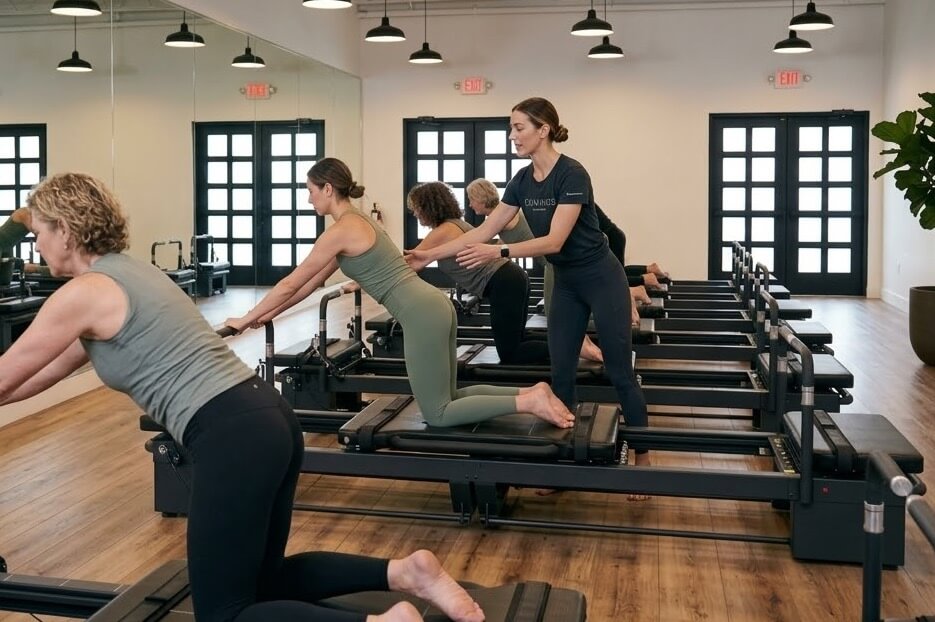
Run the arithmetic on an instructor-led class of four clients at €14 a head. That is €56 of revenue. Pay the instructor €20 to €25 for the slot and you keep €31 to €36 per class. A 110 m² Sofia unit at €12/m²/month plus utilities, insurance, booking software, accounting and the owner’s own social contributions lands around €2,400 a month in fixed cost. Divide: you need roughly 70 classes a month, about three a day six days a week, just to stand still.
That is why small rooms exist here. Six machines at €14 only works if you can fill them, and filling them at Bulgarian price levels takes a client base most first-year studios do not have.
The screen-guided model flips the equation. No instructor cost per class means €28 of revenue from four clients at €7 is already contribution. The format tolerates low utilisation per site, which is exactly why the chain can open a fourth Sofia location in a residential district rather than fight for a central address.
For a manufacturer, this splits the product requirement in two directions:
- Instructor-led boutique rooms need machines that stay quiet and consistent through five or six classes a day on one spring set, because a client paying €15 notices a grabbing carriage.
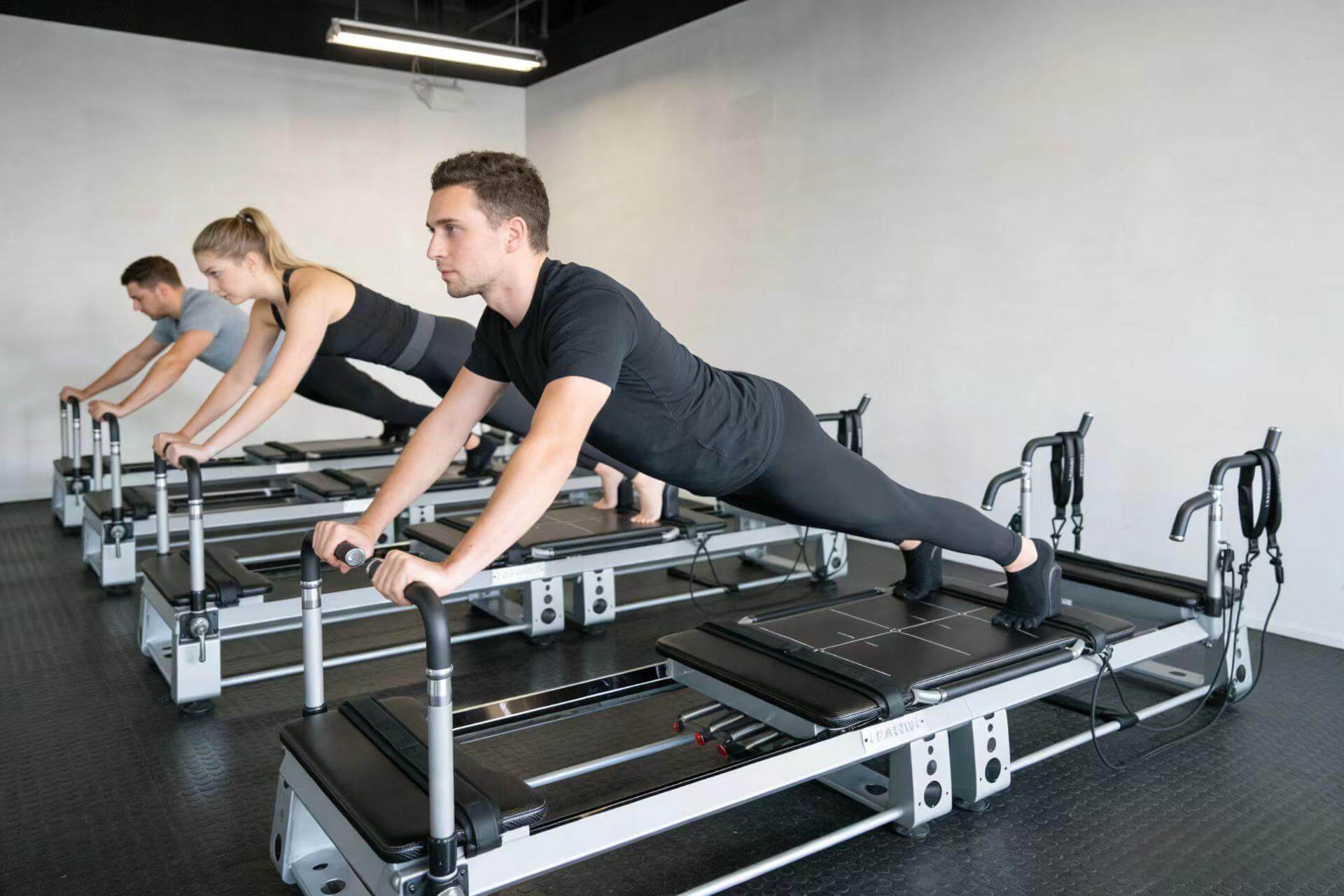
- Screen-guided rooms need machines that a first-timer can set up without help, with numbered spring positions, clear carriage stops and wear parts that cost little to replace, because €7 per visit does not carry a €250 spring set every eighteen months.
Both need the same thing underneath: a frame that survives being used by people who have never touched a reformer before. That is a design and warranty question more than a price question, and it is worth reading our notes on total cost of ownership before deciding where the cheap machine stops being cheap.
Smaller groups are now the European norm, and Bulgaria started there
Mariana Tek counted 15 million reformer bookings on its platform in 2025, up 66% on 2024. The same industry reporting shows studios cutting class sizes from twelve to eight or six machines, trading revenue per slot for retention.
Bulgarian studios never had twelve-machine rooms to cut. They opened at three and four. That is an advantage in one sense (less capital at risk) and a problem in another: at four machines, a single empty slot is 25% of that class’s revenue.
Bulgarian operators priced that in from the day they opened.
What a fleet costs, in euros, delivered
Factory-direct pricing for European studios sits in these bands, and the euro adoption means these numbers now go straight onto a Bulgarian budget sheet without a conversion line:
| Fleet | Machines | Factory-direct per machine | Equipment total | Typical room |
|---|---|---|---|---|
| Compact studio | 3 | €2,400–3,800 | €7,200–11,400 | 55–75 m² |
| Small boutique | 4 | €2,400–3,800 | €9,600–15,200 | 70–90 m² |
| Established studio | 6 | €1,900–3,500 | €11,400–21,000 | 90–130 m² |
Those are ex-works figures for machines ordered together. Freight inside the EU is a separate line of roughly €400 to €1,200 for a four-machine pallet delivery depending on distance and whether the unit has a lift. There is no customs clearance and no import duty, because this is an intra-Community supply.
VAT is where Bulgarian buyers leave money on the table. At 20%, a €12,000 fleet carries €2,400 of input VAT. A studio registered for VAT recovers it; a studio below the €51,130 threshold that never registered cannot, because voluntary registration is the only route to deduction. Order the machines after the registration, not before. Our import and landed cost guide covers the reverse-charge mechanics, and the open a studio in Bulgaria guide walks through the registration sequence in order.
Used machines are not the answer here that they are in Germany or the Netherlands. There is no developed second-hand reformer market in Bulgaria, no auction flow, no dealer refurbishment channel. A studio that buys used is usually buying from a closing studio in the same city, with no warranty and no spare parts line.
The compliance questions Bulgarian buyers have started asking
Three documents come up in procurement conversations now, and the third one is new this year.
CE marking with a declaration of conformity. The machine has to be tested to EN ISO 20957-1:2024 and, for commercial use, classified Class S. The declaration is the document that matters; a sticker proves nothing. We wrote a separate explainer on what CE certification means for EU studios.
A GPSR economic operator inside the EU. Since December 2024, Regulation (EU) 2023/988 requires a responsible person established in the Union for equipment placed on the market. A Bulgarian studio buying from Spain has that covered automatically. A studio buying direct from outside the EU does not.
EN 17229:2026, the fitness club standard. Published in March 2026, it sets requirements for how a club operates, supervises, selects and positions equipment, and what competence its trainers need. It applies to clubs open to the public, whatever their size. A four-machine studio is in scope. Insurance brokers and corporate clients have started asking about it, and we covered the practical reading in our EN 17229 breakdown.
What to watch into 2027
The VAT threshold may rise. A proposal under review would lift the mandatory registration threshold from €51,130 to €85,000 from 1 January 2027. If it passes, more small studios stay outside VAT, which cuts their admin but also removes their ability to reclaim VAT on equipment. Studios planning a fleet purchase in late 2026 should not wait for it.
Rent is the cost that moves. Sofia residential prices average around €2,300/m² with rents growing 5% to 8% a year. Commercial rents have been slower, but a studio on a three-year lease will feel the renewal. Class A office space in Sofia quotes around €9/m²/month and Class B around €5, though street-level units suitable for a studio trade higher; a 104 m² central unit we looked at lists at €1,700 a month.
Screen-guided capacity is expanding faster than instructor supply. Two more Sofia sites are announced by the price leader alone. That will keep downward pressure on class prices in the districts where it operates, and it will keep pushing instructor-led studios towards smaller, more expensive groups. If you are buying machines for Bulgaria in 2027, buy for the format you can staff, not the format you would like to run.
FAQ
Is Bulgaria in the eurozone now? Yes. Bulgaria adopted the euro on 1 January 2026 at 1 EUR = 1.95583 BGN, and the euro has been the only legal currency since 1 February 2026. Dual price display continues until August 2026.
How much does a commercial reformer cost in Bulgaria? Factory-direct for a studio ordering three to six machines: €1,900 to €3,800 per machine excluding freight, which is the same band as Spain, Italy or Germany because the machine crosses no border duty inside the EU. Local retail with a distributor adds margin on top.
How much do reformer classes cost in Sofia? Between roughly €7 and €16 per session. Screen-guided chains sell memberships down to €6.63 per workout; boutique instructor-led studios charge €14 to €16, often through an introductory pack.
Can a Bulgarian studio buy VAT-free from a Spanish manufacturer? Yes, with a valid VAT number the supply is treated as an intra-Community supply and the Bulgarian studio accounts for 20% VAT under the reverse charge, deducting it in the same return. Without a VAT number, the manufacturer has to charge Spanish VAT, which the studio cannot recover.
Do I need EN ISO 20957 Class S for a studio in Bulgaria? For commercial use, yes. Class S is the commercial classification under EN ISO 20957-1:2024, and using a home-rated Class H machine in a paid class is exactly the mismatch insurers look for after an incident.
Buying for a Bulgarian studio
If you are fitting out a room in Sofia, Plovdiv or Varna, send us the floor plan, the number of class slots per day and whether the format is instructor-led or screen-guided. Those three answers change the spring set and the wear-part plan more than the budget does.
O K30 is the machine most Bulgarian boutiques end up with: three to six units, a footprint that fits a 70–90 m² unit, and springs sized for group classes. The K10 is the compact option for a two- or three-machine room, and the K38 is for high-traffic rooms where the carriage runs eight hours a day. We build in Spain, ship across the EU without customs, and quote in euros with the VAT treatment written on the quote.
Start with the contact form, or look through the full collection and the studio fit-out service if the project includes room planning. If you are comparing this market with its neighbours, the Romanian market guide is the closest reference point on price level.
