How to Move a Pilates Reformer: Transport, Re-Assembly and Re-Commissioning in Europe
Learning how to move a pilates reformer is mostly a measurement problem before it is a lifting problem. A commercial machine is a 90–140 kg object roughly 2.3 to 2.5 metres long, and the two things that decide whether the move goes well are the width of your new stairwell and whether anyone thought to take the carriage off before carrying it. Get those two right and the rest is an afternoon with blankets and a spanner. Get them wrong and you are buying a rail.
This is written from the other side of the transaction. We build commercial reformers in Spain and ship them across Europe, and every month we get the same call: a studio is relocating, the machines are already on a van, and something has gone wrong that a twenty-minute survey would have caught.
Decide first: move the fleet, sell it, or replace it
Do this arithmetic before you book anything, because the answer changes what you need on moving day.
Take a six-machine studio with commercial reformers bought new at around €2,900 each. The move itself (two people, a tail-lift van, 200 km, packing materials, transit cover) lands somewhere between €900 and €1,700 for the day. Add two closed days and you are at €2,000 to €2,800 all in, or roughly €350 to €470 per machine.
Selling and rebuying is not close. Five-year-old machines from a known European brand hold 40–55% of retail, so you would recover €7,000 to €9,600 on the six and spend €17,400 replacing them, plus €400 to €1,200 in delivery. Moving wins by a factor of four.
| Fleet situation | Do this | Why |
|---|---|---|
| Under 6 years, frames sound | Move them | Replacing costs 4× the move |
| 6–8 years, high-hours commercial use | Move, but budget springs and upholstery | €120–250 per spring set, €200–450 per re-cover |
| Over 8 years, or rails already rough | Sell before you move | You are paying to transport scrap |
| Room count is changing anyway | Re-plan the fleet, don’t move a fixed count | The move is the cheapest moment to change machine count |
That last row is the one people miss. You are paying for a van and two people regardless. Adding or dropping a machine on the same trip costs a slot on the pallet, not a second delivery. If you have been putting off the decision to go from six to eight, the move is when it becomes cheap.
What a reformer actually weighs, and what that does to the plan
Manufacturers quote unit weight, which is not the number you need. You need the weight of the heaviest single piece you will actually lift, and the size of the space it has to pass through.
| Machine type | Unit weight | Heaviest single piece | People needed | Transport notes |
|---|---|---|---|---|
| Home / light commercial | 50–70 kg | Frame, one piece | 2 | Fits a large estate car with seats down |
| Studio commercial | 90–110 kg | Frame with carriage removed | 2 + trolley | Van; carriage out first |
| Premium / tower combination | 120–140 kg | Frame | 2–3, or 2 + tail lift | Tail lift strongly preferred |
A 100 kg frame carried by two people is 50 kg each, held at knee height, around a corner, on a floor that may be marble. The EU directive on manual handling of loads (90/269/EEC) does not set a legal kilogram limit, and that is deliberate: it requires employers to avoid manual handling where it can reasonably be avoided and to assess the risk where it cannot. Two people and a trolley is the assessment most studios should be writing down, especially if anyone on the team has a back history.
Survey the route before you book the van
Walk the route from the old room to the new one with a tape measure and write the numbers down. This takes fifteen minutes and it is the difference between a move and a scene.
- Every doorway on the route, including the lift lobby and any interior door you assumed was wide enough. A standard European interior door is 80 cm clear; a reformer on its side is 40–50 cm wide, so most doors pass. The frame plus a blanket plus two pairs of hands does not always.
- Stair turns and half-landings. The pinch point is never the stair width, it is the corner where the handrail ends.
- Lift dimensions, and whether the building will let you use it. Interior lift typically 1.0 × 1.3 m; a 2.4 m machine only goes in diagonally, and often not at all.
- The kerb to door distance. Cobbles, a 15 cm step, a bike rack. A pallet truck needs a hard, flat surface; a tail lift needs the van to park within about 5 m.
- Whether the new room’s floor can take it. Six machines plus six clients is roughly 900 kg spread over maybe 30 m². Timber joists in a converted flat are a different proposition from a ground-floor slab. If the lease does not mention floor loading, ask.
- Lift access hours and building permission. In Spain and Italy this is often a written request to the comunidad or amministratore. Allow a week.
If the machine will not fit the lift and the stairwell is tight, the answer is usually to remove the legs and pulley posts, which turns the frame into a flat 2.4 m slab you can stand on end and pivot. That works on most commercial models. Ask the manufacturer whether the legs are load-bearing bolted assemblies with a torque spec, because you will need to re-torque them on the other side.
How to move a pilates reformer: the order of work
Work in this order. It is reverse order of assembly, and it is the same order in the service manual.
- Photograph everything first. Pulley post height, rope routing through the guides, spring positions on the bar. Your phone is the assembly manual you will actually use.
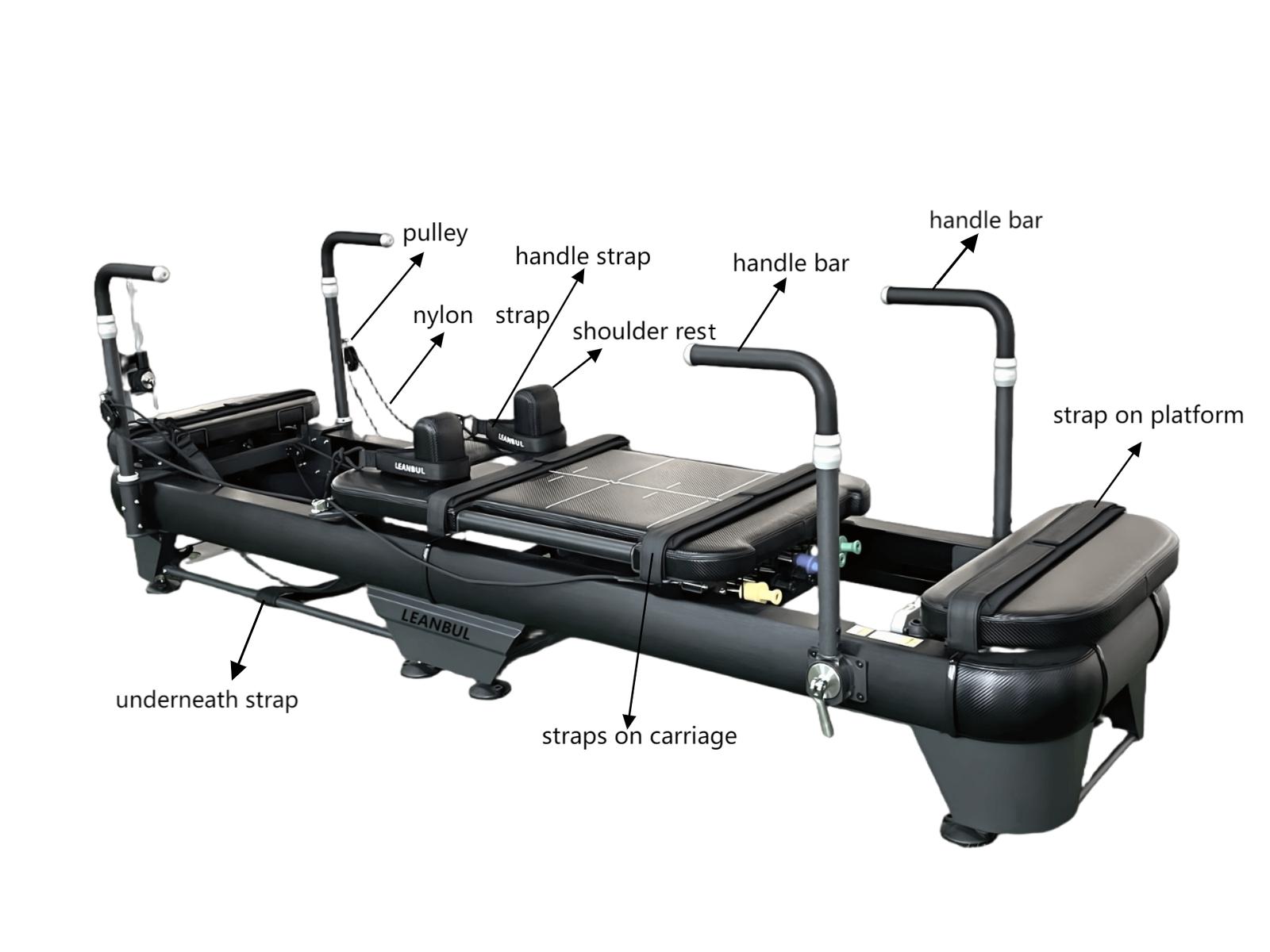
- Take the ropes off the pulleys and let them hang. Mark pulley post height with tape before you loosen anything.
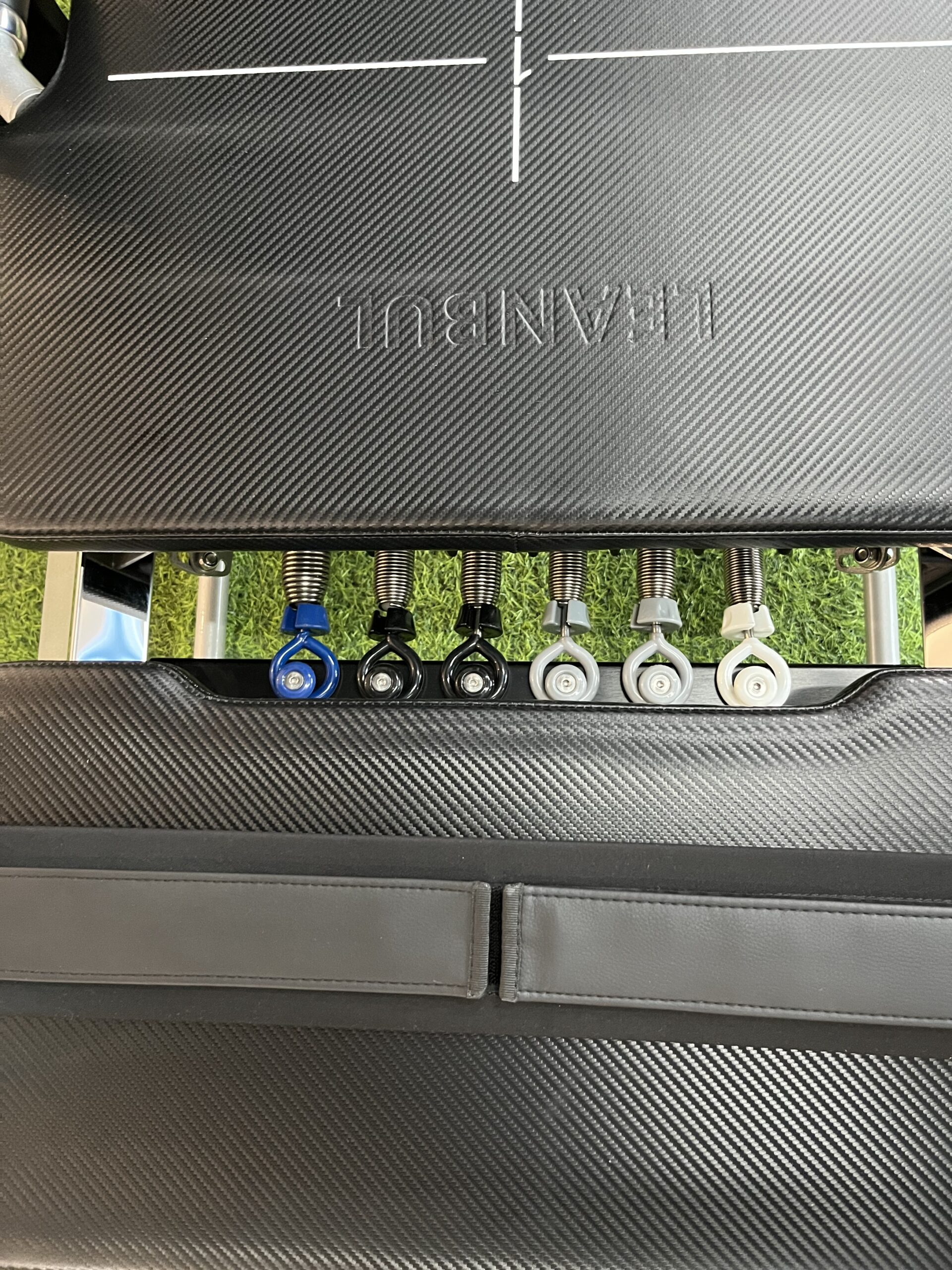
- Unhook every spring from both ends and set them aside as a set, not scattered.
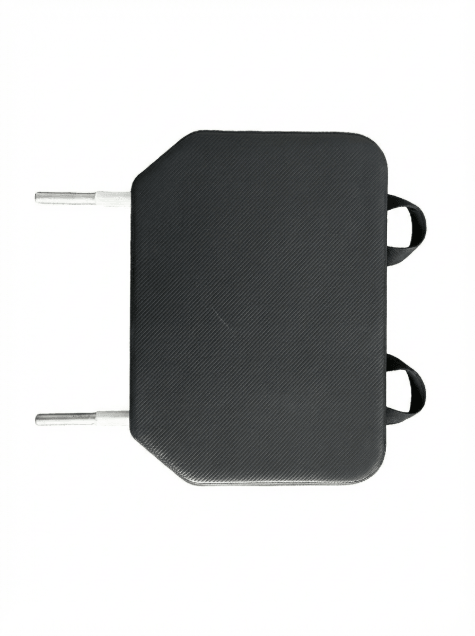
- Remove shoulder rests, headrest and any quick-release fittings. They are the parts that go missing.
- Lift the carriage off the rails. Two people, one at each end, keeping it parallel to the rails until it clears. Do not drag it off at an angle; you will chip the rail ends.
- Remove the risers and pulley posts if the route needs the height.
- Remove the legs or feet only if you must. Re-fit to torque, not to “tight”.
Two things you should not touch: the rail-to-frame bolts e any riveted or welded joint. Those bolts set the geometry of the whole machine. If they come loose you need a straight edge, a torque wrench and the manufacturer’s numbers to put it back, and “it looks straight” is not a calibration.
De-tension the springs, and leave them off
Springs are the cheapest part of the machine and the easiest to ruin in transit.
Hook them off completely. A coil spring left at extension for a week does not fail dramatically, it just gets softer, and it gets softer unevenly across the set. You will not notice at first. You will notice in month four when the resistance feels different on the left side of the bar and nobody can say why.
Keep the set together and label it. A matched set means same free length and the same wire diameter. Swapping positions between machines after a move is how studios end up with one machine that feels heavier than the other five at the same spring count.
If the springs are already two years old and the machines are going into a new room with a full class schedule, replace them during the move rather than after. A commercial spring set runs €120–250 per machine, and doing it while the machine is already apart costs you nothing in labour.
Loading and strapping: four rules that prevent most damage
Nothing on the carriage, ever. Not a box of blankets, not a bag of springs, not a laptop. Foam under vinyl takes a permanent set: an indent that never comes back. It happens in an hour under 20 kg in a warm van. Merrithew makes the same point about using wheeled reformers as trolleys, and it applies to every brand.
Strap the frame, never the rails. Soft straps over the frame ends or the leg assemblies. A ratchet strap over the mid-span of an aluminium rail will dent it, and a dented rail is a carriage that rumbles for the rest of the machine’s life.
Do not use the machine’s own wheels as a dolly. They are sized for a carriage, not for a 100 kg frame on a sloping pavement.
Watch the temperature. A closed van in an Andalusian August passes 60°C inside. Vinyl adhesive softens, foam takes a set, and wooden frames move with the humidity swing between a dry van and a coastal studio. Move early in the morning, keep the doors open during loading, and do not leave a loaded van parked in the sun for a lunch break.
Re-commissioning: the twelve-point checklist
Do this before the first client walks in, not after the first complaint.
- Run a straight edge along both rails. Any dent or bow you can see is a carriage problem you will feel.
- Check every bolt you undid with a torque wrench. Legs, risers, pulley posts.
- Seat the carriage on the rails and check lateral play. It should move a millimetre, not knock.
- Re-hang the springs in their labelled positions and confirm the set is complete.
- Reset rope length equal on both sides, then check the rope sits in the pulley groove rather than on the flange.
- Work the footbar through every position and confirm a positive lock on both sides.
- Seat the shoulder rests and rock them. Any movement means the fitting is not fully home.
- Test the headrest ratchet through its full range.
- Level the machine with a spirit level across the rails and along them. Adjust the feet, not the frame.
- Run the carriage through full travel, unloaded, listening for rumble or a change in pitch at one spot.
- Load it: 30 slow reps at maximum spring with someone on the carriage, then re-check bolts and play.
- Log the move date and every serial number in your asset register. You will need it for insurance and for warranty claims.
That is an hour per machine if you are doing it properly, or about a day for six with two people. Budget the day. A studio that reopens the morning after the move with half-checked machines will find the problems in front of paying clients.
Warranty, CE paperwork and insurance after a move
Three separate things get confused here, and the confusion costs money.
Warranty. Moving your own machine does not void a frame warranty. Damage caused during the move is not a warranty claim either. It is a transit claim. Those are different policies and only one of them is likely to pay.
CE and conformity. Reassembling a machine according to the manufacturer’s instructions does not require new CE marking. The machine was placed on the market once, with a declaration of conformity to EN ISO 20957-1:2024 at Class S for commercial use. What you should keep, per machine, is the declaration of conformity and the serial number. Under the General Product Safety Regulation (EU) 2023/988, traceability matters, and a future buyer of your fleet will ask for exactly those documents.
What does change the picture is structural modification. If you weld a bracket on, cut a rail, or fit a tower the machine was not designed for, you have made a different product and the paperwork no longer describes it.
Insurance. Tell your insurer the address changed, in writing, before you move. A studio policy written for one premises can be void at another, and a fire or a burst pipe in an unoccupied new unit is exactly the claim where an insurer checks the schedule. Check separately whether you have goods-in-transit cover for the day itself. Many studio policies exclude it, and the van hire company’s cover protects the van, not your cargo.
What actually goes wrong, and what it costs to fix
These are the six failures we see or hear about most, with typical European workshop prices.
| Damage | How it happens | Typical fix |
|---|---|---|
| Torn or indented upholstery | Parts stacked on the carriage; dragging past a door frame | €200–450 re-cover with labour |
| Dented rail | Strap over the rail mid-span; dropped at a kerb | Rail replacement, €300–700 with labour |
| Bent pulley post | Machine tipped over with posts still fitted | Post and realignment, €80–200 |
| Uneven spring set | Springs left hooked under tension in transit | New matched set, €120–250 |
| Frame out of square | Someone “tightened everything” on arrival | Workshop realignment, €150–400 |
| Damaged footbar lock | Loaded with the footbar in the down position | €90–250 |
Add the cost of the days you cannot teach and the cheapest item on that list stops looking cheap.
When the move is the moment to change the machine
A relocation is the only time in a studio’s life when the marginal cost of changing your fleet is close to zero. The van is going anyway, the crew is booked anyway, and the machines are already in pieces.
Three questions worth asking while they are apart. Are the rails still straight, checked with a straight edge rather than a glance? Are the spring sets still matched after however many years of classes? And does the new room’s layout want the same footprint you had in the old one, since a 2.4 m machine needs 30–40 cm of working clearance around it, and a room that was fine at six machines may be comfortable at five with better sightlines.
If the answers point to replacement, the economics work better than most studios expect when you sell the old machines rather than storing them. If they point to keeping, the €120–250 spring set and a €200–450 re-cover will buy you another four or five years on a frame that was built for fifteen.
Either way, plan the new room properly. Our K30 commercial reformer e K38 premium reformer pages list the unit and crated dimensions you need for the survey, and the studio solutions section covers layout and machine count for rooms from four machines up. If you are planning a move or a re-equip and want the dimensions and weights for your specific route, send us the measurements and we will tell you whether it fits in the lift.
FAQ
Can two people move a pilates reformer? Yes, up to about 110 kg with the carriage removed, on a flat route. Above that, or with stairs and corners, use a tail-lift van or a third person. Two people carrying a 140 kg machine down a stairwell is how backs and rails get broken.
Do I have to take the springs off to move a reformer? Yes. Hook them off both ends and keep the set together and labelled. Springs stored at extension lose tension unevenly, and an uneven set is the most common reason a machine “feels different” after a move.
Does moving a reformer void the warranty? Moving it does not. Damage during the move is not a warranty matter, though. That is transit insurance. Keep the serial number and the declaration of conformity with each machine either way.
Can I move a reformer in a car? A home reformer at 50–70 kg, possibly. A 2.4 m commercial frame, no. A van with a tail lift costs less for one day than the rail you will otherwise replace.
How long does it take to move six commercial reformers? One day to strip, load and drive, one day to reassemble, level and test. If you skip the second day, you will spend the following week finding the things you skipped.
