Hot Pilates Humidity: Why the Room Gets Slippery and the Springs Rust Overnight
Hot pilates humidity is the number that decides whether the room feels energising or like a swimming pool with reformers in it. At 34 °C and 40% relative humidity the room is comfortable. At the same temperature and 75%, the carriage feels greasy, towels stop working, and the springs show orange bloom within a season.
The difference between those two rooms is not the heater. Heaters raise temperature, and warm air holds more water — which is why the humidity reading drops for the first twenty minutes after you switch on, then climbs back up and stays there. Nothing in a heater removes water. Twelve people sweating through a 50-minute class put roughly 8 to 10 litres of water into the air. That water has to leave the building, or it lands on your mirrors, your walls, your upholstery and your spring anchors.
This is the part of hot-room design that gets skipped, because the equipment conversation usually stops at “can the machine take the heat”. The answer to that is yes. The better question is what the room does to the machine between classes, at night, over three years.

Hot pilates humidity in numbers: the arithmetic of a sweaty room
Sweat rates during exercise typically fall between 0.5 and 2.0 litres per hour, with around 1.2 L/h as a common average across trained adults and considerably more in heat. In a hot room, assume 0.7–0.9 L/h for a mixed class.
Do the sums on a 12-station room, 120 m² with a 2.7 m ceiling (about 324 m³ of air):
| Quantity | Figure |
|---|---|
| Water vapour in the air at 34 °C / 50% RH | ≈ 6 kg |
| Water vapour at 34 °C / 60% RH | ≈ 7.5 kg |
| Sweat from 12 clients at 0.8 L/h | ≈ 9.6 kg/h |
| Water the air can hold at 34 °C when saturated | ≈ 13 kg |
Read the first and third rows together. A full class adds 9.6 kg of water to air that is already carrying about 6 kg, and the room only has 7 kg of headroom before the air is saturated. In a sealed room the excess condenses within the hour on the first cold surface it finds. In practice that is the window glass, the mirror frames, the outside wall, and the underside of the rails.
Ventilation is the removal mechanism, and this is where most small studios are undersized. The European indoor-environment standard EN 16798-1:2019 suggests design ventilation around 10 L/s per person for the highest category and 7 L/s for the middle one; ASHRAE 62.1 puts gym and sports areas at 10 L/s per person plus 0.9 L/s per m². Take 7 L/s × 12 people = 84 L/s, or about 300 m³/h.
Now check whether that can carry the sweat:
| Airflow | Moisture difference it can exploit | Water removed per hour |
|---|---|---|
| 84 L/s, supply 13 g/kg, exhaust 20 g/kg | 7 g/kg | ≈ 2.5 kg/h |
| 84 L/s with exhaust near saturation | 21 g/kg | ≈ 7 kg/h, at a room that feels like a bathroom |
| 250 L/s with exhaust at 20 g/kg | 7 g/kg | ≈ 7.5 kg/h |
In other words, ventilation sized for comfort removes roughly a quarter of the sweat load while holding 60% RH. To remove all of it by air alone you need three to four times the airflow, which most small studios cannot duct and which costs more to run than a dehumidifier. The practical answer is a combination: enough fresh air for CO₂ and body odour, plus mechanical dehumidification for the water.
What 60% actually means, in dew point
Relative humidity on its own tells you very little. What matters is the dew point: the surface temperature at which water starts condensing out of the air.
At 34 °C and 60% RH, the dew point is about 25 °C. Any surface below 25 °C gets wet. In a Spanish or Greek summer that is almost nothing. In a German or Polish January it is every window, every mirror on an external wall, every metal frame near a cold corner, and the rails themselves if the room cools down overnight with the heating off.
This is why hot studios tend to corrode equipment in winter, in buildings that look fine in spring. The damage is not happening during class when the room is at 34 °C — it is happening at 2 a.m. when the room has dropped to 18 °C, the air is still carrying yesterday’s moisture, and every steel part is below the dew point.
Two practical consequences:
- Do not let the room go cold overnight without drying it first. Run the dehumidifier for 45–60 minutes after the last class, before the heating drops.
- Watch the surfaces, not just the air. A cheap hygrometer on the wall will read the air at head height. A €30 logger placed near the floor and near the window tells you what the building is actually doing.
What moisture attacks first, in order
Reformer fleets in hot rooms fail in a predictable sequence, and it is not the frame.
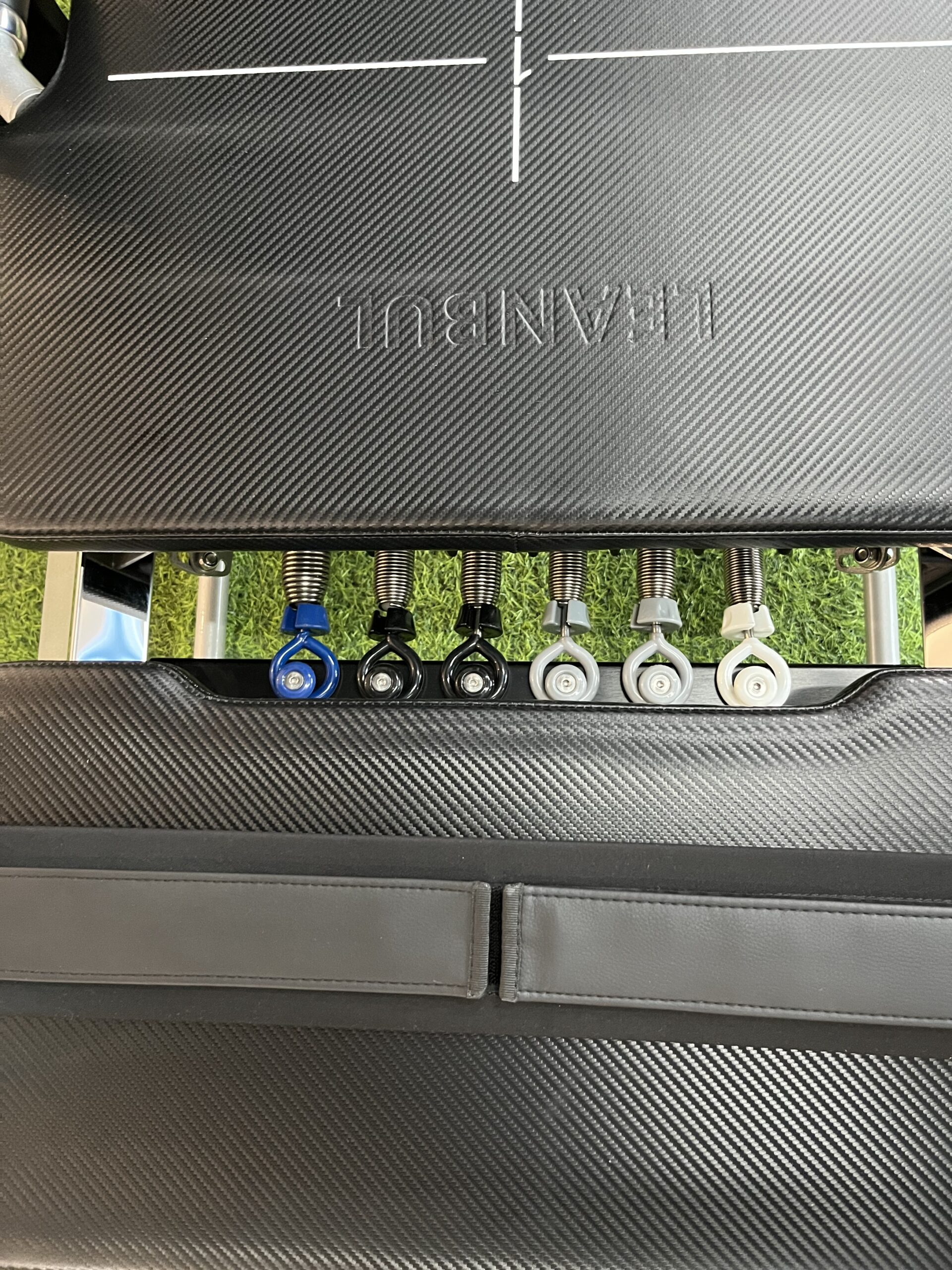
- Springs. Sweat is salt water — roughly 800–1,200 mg of sodium per litre. Chlorides plus moisture plus a stressed steel coil is the classic corrosion-fatigue recipe. Springs that would give 24 months in a dry studio can lose tension noticeably faster in a room that sits above 70% RH, and the first sign is not rust, it is a class that suddenly feels different on one side.
- Spring anchors and hooks. Usually plated steel rather than stainless. They corrode first because they are small, hidden and never cleaned.
- Rails and carriage wheels. Surface rust on a chrome or zinc rail raises friction and starts chewing the wheel. Anodised aluminium rails and sealed bearings do not care; unprotected mild steel does.
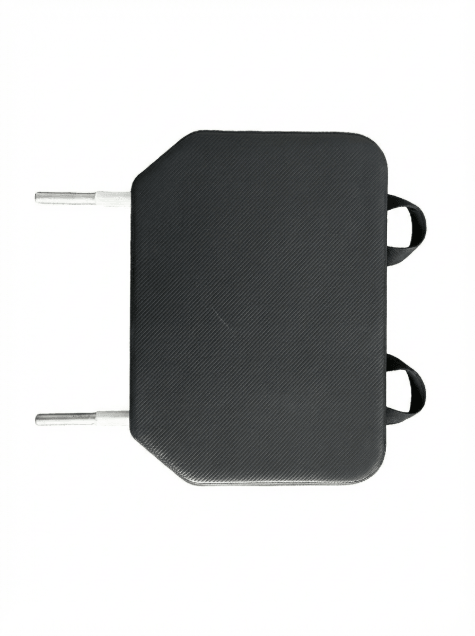
- Upholstery and foam. Vinyl is a vapour barrier on the outside only. Sweat wicks through stitching, and open-cell foam holds it. Once the foam is wet it stays wet, smells, and compresses permanently.
- Bolted joints and fasteners. Corrosion in a thread changes torque values, and a machine that no longer holds its settings is a warranty conversation you will lose.
- The building. Mould on the ceiling corners, plaster blowing behind the mirrors, and a landlord who now has an opinion.
What to specify if you are buying for a hot room
Most reformer specifications are written for a dry studio. A hot room needs a slightly different list, and it costs very little to ask for it at the quotation stage.
| Specification | Why it matters in a hot room |
|---|---|
| Aluminium frame, anodised or powder-coated | No swelling, no delamination, no timber movement at 35 °C |
| Stainless or properly passivated spring anchors | The first thing to corrode, and the cheapest thing to get right |
| Sealed bearings in wheels and pulleys | Sweat and cleaning fluid kill open bearings |
| Closed-cell foam in the carriage | Does not hold water, does not grow anything |
| Removable, washable covers | Zipped covers can be laundered; stapled covers cannot |
| Water-resistant grease at service | Standard grease emulsifies and runs |
| Documented humidity range | Ask the manufacturer what RH range the warranty assumes |
That last row is the one nobody asks about. A warranty that excludes “corrosion” without defining the humidity the machine was designed for is not a warranty in a hot studio; it is a negotiation. Get the number in writing, and if the room is designed to run at 40–60% RH, say so in the purchase order.
Sizing the dehumidifier without guessing
Dehumidifier capacity is usually quoted at 30 °C and 80% RH. That number is not the number you get at 34 °C and 60%, because what a refrigerant dehumidifier removes depends on absolute moisture, not on relative humidity. At 30 °C / 80% the air carries about 21.5 g/kg; at 34 °C / 60% it carries about 20 g/kg. Those are close, so a unit rated at 30/80 will deliver something in the same range at 34/60. If your room actually runs at 34 °C and 50% (about 17 g/kg), expect 20–25% less than the label.
Three rules:
- Size on litres per hour during a class, not litres per day. You need roughly 6–8 L/h of removal capacity for a 12-station room running back-to-back classes, and a unit that only achieves that in a 30 °C / 80% laboratory is not the right unit.
- Condensation heats the room. Removing water releases the latent heat back into the air — about 0.68 kWh per litre. Pulling 7 L/h adds roughly 4.8 kW of heat. In a hot studio that is free heating; in summer it is a cooling load you did not plan for.
- Drain continuously. A unit with a 5-litre tank in a studio producing 30 litres a class is a part-time job, not a solution.
Budget for a unit in the low four figures for a room this size, installed with a permanent drain and a humidistat. That is less than the cost of replacing one reformer’s springs, upholstery and rails at year five.
The daily routine that keeps a hot room honest
| When | What | Why |
|---|---|---|
| During class | RH 40–60% at 32–35 °C, logged every 5 minutes | Catches a failing unit before the room does |
| Between classes | 10-minute purge at full fan, dry mop the floor | Removes the bulk of the water and the slip risk |
| After the last class | 45–60 minutes of dehumidification before heating drops | Prevents overnight condensation on cold metal |
| Weekly | Wipe upholstery with pH-neutral cleaner, dry fully, inspect spring anchors | Salt sits on surfaces, not inside them |
| Monthly | Wipe rails dry, check wheel play, check fasteners | Corrosion shows as friction before it shows as rust |
| Quarterly | Clean dehumidifier filters, check condensate drain, verify the RH sensor | A drifted sensor makes the whole system lie |
Two habits worth banning: leaving wet towels on the carriage between classes (the foam takes days to dry), and using the room as storage for mats and bolsters that then sit damp against the frames.
The honest version
Hot pilates is a good business and a demanding room. The machines are not the fragile part — a properly built commercial reformer in aluminium will take 35 °C all day. What it will not take is being stored in a damp box for eight hours a night, twelve months a year, and then being blamed for corroded springs at year two.
If you are fitting out a heated studio, treat moisture as a design input alongside airflow and sound. Our guides on hot rooms and machine spec e studio ventilation cover the other two sides of the same problem; between them they are the difference between a room that runs for a decade and a room that eats equipment.
FAQ
What humidity should a hot pilates studio run at? 40–60% relative humidity at 32–35 °C is the working range most hot studios target, and the range most equipment warranties implicitly assume. Below 40% the air is dry enough to irritate airways; above 60% you are accelerating corrosion and creating condensation on any surface below the dew point.
Can I just run a heater and open a window? You can raise the temperature, but a heater adds no removal capacity and an open window in winter creates exactly the cold surfaces that condense. Opening a window between classes helps purge CO₂ quickly; it does not solve a moisture problem across a day of classes.
Will humidity damage my reformers? Not the frame, if it is aluminium. It will attack plated spring anchors, unprotected rails, open bearings and open-cell foam, and it will make springs lose tension faster. The failure shows up as inconsistent resistance long before it shows up as visible rust.
Do I need a commercial dehumidifier or will a domestic one do? A domestic unit can hold a small room if it drains continuously and runs all day, but the capacity numbers on the box are measured in conditions your room will not match. For 10–12 stations running several classes a day, size on litres per hour and buy a unit with a permanent drain.
Is sweat corrosive on its own? Sweat is a dilute salt solution, and chlorides are what attack steel. On a wiped, ventilated machine it is a non-issue. On a machine that sits damp overnight with salt residue in the anchors and threads, it is the main reason springs and fasteners fail early.
Fitting out a heated room?
We build commercial reformers in Spain and ship them across Europe, and we would rather sell you a machine that survives your room than one that survives the showroom. If you are planning a heated studio, tell us the design temperature, the humidity target and the class turnaround, and we will tell you which specification we would put in it — including what our warranty assumes about moisture.
Start with our contact page for a specification conversation, or see the K30 for most boutique hot rooms and the K38 where the frame and the client load call for more machine. Full studio fit-outs, including fleet sizing and delivery access, are covered under studio solutions. Leanbul is a Spain-based manufacturer; every machine ships with its serial number and declaration of conformity.
