How to Open a Pilates Studio in Poland in 2026: Legal Steps, VAT, Costs and Equipment
Opening a Pilates studio in Poland in 2026 comes down to a short list: pick a legal form, register with the state, sort out VAT and ZUS social contributions, sign a lease, and buy the reformers. The country is genuinely attractive for it. Fitness penetration is only around 7%, the major chains are still expanding, and reformer Pilates is one of the fastest-growing boutique formats in the big cities. What catches new owners out is not the paperwork but the fixed costs, above all the ZUS contributions that run whether or not a single client walks in.
This is the practical route from idea to open studio: legal form, registration, taxes, rent, insurance, and the equipment decision that quietly determines whether the numbers work.

Step one: choose a legal form
Poland offers two realistic routes for a studio, plus a heavier one for operators planning to scale.
| Form | Polish name | Share capital | Liability | Best for |
|---|---|---|---|---|
| Sole proprietorship | JDG (jednoosobowa działalność gospodarcza) | None | Unlimited | A single owner-operator, first studio |
| Limited company | sp. z o.o. | PLN 5,000 | Limited to capital | Studios with partners, investors, or growth plans |
| Joint-stock company | S.A. | PLN 100,000 | Limited | Larger enterprises, rarely relevant at studio scale |
The sole proprietorship, registered in the CEIDG register, is free and quick, and it is how most instructors start. The trade-off is unlimited personal liability, which matters in a business where clients exercise on machines under supervision. A limited liability company costs more to set up and run but walls off your personal assets, and if you plan to bring in a partner or a bank loan, it is usually the better foundation.
EU and EEA citizens can set up in Poland on the same terms as Polish nationals. Non-EU founders can also register an sp. z o.o. or a branch. The one practical hurdle for the online route is that it wants an eIDAS-qualified electronic signature; without one, the notary route is the fallback.
Step two: register the business
For a sole proprietorship, the whole thing runs through the CEIDG system, and it is free.
For a company, the process is:
- Draft the articles and register online via the S24 portal (about PLN 350) or execute them before a notary (roughly PLN 800–1,500), plus the court registration fee of about PLN 600.
- File the motion with the National Court Register (KRS).
- Receive the KRS number, plus an NIP tax number and a REGON statistical number, which are issued automatically through the filing.
- Open a Polish business bank account and deposit the share capital.
- Register for VAT if your activity requires it from day one.
Timelines vary: online registration can complete in a few days, while the notary route, a bank account and tax registrations can stretch to several weeks.
Step three: get VAT right
Poland’s standard VAT rate is 23%, with reduced rates of 8% and 5% for certain goods and services. The registration threshold is the number to know: it was PLN 200,000 and rises to PLN 240,000 from 1 January 2026, roughly €55,800, as the Tax Foundation notes.
Three practical points:
- Below the threshold you can stay outside the VAT system, but you then cannot reclaim the VAT on your equipment. Given the price of a reformer fleet, most studios register voluntarily so they can recover input VAT.
- Poland applies a reduced 8% rate to many sport and recreation services and the standard 23% to most other commercial services. Which bucket a given studio lands in depends on how the activity is structured, so confirm the treatment for your specific offering with an advisor before you set prices.
- Watch the e-invoicing rollout. Poland’s KSeF national e-invoicing system is being phased in, which changes how you issue and store invoices.
Step four: budget for ZUS and income tax
For a sole proprietor, ZUS social contributions usually cost more than income tax, and they arrive from month one. The 2026 full contribution is PLN 1,926.76 a month, or PLN 1,788.29 without the voluntary sickness element. Three reliefs soften the start:
- Ulga na Start: the first six months are exempt from social contributions.
- Preferential contributions: the next 24 months run at a reduced rate starting around PLN 456.18.
- Mały ZUS Plus: after that, if your previous-year revenue was under PLN 120,000, contributions scale with your income for up to 36 months in any 60-month window.
On top of ZUS there is the health contribution, which is set at 9% of income under the tax scale or 4.9% under the flat 19% rate, with a monthly floor of PLN 432.54 for the period from February 2026.
Income tax depends on the regime you choose. A sole trader can use the progressive scale (12% up to PLN 120,000 of income, 32% above), a flat 19% rate, or lump-sum taxation (ryczałt) where a single percentage applies to revenue. For service businesses with low costs, ryczałt is often the simplest to administer. A company, by contrast, faces corporate income tax: 19% standard, or 9% for small companies under the revenue limit, with the option of the deferral-based Estonian CIT for some structures.
| Item | 2026 figure | Note |
|---|---|---|
| Full ZUS | PLN 1,926.76 / month | With sickness contribution |
| Start-up relief | First 6 months | Exempt from social contributions |
| Reduced contributions | From PLN 456.18 / month | Following 24 months |
| Health contribution floor | PLN 432.54 / month | Feb 2026 – Jan 2027 |
| VAT threshold | PLN 240,000 | From 1 January 2026 |
| Minimum wage | PLN 4,806 gross / month | Reference for staffing costs |
Step five: find and lease the right space
Rent is the fixed cost that decides whether a studio thrives or merely survives. Prime Warsaw office space runs about €19 to €27.50 per square metre per month at the Class A end, with premium floors above that; service and retail units in residential districts sit lower and are usually the better fit for a studio, because clients come from the neighbourhood, not the central business district.
A Polish commercial lease (umowa najmu) typically combines the headline rent with a service charge (opłata eksploatacyjna) covering common areas, plus utilities, and landlords commonly ask for a deposit of a few months’ rent. Read the terms carefully: rent indexation, the notice period, and any fit-out obligations all shift your break-even.
On space, plan about 3 metres by 1.5 metres of working area per reformer plus circulation between machines. A six-reformer boutique with a small reception and storage usually needs between 90 and 130 square metres. Confirm the local zoning permits a service business before you sign, and check that a room full of moving machines will not create a noise complaint in a mixed residential building.
Step six: insurance and compliance
Three cover lines matter for a reformer studio:
- Business liability (OC działalności) for injury to clients and damage to third parties.
- Property and contents cover, valued at replacement cost, for the machines.
- Product liability (OC produktu), which is the supplier’s responsibility, but which a studio should be able to point to.
On the equipment side, a commercial studio should buy machines certified to EN ISO 20957 Class S with a declaration of conformity on file. The newer EN 17229:2026 framework for fitness clubs is also worth reading, since it touches equipment selection, supervision and space planning. We covered the detail in our EN 17229 guide.
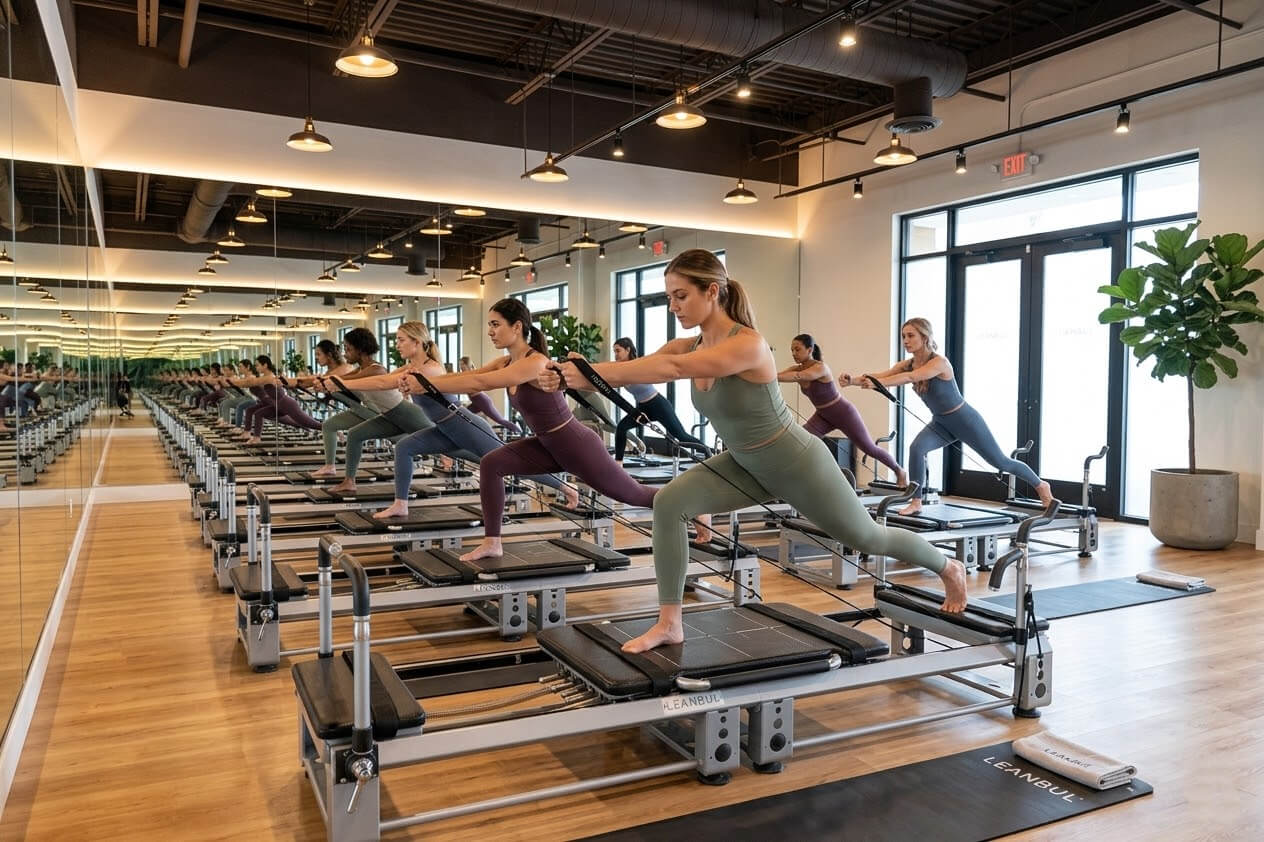
A realistic startup budget
Figures below are indicative for a six-reformer boutique in a Polish secondary city, in złoty. Warsaw rents and fit-out costs run higher.
| Item | Indicative cost (PLN) |
|---|---|
| Registration and legal setup | 0 – 2,000 |
| Company setup (if sp. z o.o.) | 2,000 – 8,000 |
| Deposit and first rent (3 months) | 15,000 – 40,000 |
| Fit-out and equipment (floors, mirrors, sound, reception) | 80,000 – 200,000 |
| Six commercial reformers | 55,000 – 110,000 |
| Insurance, permits, initial marketing | 10,000 – 25,000 |
The single largest controllable line is the reformers, and it is also the one that outlasts everything else in the room. A commercial machine that lasts fifteen years spreads its cost far better than a cheap one replaced twice over the same period.
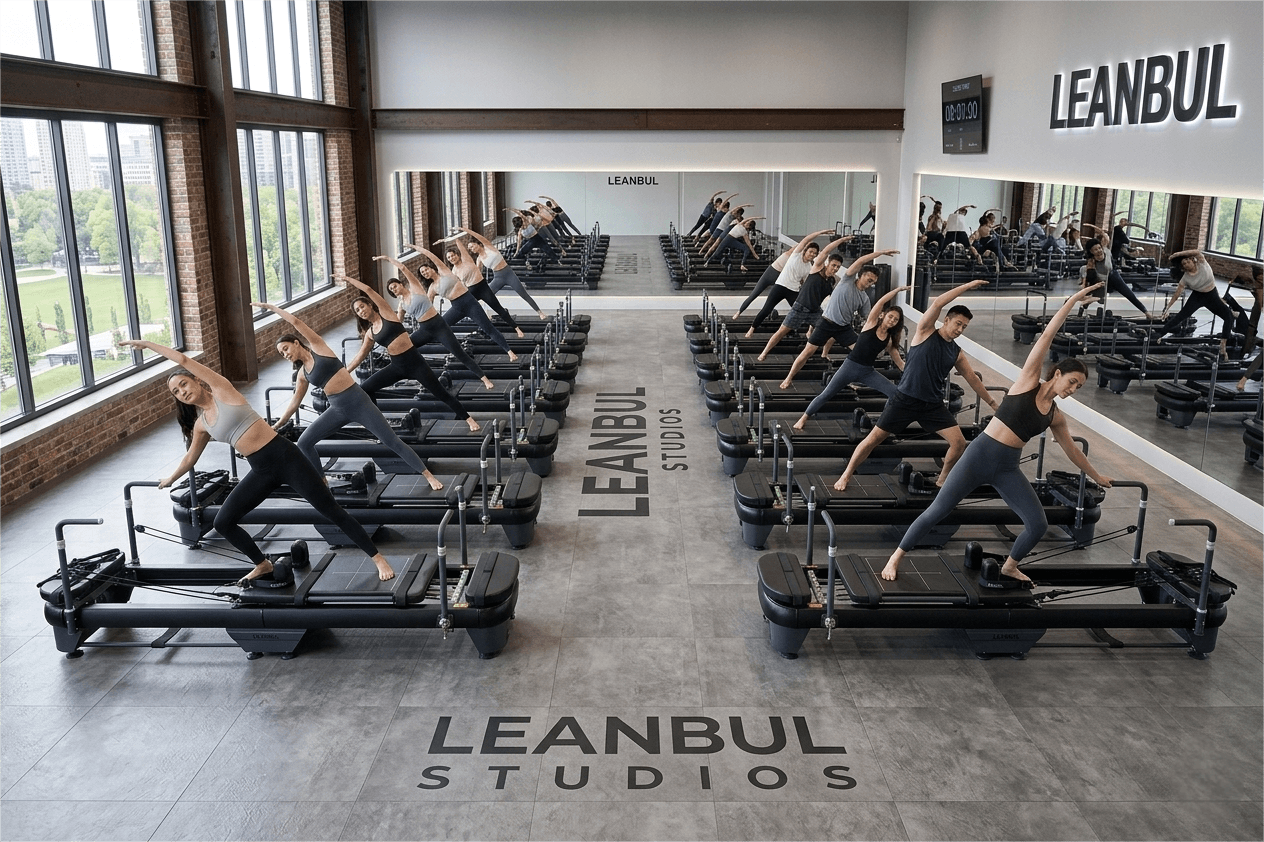
The equipment decision
Polish buyers compare machines closely, and they should. The questions that separate a good reformer from a weak one are the frame material and stiffness, the carriage and spring system, the warranty, and the availability of spares years down the line.
For most studios, a machine in the European commercial band fits the bill. Our K30 commercial reformer is the workhorse for small-footprint studios, the K38 premium reformer suits higher-volume rooms, and the K10 covers compact spaces. Buying from a manufacturer inside the EU also removes customs from the equation: an intra-Community purchase is not subject to import duty, and VAT is handled by reverse charge. The one Polish-specific wrinkle is the złoty. Because Poland is outside the euro zone, there is real currency exposure on a foreign invoice, which is why fixing the contract price in euros or złoty early, rather than leaving it to the payment date, is worth the effort.
FAQ
How much does it cost to open a Pilates studio in Poland? A six-reformer boutique in a secondary city typically costs somewhere between PLN 150,000 and PLN 400,000 for setup, deposit, fit-out and equipment, with Warsaw higher. The reformers are the biggest single capital item.
Do I need a company to open a Pilates studio in Poland? No. Most instructors start as a sole proprietor (JDG), registered free in CEIDG. A limited liability company (sp. z o.o.) becomes worthwhile when you have partners, investors, or want to separate personal liability from the business.
How much is ZUS for a new business in Poland? Full ZUS in 2026 is PLN 1,926.76 a month, but a new business is exempt for the first six months under Ulga na Start, then pays reduced contributions for the next 24 months before moving to the standard amount or Mały ZUS Plus.
When does a Pilates studio have to register for VAT in Poland? Once revenue passes the registration threshold, which rises to PLN 240,000 from 1 January 2026. Many studios register voluntarily before that, because it lets them reclaim the VAT on their reformers.
What reformer specification should a Polish studio buy? Commercial machines certified to EN ISO 20957 Class S, with a declaration of conformity and a proper warranty, and ideally sourced inside the EU to avoid customs and simplify VAT.
Opening the doors
Poland rewards a studio that gets the fixed costs under control before it signs a lease. Registration is cheap and fast, VAT is manageable, but ZUS and rent arrive every month whether or not the room is full, and that is what makes the equipment choice strategic rather than cosmetic. A reformer that lasts a decade and a half changes the maths in your favour. Leanbul is a Spain-based manufacturer of commercial reformers for European studios. We ship across the EU without customs friction and quote in euros. Browse the full collection, see our Pilates studio solutions, or contact us and we will help you plan a Polish studio from the machines up.
