How to Open a Pilates Studio in Germany in 2026: Legal Steps, Costs and Equipment
To open a pilates studio in Germany you register a Gewerbe, pick between a sole proprietorship and a GmbH or UG, decide whether the small-business VAT rule helps or hurts you, find a unit the building authority will approve for studio use, sign a commercial lease that normally runs five to ten years, and buy commercial-rated reformers. There is no Meisterbrief to earn and no state licence for teaching fitness — Germany regulates the premises and the tax, not the job title.
Budget €45,000 to €130,000 for a boutique opening in a German city. Rent, fit-out and the machine fleet are the three numbers that decide whether it works; everything else is smaller but the small items are where first-time owners lose weeks.
Here is the order you actually do it in.

Why open a pilates studio in Germany now
Germany is the largest fitness market in Europe, and it is still adding clubs. The 2026 European Health & Fitness Market Report from EuropeActive and Deloitte put German membership at 12.36 million for 2025, ahead of the UK’s 12.2 million, with 9,647 facilities and €6.25 billion in net revenue. The country added a net 520 clubs last year and net revenue rose 7.4% — operators were investing, not treading water.
The reformer niche is moving fastest inside that base. Studio Pilates International, a reformer franchise with more than 135 studios worldwide, opened its first German mainland site in Wiesbaden in May 2026, and the bigger chains are testing reformer zones inside existing clubs. When a franchise commits to a fleet spec, orders arrive in dozens, not ones.
Penetration tells you how much room is left. Germany reached 14.8% of the total population and 21.9% of people aged 15 to 65, passing its 2019 levels for the first time — a mature market rather than an empty one, so you are taking share, not creating demand. Berlin, Munich, Hamburg and the Rhine-Main region are where boutique demand sits deepest.
Step 1: Choose your legal form
Three structures cover almost every new German studio, and the choice is mostly about liability and paperwork rather than tax tricks.
The Einzelunternehmen is a sole proprietorship. You register a Gewerbe, you are trading, and there is no capital requirement and no notary. The catch is unlimited personal liability: a client injury claim or an unpaid supplier reaches your private assets.
The GmbH is the limited company. Minimum share capital is €25,000, at least half (€12,500) paid in before registration, plus notarised articles and a Handelsregister entry — a few hundred to a couple of thousand euros in notary and court fees on top of the capital.
The UG (haftungsbeschränkt) is the small limited company, sometimes called a Mini-GmbH. It can be founded from as little as €1, but the law forces you to reserve a quarter of annual profit until you reach the €25,000 GmbH threshold. It is a stepping stone, not a destination.
| Einzelunternehmen | UG (haftungsbeschränkt) | GmbH | |
|---|---|---|---|
| Minimum capital | None | From €1 (25% profit reserve) | €25,000, half paid in |
| Setup cost | Gewerbe fee only | Low, plus notary | Notary and register fees, ~€1,000–2,500 |
| Liability | Unlimited, personal | Limited to company assets | Limited to company assets |
| Accounting | Simple EÜR possible | Balance sheet required | Balance sheet required |
| Best for | Solo instructor testing the market | Cautious solo or pair start | Studio with a lease, staff or investors |
My honest read: start as an Einzelunternehmen if you teach alone in a rented room. Move up when you sign a multi-year lease or put instructors on payroll, because the company form costs real money every year in accounting and only earns its keep once you carry real contracts and real liability. A studio that leases a unit and employs two instructors on a sole-trader structure is a risk with no upside.
Step 2: Gewerbeanmeldung, IHK and the tax registration
Gewerbeanmeldung. You register the business at the local Gewerbeamt (or Ordnungsamt). The fee is set by each municipality and runs €15 to €60 in practice. For 2026 the pattern looks like this: Hamburg, Leipzig and Dresden charge €20; Berlin, Cologne, Düsseldorf and Frankfurt sit around €25; Hanover €35; Nuremberg €40; Munich €47; Stuttgart €54. Deregistration is free everywhere. Some municipalities also ask for a Führungszeugnis (certificate of good conduct, €13) or a register extract (€13), depending on the activity. The municipal fee table is a useful sanity check before you budget.
Two wrinkles catch people out. First, whether your activity is a Gewerbe or a freiberufliche Tätigkeit (a liberal profession). Pure teaching can sometimes be treated as freelance, but running a studio on commercial premises with employees, advertising and a shop front is a Gewerbe. Register as a Gewerbe and let your tax adviser tell you if you qualify for the other route. Second, the Gewerbeanmeldung automatically makes you a member of your local IHK (Chamber of Industry and Commerce). Membership is mandatory, and the annual contribution is billed on your profit — small in year one, but not zero, and people forget it.
Kleinunternehmerregelung. Under §19 of the German VAT Act (UStG), if your turnover stayed under €25,000 in the previous year and stays under €100,000 in the current one, you can skip VAT altogether: no VAT on your invoices, no VAT returns. The trade-off is that you cannot reclaim input VAT on your equipment. The current thresholds and the rules for crossing them are set out in the official §19 framework.
Do the arithmetic before you decide, because it is not obvious. Eight reformers at €3,000 each is €24,000, and at the standard 19% rate the input VAT alone is €4,560. A studio that buys a fleet and fits out a room will usually come out ahead by registering for VAT voluntarily and reclaiming that tax, even if it means charging VAT on classes. Solo instructors teaching from a rented room usually do better inside the small-business exemption. Ask your Steuerberater to model both; the answer changes with fleet size.
Step 3: The unit, the permits and the lease
German building law is where the real friction lives, and it is a landlord-and-authority problem before it is a design problem.
Change of use. If the unit is not already approved for studio or fitness use, converting it usually needs a Baugenehmigung for Nutzungsänderung. That means drawings, a fee and a wait. A former retail or office unit is often simpler than a residential building, but do not assume — check the existing use with the Bauamt before you sign.
Noise. This is the German specialty. Commercial noise is governed by TA Lärm for outdoor and premises noise, and sound insulation between units by DIN 4109. A reformer room with music, dropped weights and repeat impact sits in a category that annoyed neighbours can act on, and mixed residential buildings are the worst case. Ask about the building’s existing sound insulation and what the neighbours are, get any operating-hours limit in writing, and budget for acoustic flooring or a suspended ceiling if the unit needs it.
Music. Playing recorded music in a class is a public performance and needs a GEMA licence. It is a routine cost for studios, not an exotic one, and the tariff depends on the room size and how you use the music. Handle it through GEMA directly.
The lease. A Gewerbemietvertrag is a different animal from a residential lease, and German commercial law gives tenants far less automatic protection. Fixed terms of five to ten years are standard, often written as a firm term with one or two renewal options. Termination by the tenant mid-term is generally not possible unless the contract allows it; an open-ended lease is the exception, and under §580a of the Civil Code it can be ended with nine months’ notice. Deposits of about three months’ rent are common.
Rents are quoted per square metre per month, net of utilities. Office space in Hamburg averaged €22.50 per m² in 2026 with the best addresses at €37, and secondary districts like Eimsbüttel or Eppendorf ranged €11 to €17. Retail is a different market again: prime rents in the second quarter of 2026 were around €280 per m² per month in Berlin and Frankfurt, €250 in Hamburg and €340 in Munich. A studio rarely needs prime frontage, so most operators look at secondary units well below those figures.
Two things to negotiate beyond the rate. A rent-free fit-out period of three to six months is normal and often worth more than a discount on the headline rent. And a Baukostenzuschuss — a one-off landlord contribution to your fit-out — is standard in the German market. What you actually pay is the effective rent, not the headline number in the brochure, and the difference between two offers is often entirely in these terms.
For the room itself, plan around the machines rather than the square metres. Each reformer needs roughly a 3 m × 1.5 m working area once you allow for the moving carriage, the client and the instructor, plus circulation. A six-reformer boutique including back of house and a small reception wants about 90 to 130 m².
Step 4: Equipment — commercial-rated and bought inside the EU
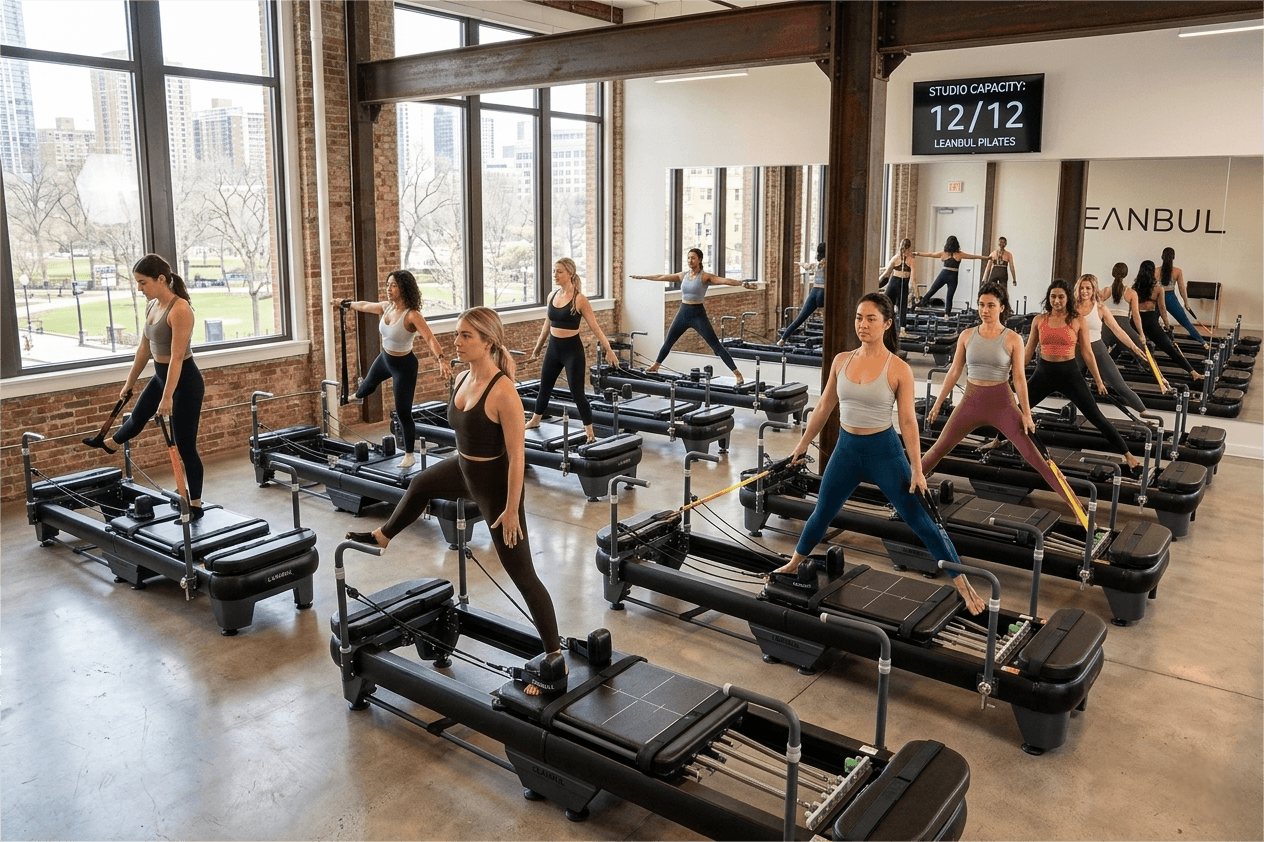
For a studio, the specification is settled: you want EN ISO 20957 Class S machines, the commercial classification. Class H is home use. A home-rated reformer in a shared studio is a compliance problem and, after an incident, an insurance problem.
German buyers are spec-conscious. They ask for datasheets, load ratings, weight capacity and certification before they discuss price, and they expect the compliance file from the manufacturer or a European importer, not a promise. A cheap imported machine with no CE documentation is a bad deal even when the invoice looks attractive.
What commercial reformers actually cost in Europe in 2026:
| Fleet size | Typical price per reformer | Notes |
|---|---|---|
| 1–2 units | €2,800–6,500 | Retail single-unit pricing |
| 5+ units | €1,900–3,500 | Manufacturer-direct fleet pricing |
| Spare spring set | €120–250 | Consumable, budget for it |
| Delivery within EU | Included or quoted | Pallet freight |
Two decisions separate a studio that ages well from one that does not. Standardise on one model, because a mixed fleet looks fine on day one and becomes a spare-parts problem by year three. And order consumables — springs, straps, carriage pads — with the machines.
Buying from a manufacturer inside the EU also removes the import headache: no customs clearance, no duty, VAT handled by reverse charge, and short pallet-freight delivery. Set the delivery term clearly. DDP means the manufacturer delivers to your door; DAP means you handle the final leg and the unloading, which for a machine that weighs close to a tonne is not a trivial detail.
For a first room, a compact commercial reformer like the K10 suits a small footprint, the K30 is the workhorse multi-site operators standardise on, and the K38 premium reformer is built for high-spec boutique and hotel rooms.
Step 5: Pricing, utilisation and break-even
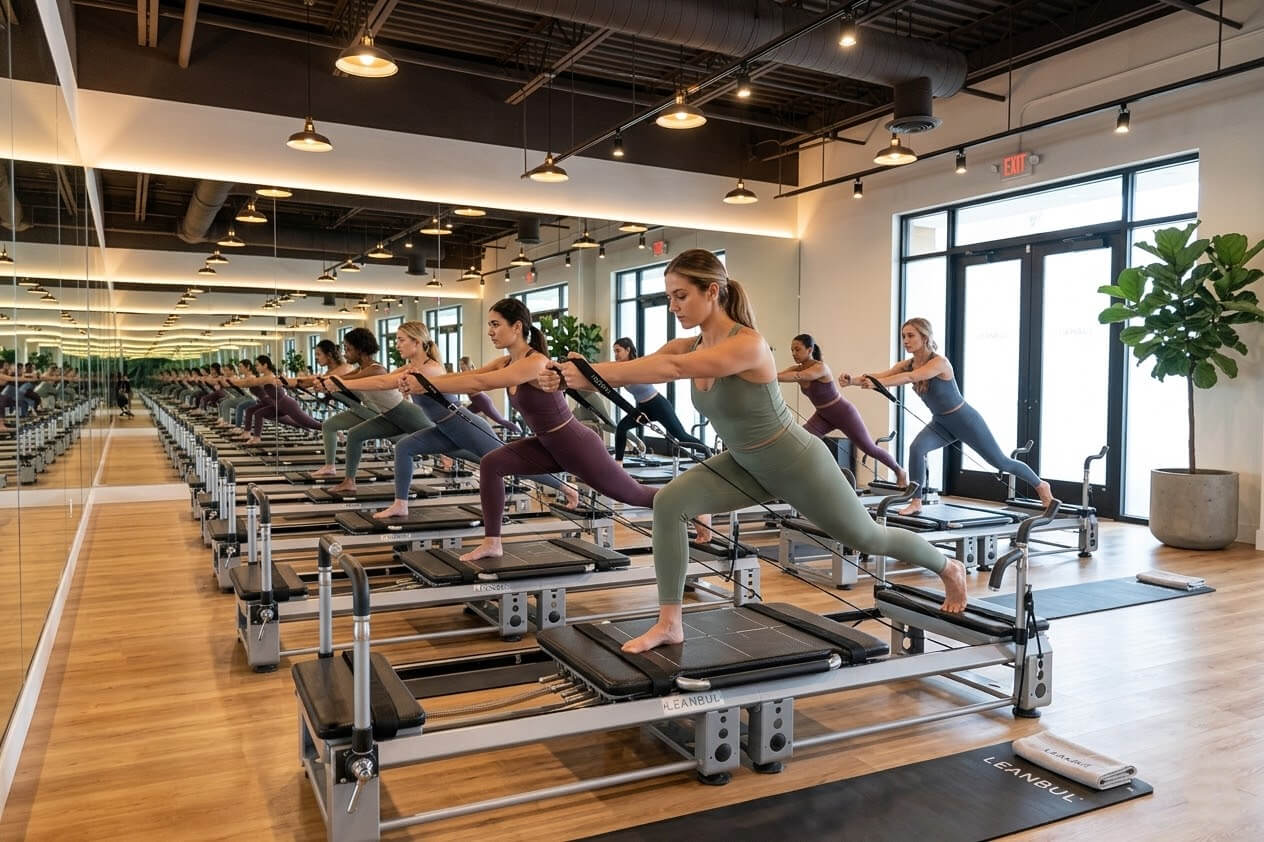
German reformer pricing sits in a wide band, split between premium boutique studios and gyms that fold reformer classes into a standard membership. Call it €22 to €30 per class at the boutique end in the big cities, with monthly memberships in the €120 to €200 range for two to three sessions a week. Value operators undercut that sharply, which is why the middle of the market is thin.
Run a capacity sum with your own numbers: eight reformers, four sessions a day per machine, at €24 a place, five days a week, is about €3,840 a week at full utilisation. Year-one utilisation is realistically 50–60%, so about €2,100 a week, or €9,000 a month before rent, wages, VAT and equipment finance. A €4,000 monthly rent and 19% VAT turn that from comfortable into tight — the whole argument for negotiating rent-free months at the start. Do the sum before you sign, and refuse to use optimistic utilisation.
Step 6: Staff, insurance and the German pension trap
Three points that regularly surprise new owners.
Berufsgenossenschaft. As soon as you employ anyone — instructors, a receptionist, a cleaner — you must register with the relevant Berufsgenossenschaft, the statutory accident insurer (usually the BGW for health and welfare services). It is mandatory and separate from private insurance.
The pension trap. Self-employed people generally are not forced into the state pension scheme, but §2 of the Social Code VI carves out exceptions, and self-employed teachers are one of them. If you teach regularly and do not employ other insured staff, you can be treated as compulsorily insured under §2 SGB VI. The same section catches people who work long-term mainly for a single client. Read it before you assume you are exempt.
Health insurance. Self-employed people must hold health cover, either voluntary statutory cover (freiwillig gesetzlich) or private cover (PKV). It is not optional and not cheap, so model it from month one.
On top of that you want Betriebshaftpflicht (business liability) covering the premises and the public using it, and your instructors want their own Berufshaftpflicht (professional indemnity). Make sure the policy covers commercial reformer use, and keep CE documentation and maintenance records where you can find them if a claim ever arrives.
Unlike Portugal or Ireland, Germany does not require a state certificate to teach fitness or Pilates. That is a genuine advantage for operators, and it cuts the other way too: with no licence barrier, the thing that differentiates you is the room, the equipment and the quality of instruction, which is what clients actually compare.
What the whole thing costs
| Item | Realistic range (excl. VAT) |
|---|---|
| Legal setup (sole trader to GmbH) | €15–3,000 |
| Fit-out (flooring, acoustic treatment, mirrors, HVAC, signage) | €20,000–60,000 |
| Reformers (6–10 units, fleet price) | €12,000–35,000 |
| Consumables, spare springs, small equipment | €1,000–3,000 |
| Rent deposit | ~3 months’ rent |
| Insurance, professional fees, opening marketing | €3,000–8,000 |
| Working capital buffer (6 months) | €10,000–25,000 |
| **Total** | **€45,000–130,000** |
The biggest lever is the unit. A secondary location with six months’ rent-free build-out can take €30,000 off that total without touching the specification of the machines.
FAQ
Do I need a licence to open a pilates studio in Germany? There is no professional licence in the sense of a mandatory qualification, and no state certificate to teach fitness or Pilates. What you need is a unit approved for the use, a valid lease and an operator’s insurance package. The barriers in Germany are premises and paperwork, not permission to practise.
How much does it cost to open a pilates studio in Germany? €45,000 to €130,000 for a boutique studio, depending on the city, the unit and how many reformers you start with. A solo instructor working from a rented room can start for far less, but a studio with a lease and a fit-out sits in that range.
Should I register as a sole trader or set up a GmbH? Start as an Einzelunternehmen if you teach alone. Move to a UG or GmbH once you sign a long lease, hire staff or take on a partner, because the company costs more in accounting every year and only pays off once you have real liability and real contracts.
Can I reclaim VAT on my reformers? Only if you register for VAT. Inside the Kleinunternehmerregelung you do not charge VAT on classes and you cannot reclaim input VAT on equipment. For most studios buying a fleet, voluntary VAT registration is the better call — at €24,000 of equipment, the input VAT alone is around €4,560.
Do I need CE-marked reformers for a German studio? Equipment sold for commercial studio use should carry CE marking and be classified under EN ISO 20957, with Class S for commercial application. It affects insurance validity and is increasingly checked by franchise brands and corporate clients. See our CE certification guide for EU studios.
Next step
If you are planning a German studio, tell us the city, the room size and how many reformers you need, and we will put together a layout and a fleet quote. We are a Spain-based manufacturer selling direct into Germany, so your machines arrive inside the EU with no customs and reverse-charge VAT, and the compliance file comes from the factory that built them.
Send the details through our contact page, look at our studio solutions, or start from the commercial reformer collection.
