Music Licensing for Pilates Studios in Europe: What You Actually Have to Pay
If clients can hear music in your studio, someone owns the right to that music being played in public, and in every European country that right is licensed and paid for. Music licensing for pilates studios works like licensing for a bar or a gym: there is no small-business exemption for a reformer studio, and no exemption for background music at reception. The published examples give the scale: a UK fitness instructor running three classes a week for 50 weeks pays £345 a year, and a German fitness studio pays roughly €635 to €970 a year for background music alone, before course music is counted.
Most studio owners discover this in year two, usually after a letter. The bill is rarely large enough to threaten the business. It is large enough to be annoying, and the back-payment for unlicensed years is what actually hurts.
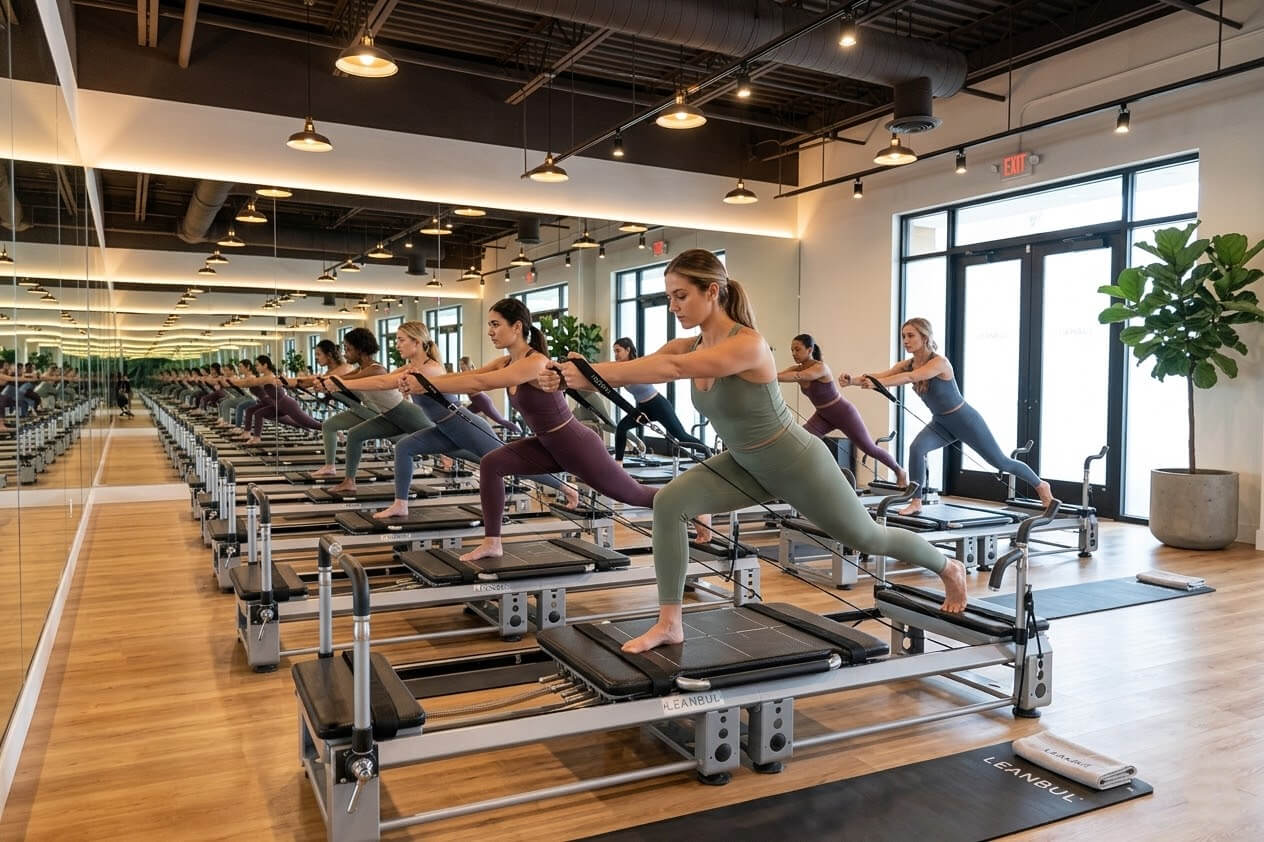
Here is what the licence covers, what it costs, who to pay in each market, and the cheaper lawful routes that hold up.
Two rights, two payees
Music carries two separate copyrights, and a public performance uses both.
The composition. The song itself, owned by the songwriter and publisher. Collected by the author-side society: PRS for Music in the UK, GEMA in Germany, SACEM in France, SGAE in Spain, SIAE in Italy, Buma/Stemra in the Netherlands, SABAM in Belgium, SUISA in Switzerland, AKM in Austria, ZAiKS in Poland, STIM in Sweden, KODA in Denmark, Teosto in Finland, IMRO in Ireland, SPA in Portugal, OSA in Czechia.
The recording. The specific audio file, owned by the performer and the record producer. Collected separately by PPL in the UK, GVL in Germany, SENA in the Netherlands, SCPP and SPPF in France, AGEDI and AIE in Spain, SCF in Italy, SIMIM in Belgium, Swissperform in Switzerland, Gramex in the Nordics, Intergram in Czechia, PPI in Ireland, Audiogest in Portugal.
In the UK both are sold together as one product through PPL PRS, which is why the paperwork looks simpler there than it is. In Germany you can receive a GEMA invoice and a GVL invoice for the same playlist. When you budget, assume two licences and one combined price.
Why your Spotify subscription is not a licence
Consumer streaming subscriptions are sold for personal, non-commercial listening. Playing that account through a studio sound system for paying clients is commercial use, and it falls outside the consumer terms. Instructors do it constantly. It is still unlicensed.
The same applies to a downloaded track library: buying the file gives you a copy, not a right to perform it publicly. And when an instructor hands you a USB stick of their own playlist, the venue is normally treated as the music user, not the freelancer, so the studio carries the exposure.
Three things that do work, in rough order of cost:
- A commercial background-music service that includes the performance licence in its subscription, typically €10 to €45 a month for a single small premises.
- A production-music library sold with a performance licence for studio use, often a one-off purchase per track or per year.
- The collective licence for your country, paid annually, which lets you play whatever you want.
What the music licensing tariff is actually based on
No two countries calculate identically, but the same four variables keep appearing.
Floor area or number of rooms. A 110 m² studio with one training room is priced differently from a 300 m² site with two rooms and a reception.
Whether music is background or course-led. Background music at reception and in the studio between classes is usually a flat annual fee. Music used to drive a class is often charged per class hour, or as a percentage of admission and membership revenue.
Class hours and participant numbers. Germany’s 2026 course tariff starts at €0.56 per class hour for up to 10 participants where the membership fee is up to €8.41 net per month, and scales up from there. A studio running 90 classes a month is not on the entry rate.
Whether the public pays to attend. A free community class in a village hall and a €28 reformer class in a city centre are not the same use.
| Market | Published anchor | What it covers |
|---|---|---|
| UK | £345 a year for an instructor running 3 classes a week, 50 weeks a year, in a hall (PPL PRS example, updated February 2026) | Both rights, one licence, class and background use |
| Germany | €635–€970 a year for fitness studio background music (GEMA 2026 tariff commentary); course music from €0.56 per class hour | GEMA for compositions; GVL invoiced separately |
| Netherlands, Belgium, France, Spain, Italy | Priced per premises by area, rooms and use | Author society plus recording society, usually two invoices |
Treat the table as a shape, not a quote. A 12-reformer studio in a capital city with 100 classes a month will sit above these anchors, sometimes well above.
The setups that decide your bill
Reception and between-class background music. The cheapest use to licence and the one most likely to be missed, because nobody thinks of it as “playing music to the public”. A radio or a streaming service in the waiting area is a licensed use.
Class music. The expensive part if you run high volume. Charged per class hour in some markets, as a percentage in others. If your timetable grows from 60 to 110 classes a month, expect a conversation with the society.
Instructor-supplied playlists. The venue is the user. A freelance instructor cannot license your premises on your behalf, and their personal subscription does not transfer.
Live music or guest events. A workshop with a live musician needs a different licence again, and usually advance notice to the society.
Cheaper lawful routes, honestly assessed
Production-music libraries with performance rights included. The practical option for most small studios. You get a catalogue, a licence certificate, and no annual society bill for those tracks. Limits: the repertoire is not commercial pop, clients notice, and you must keep the licence documentation and only play covered tracks. If a guest instructor plugs in their own phone, the licence no longer covers the room.
Commercial background-music services. Around €10 to €45 a month for small premises, with scheduling and licensing bundled. Usually cheaper than the collective licence for a single room, and cleaner to audit because the provider holds the rights. Read the contract for whether it covers class use or background only.
Paying the collective licence. For a studio running 80 or more classes a month with instructor-chosen music, the annual fee is often the cheapest defensible option. It is roughly the cost of one reformer spring set, and it removes the argument entirely.
What does not work. “We only use Spotify.” “The instructor brings the music.” “It is quiet in the background.” “Nobody has ever checked.” Societies do check premises, and they can claim for past use going back through the statutory limitation period. A back-payment for three unlicensed years costs more than three years of licence.
Who actually comes knocking
Collective management organisations run systematic premises checks. In Germany GEMA has field staff and a dedicated fitness tariff; in the UK PPL PRS markets TheMusicLicence directly to gyms and studios; in Spain, Italy and France the societies have long histories of inspection in hospitality and leisure. The pattern is a letter, a questionnaire asking for floor area, rooms, class hours and opening times, then an invoice with a back-period.
Two practical points. First, the questionnaire is where the bill is decided, so answer it accurately and keep a copy. Second, if you have been unlicensed, approaching the society before they approach you usually produces a better outcome than waiting.
A compliance routine that takes an hour a year
- List every place music is audible: studio, reception, changing area, outdoor terrace.
- List every source: streaming account, downloaded files, instructor phones, licensed service, radio.
- Get one licence per premises, not per instructor, and put the certificate in the same folder as your insurance.
- If you use a licensed service, keep the contract and the page confirming performance rights are included.
- If you make your own mixes from purchased tracks, check whether a dubbing or format-shifting licence applies. The UK has a specific one; other markets fold it into the main tariff.
- Review after any change: new room, longer hours, more classes, live events, a second site.
Frequently asked questions
Do I need a music licence if I only play music during classes and not in reception? Yes. Class use is public performance. In several markets it is the more expensive category.
Can my instructor use their own Spotify account in my studio? No. Consumer subscriptions are for personal use, and the venue is treated as the user. Either the studio holds a licence or the music comes from a licensed service or library.
Is it cheaper to just use royalty-free music? Often yes, at €10 to €45 a month for a small studio. The trade-off is repertoire: no commercial tracks, and you must be able to prove every track played is covered if asked.
What happens if I get caught without a licence? Typically a back-licence invoice covering past use plus the current year, and in some jurisdictions further damages. The sums are usually survivable for a small studio, but they arrive at the worst moment and they are entirely avoidable.
Does the licence cover a second studio? No. Each premises is licensed separately.
Where this fits in the studio budget
Music licensing is one of a handful of small compliance lines that a European studio has to carry: the lease, insurance, the EN 17229 operating framework, and now the music. None of them is large on its own. Together they are the difference between a studio that survives its first lease and one that does not.
We build reformers in Spain for studios across Europe, and we spend a lot of time on the parts of opening a studio that are not about machines. If you are working through a fit-out, our guide to pilates studio fit-out costs covers the build side, and the K30 and K38 pages cover the machines themselves. For a room plan and a quote, get in touch.
