Pilates Studio Ventilation: The Number Your Clients Feel Before They Complain
Pilates studio ventilation is not a building-services detail you sort out after the machines arrive. It sets how many clients can train in your room at once, and in most small studios it is already the binding constraint. The maths is unforgiving: a room designed to office occupancy figures will pass 1,200 ppm of CO2 inside twenty minutes of a full reformer class, and no air purifier will fix that, because purifiers do not remove CO2.
I have stood in studios where six people finish a class with headaches and blame the springs, the music, or the instructor’s cueing. Then you put a €150 CO2 logger on the reformer and watch the number climb past 1,800. The machine was never the problem.
Here is what the standards say, what the arithmetic does to a 60 m² room, how to test your own space in two class slots, and what it means for the equipment and the fleet size you are about to buy.
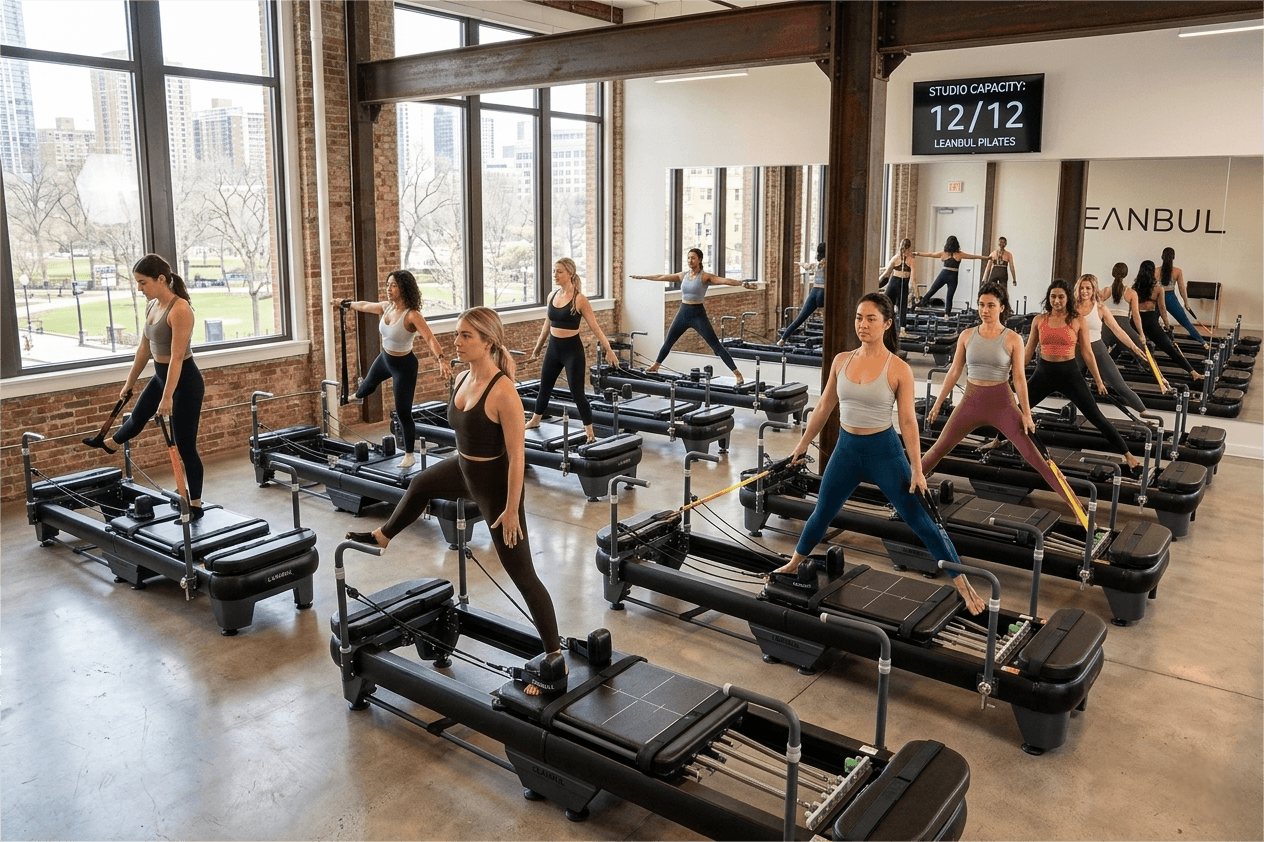
Why a reformer studio is a harder room than a gym
Three things make reformer rooms worse than the gym floor they get compared to.
Density. A commercial reformer needs roughly 2.0 to 2.2 m² of floor including clearances. Eight machines in a 60 m² room means eight clients in 60 m². A gym floor gives each member ten times that. You are running close to classroom density with people doing resistance work.
Posture. Your clients lie down. Their breathing zone sits 30 to 60 cm above the floor, which is exactly where dust, and the heavier fraction of cleaning chemicals, end up. The upholstery is 20 cm from their face during footwork. Nobody designing a gym ventilation system thinks about that.
Metabolism. This is the part almost everyone misses, and it is where the numbers break.
The guidance documents disagree by a factor of four
Ask five sources how much fresh air a studio needs and you get five answers. I ran them against the same room: 60 m², 2.7 m ceiling, eight clients plus an instructor.
| Design basis | Rate | Airflow for this room | Equivalent air changes |
|---|---|---|---|
| EN 16798-1:2019, Category II (default for new buildings) | 7 L/s per person | 227 m³/h | 1.4 ACH |
| EN 16798-1:2019, Category I (high indoor air quality) | 10 L/s per person | 324 m³/h | 2.0 ACH |
| ASHRAE 62.1-2022, gym and sports area | 10 L/s per person + 0.9 L/s per m² | 518 m³/h | 3.2 ACH |
| UK guidance for class-based studios | 20 L/s per person | 648 m³/h | 4.0 ACH |
| “10 to 12 air changes per hour” rule of thumb | 10–12 ACH | 1,620–1,944 m³/h | 10–12 ACH |
The top row and the bottom row differ by a factor of seven. Both are quoted in good faith, in documents written by competent engineers. The reason is that air changes per hour is a terrible unit for a small, dense room: the same airflow gives a big hall two air changes and your 162 m³ studio twenty. If a supplier quotes you “12 air changes”, ask what that is in litres per second per client. That number is comparable. Air changes are not.
What 20 litres a second per client actually buys you
EN 16798-1’s default rates come with an assumption you should know about: about 20 litres of CO2 per hour per person. That is a seated adult. Office numbers, in other words.
A reformer class is not seated. Moderate continuous work produces something closer to 50 to 60 litres per hour, and a jumpboard or strength block pushes higher. CO2 concentration settles where generation divided by airflow equals the room’s excess concentration. Run the same formula with a working body and the answer moves by a factor of three.
| Fresh air per client | Steady-state CO2 during class | What it feels like |
|---|---|---|
| 7 L/s | ~2,600 ppm | Heavy, everyone is quiet for the wrong reason |
| 10 L/s | ~1,950 ppm | Stuffy by minute 15, windows get opened in winter |
| 15 L/s | ~1,440 ppm | Complaints start in the third class of the evening |
| 20 L/s | ~1,180 ppm | Acceptable for most people, noticeable in hot classes |
| 25 L/s | ~1,030 ppm | Good. This is where I would design a new studio |
| 30 L/s | ~930 ppm | Very good, and expensive to run in heating season |
Figures assume 420 ppm outdoors and 55 L/h CO2 generation per person. Change those assumptions and the trend holds.
This is why “we have air conditioning” means nothing. A split unit recirculates indoor air and cools it. It adds zero fresh air. Studios in southern Europe that run splits all summer are, from a ventilation standpoint, running a closed box with a fan in it. In Spain this is the single most common problem I see, and it is invisible until someone measures.
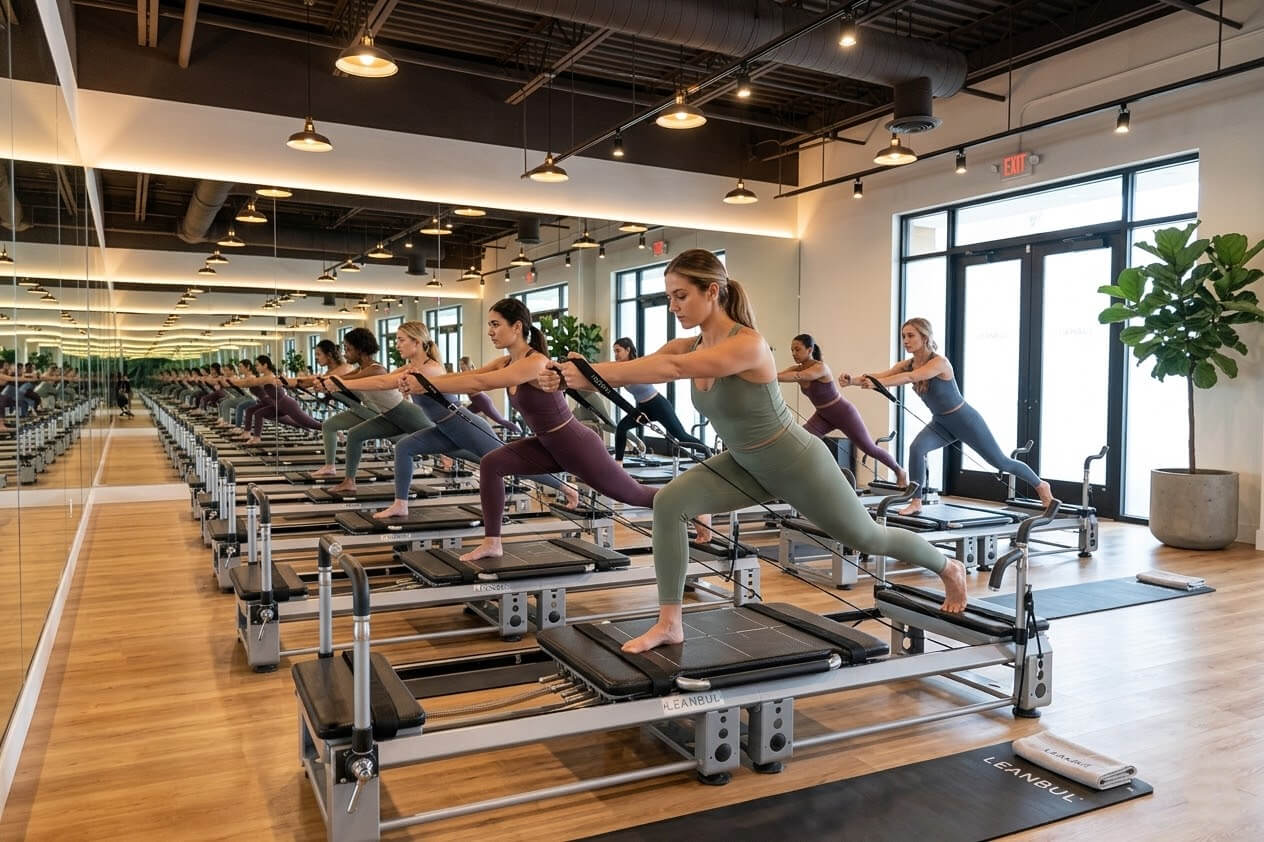
What the number does to the people in the room
CO2 at these levels is not toxic, but it is a proxy, and the effects show up anyway.
The German Environment Agency treats 1,000 ppm as the indicator that ventilation is insufficient in occupied rooms. EN 13779’s older bands describe the excess above outdoor air: below 800 ppm above outdoor is high indoor air quality, 800 to 1,000 is medium, 1,000 to 1,400 moderate, above 1,400 low. With 420 ppm outside, the “medium” ceiling lands at roughly 1,200 ppm on a logger. Field studies of fitness centres routinely find the weights area above 800 ppm even with mechanical ventilation running, which tells you how badly rooms perform when the design assumes seated people.
Then there is the cognitive side, which matters because your clients are paying for control and coordination. A 2016 study by Joseph Allen and colleagues at Harvard, with Syracuse, tested office workers at different CO2 and ventilation conditions. At about 945 ppm, decision-making scores came out 15% lower than at 550 ppm. At 1,400 ppm they were around 50% lower. Office workers, not pilates clients, so I would not overclaim. The direction is consistent though, and the room is part of the class.
Studio owners describe it before they ever measure it. Clients yawn in the second half. The last class of the evening feels heavier than the first. Somebody says “it’s a bit close in here” and everyone nods. Those are CO2 conversations wearing a different hat.
Test your own room in two classes
You do not need a consultant to find out where you stand. You need a logger with an NDIR sensor, which costs €100 to €250 and reads in ppm rather than a coloured light.
- Put it at breathing height, around 1.1 m, in the middle of the room, away from vents, doors and the instructor’s position.
- Log at one-minute intervals across three classes: your fullest class, an average one, and the last of the day.
- Note the reading at minutes 5, 20, and 45 of each class.
- Then do the decay test. After everyone leaves, keep logging for 20 minutes with doors and windows as they are normally left. The fall rate tells you the room’s real air change rate, not the design figure.
The decay calculation, if you want to do it properly:
ACH = ln[(C1 − Cout) ÷ (C2 − Cout)] ÷ hours elapsed
where C1 is the concentration when the room empties, C2 is twenty minutes later, and Cout is outdoor CO2, around 420 ppm in a city. If CO2 drops from 1,500 to 900 in 20 minutes, that room is running at roughly 2.1 air changes per hour. Which is to say, barely exchanging air at all.
Now the number that decides your timetable: how long a gap do you need between classes? One air change closes about 63% of the gap to outdoor levels.
| Gap between classes | At 2 ACH | At 4 ACH | At 8 ACH |
|---|---|---|---|
| 5 minutes | 1,340 ppm | 1,150 ppm | 990 ppm |
| 10 minutes | 1,120 ppm | 920 ppm | 740 ppm |
| 15 minutes | 950 ppm | 760 ppm | 620 ppm |
Starting from 1,400 ppm at the end of a class. That table is the argument for the ten-minute turnaround, and also the argument for a boost mode on the ventilation rather than a longer gap.
The fix ladder, cheapest first
Free. Add a gap between classes. Cap the class at what the air can carry rather than what the floor can fit. Leave the door open between classes, and open the high window if you have one.
Cheap. Put the CO2 reading on a screen in the room. Visible numbers change behaviour faster than any policy, because the instructor stops arguing about whether it is stuffy.
Moderate. Get the ventilation system onto a CO2 sensor so it boosts when the room fills instead of running at a fixed rate. Check the filters, too. A clogged prefilter quietly turns a working system into a recirculating fan.
Expensive. A heat recovery or energy recovery unit sized in m³/h, ducted to the studio. Low thousands of euros for a unit in the 500 to 800 m³/h range before ductwork. Get three quotes, because installation dominates the price. In a Spanish or Italian summer the recovery side matters less than the cooling coil, so specify both.
What does not work. Portable HEPA purifiers remove particles, not CO2. Scented diffusers make the problem harder to notice. Ionisers do nothing for CO2. Opening a window into an internal courtyard does very little. And “we’ll just tell people to breathe through their nose” is not a ventilation strategy.
What this means for the machines you are buying
Ventilation and equipment spec are the same conversation, and this is the part that changed in 2026.
Since 6 August 2026, entry 77 of REACH Annex XVII restricts formaldehyde emissions from articles placed on the EU market for indoor use. Wood-based articles and furniture are capped at 0.062 mg/m³; other articles that can release formaldehyde are capped at 0.080 mg/m³, measured by the chamber method in Appendix 14 of Regulation (EU) 2023/1464. A reformer is an indoor article. If it has an MDF or plywood frame, or foam-filled upholstery, it is in scope.
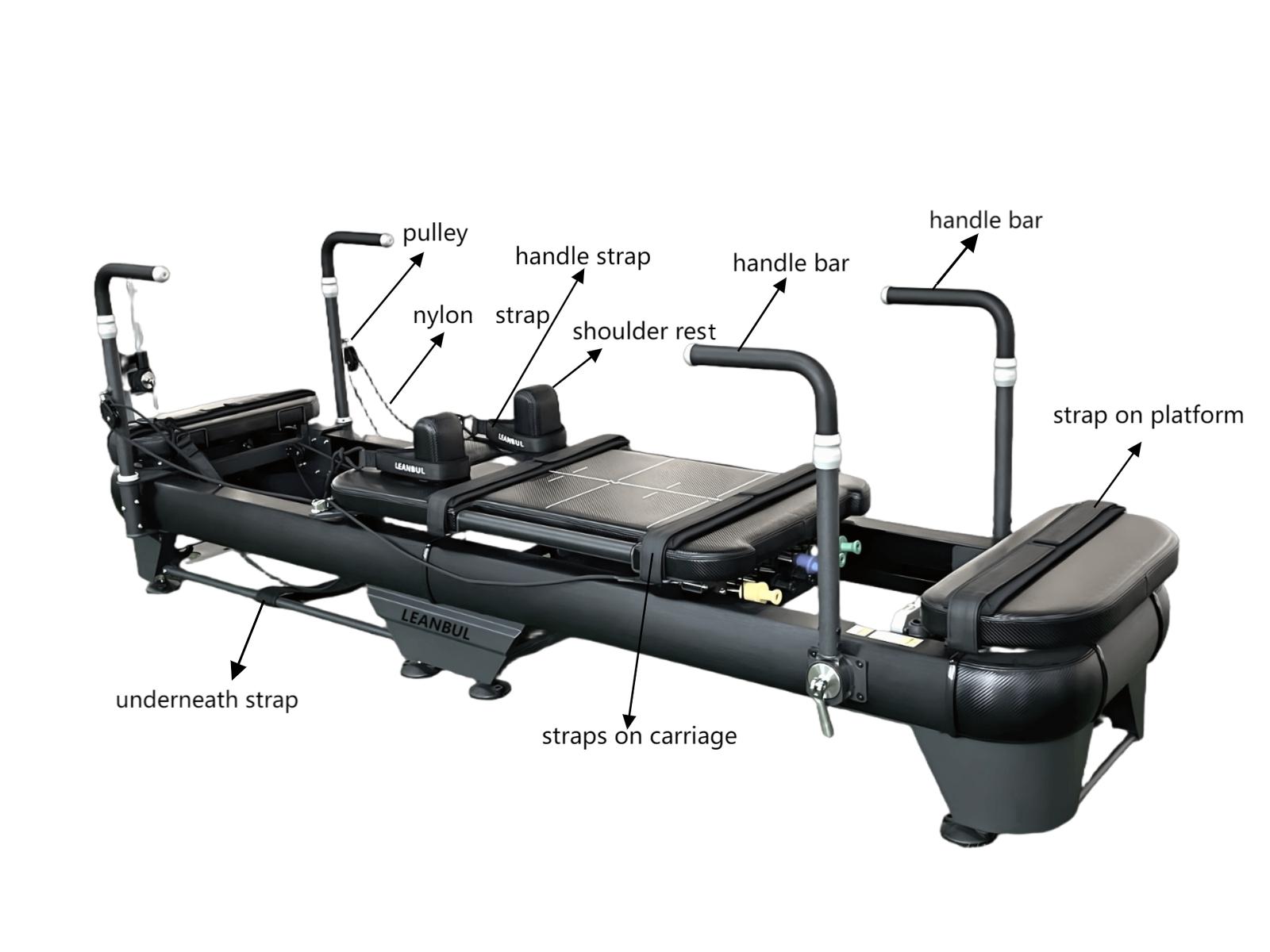
That does not make wooden reformers illegal, and I would not pretend otherwise. It does mean the question “what does this machine emit?” now has a documented answer to ask for. A powder-coated aluminium frame has no adhesive-bound board in it, which removes one whole class of emission from the room before you start arguing about airflow.
Three practical things, whoever you buy from:
- Ask for the emission test or at least a material declaration for the upholstery foam and any board in the frame. “Low emission” without a number is marketing.
- Air new machines for a week in a ventilated space before the first class. Six new reformers unwrapped in a sealed room is a chemical event, and the smell people call “new machine” is exactly what the restriction is about.
- Clean with ventilation running, and skip the fogging. A residue that stays on the vinyl is a residue your clients breathe against for the next hour.
If you are running hot pilates, add the heat to the equation. Warmer air holds more of everything, emission rates rise, and sweat adds humidity that the same ventilation system now has to handle. The room that works at 21°C is not the room that works at 38°C.
Ventilation is a capacity decision, not a building detail
This is where it stops being about air and starts being about money.
Your class size is the smallest of three numbers: what the floor allows, what the instructor can teach well, and what the air can clear. In a 60 m² room, the floor allows eight. If the ventilation holds six at a reasonable CO2 level, you own two reformers you cannot fill without making every class worse.
That is why I would rather see the CO2 test done before the fleet order than after. It costs €150 and an afternoon. Getting it wrong costs two machines, or a year of classes that clients quietly stop booking.
If the room turns out to be the limit, the answer is often not a bigger ventilation system but a different timetable: fewer, fuller classes with proper gaps beat a packed schedule in a room that cannot clear. Our guide to adding reformers without breaking the timetable works through that arithmetic, and the hot pilates piece covers what heat does to the machine itself.
FAQ
What CO2 level should a pilates studio be at?
Under 800 ppm between classes, under 1,200 ppm at peak during a class. Under 1,000 during class is excellent and expensive with exercising adults. Anything sustained above 1,400 needs action that week.
Do air purifiers fix a stuffy studio?
No. HEPA and carbon filters remove particles and some gases, but CO2 is removed only by replacing indoor air with outdoor air. A purifier next to a reformer is treating the symptom you can smell, not the one you are measuring.
My studio has air conditioning. Is that ventilation?
Only if the system has a fresh air intake and it is actually open. Most split units and many cassette systems recirculate indoor air. Check by measuring CO2 in a full class: if it climbs past 1,500 ppm, you have cooling, not ventilation.
Is 10 to 12 air changes per hour the right target?
Treat it as a rule of thumb for large halls, not for studios. Air changes scale with room volume, so the same figure means wildly different airflow in a 60 m² room and a 400 m² gym. Specify in litres per second per client.
How much does fixing it cost?
A logger is €100 to €250. A demand-controlled boost and filter service is hundreds. A ducted heat recovery unit is low thousands before install. Class-size caps and ten-minute gaps cost nothing and buy you time.
Sorting the room before the fleet
We build reformers in Spain for studios, gyms, clinics and hotels across Europe, and we quote ventilation-relevant spec as part of the order: frame material, upholstery, weights, and what the machine emits, in writing. If you are planning a room and want the spec sheet before you commit to a machine count, look at the K38 premium reformer or the full collection. For fit-outs where the room, the timetable and the fleet get decided together, studio solutions is the place to start, and you can contact us with the room dimensions and occupancy you are designing for. We would rather tell you to buy six machines in a well-ventilated room than eight in a bad one.
