How to Open a Pilates Studio in France in 2026: Legal Steps, Costs and Equipment
To open a pilates studio in France you pick a legal status, register the business through the guichet unique, sort out your social contributions and VAT position, find premises the municipality will accept as a public-facing fitness space, sign a bail commercial that locks you in for years, and buy commercial-rated reformers. France does not require a state diploma to teach fitness, but it regulates the room, the building, the music and the tax in ways that surprise people coming from the UK or Germany.
Budget €40,000 to €120,000 for a boutique opening outside central Paris. The lease, the fit-out and the reformers are the three big numbers, and the lease is the one that decides whether the other two are affordable.
Here is the sequence.
Why open a pilates studio in France now
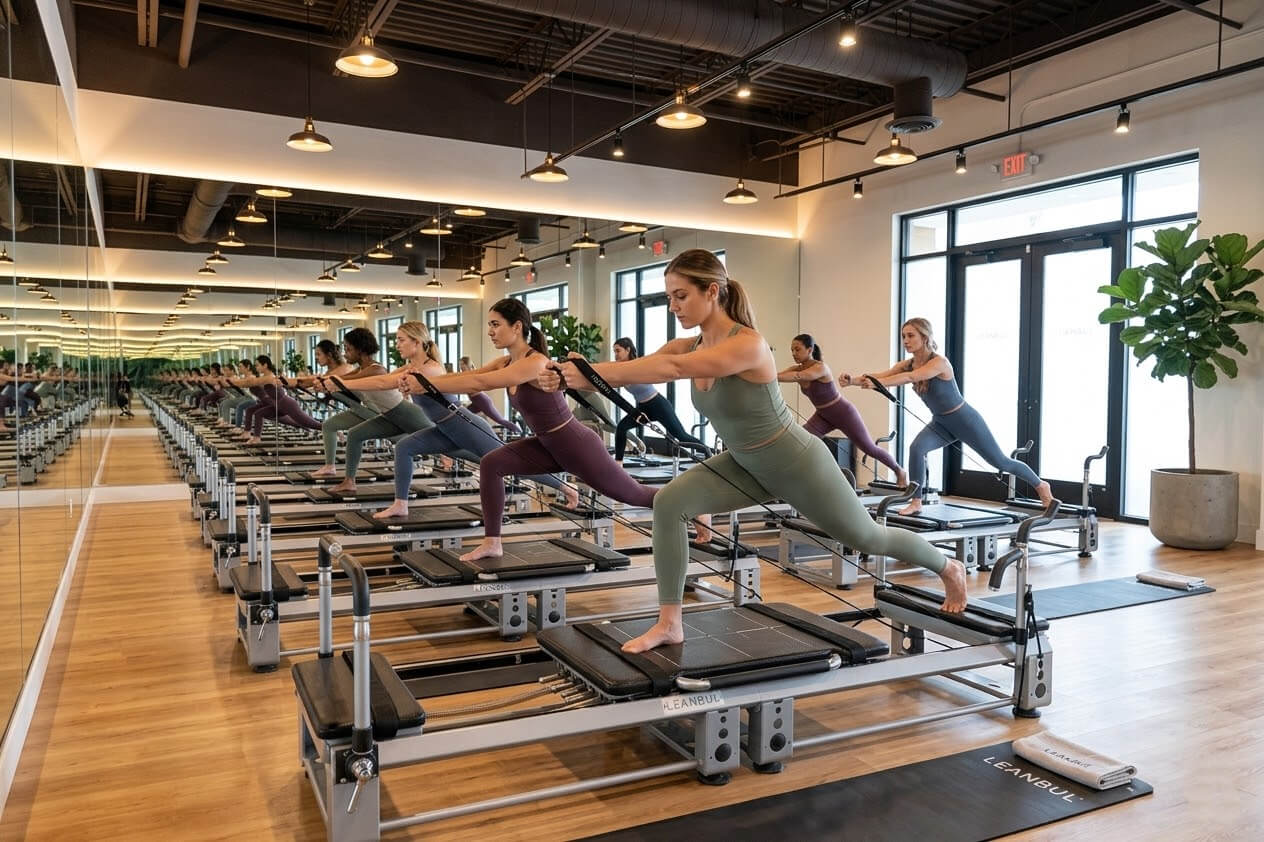
France is the third-largest fitness market in Europe after Germany and the UK, with around 7 million members, and it is under-penetrated. The market analyst Epsimas counted at least 6,811 active gyms and studios in March 2026, up from roughly 6,000 a year earlier — close to 800 new facilities in twelve months. Penetration sits near 10%, against Germany’s 14.8% and a European average of 9.3%. That gap is the opportunity.
Reformer Pilates is the format doing the heavy lifting at the boutique end. The New Me, a French reformer franchise, has grown to around 30 open studios with a target of 60 by 2027 and has already pushed into Geneva and Montreal. Meanwhile the big-box chains — Basic-Fit with roughly 858 French sites, Fitness Park around 400, L’Orange Bleue about 380, Keep Cool roughly 300 — are adding reformer and wellness zones to differentiate mid-market offers. Franchise networks already account for roughly 60% of French facilities, which means equipment decisions increasingly get made at brand level, in spec sheets, not just studio by studio.
For context, EuropeActive and Deloitte put the European market at 75.5 million members, 67,515 clubs and €39.1 billion in revenue for 2025. France is a headline contributor, not a fringe one.
Step 1: Choose your legal status
Two structures cover most new studios, and the choice is about how much administration you want to buy into.
The micro-entreprise (the auto-entrepreneur regime) is the simple path. You register once, you pay social contributions as a percentage of turnover, and you can stay outside VAT while you are small. It suits a solo instructor teaching alone in a rented room. It does not suit a studio with a lease and employees, where the turnover ceiling and the inability to reclaim much VAT become real constraints.
The EURL (a single-shareholder SARL) or SASU (a single-shareholder SAS) is the company route. No legal minimum capital for a SARL in practice, but you need statutes, a legal notice in a journal d’annonces légales and a greffe registration. Setup costs typically land between €500 and €2,000 depending on whether you use a lawyer and how much you pay the greffe. The advantage is limited liability and a clean structure once you sign a lease and hire.
| Micro-entreprise | EURL / SASU | |
|---|---|---|
| Setup cost | Free registration | ~€500–2,000 (statutes, legal notice, greffe) |
| Liability | Unlimited, personal | Limited to company assets |
| Social contributions | % of turnover, paid monthly or quarterly | Based on salary or remuneration, more complex |
| Accounting | Minimal | Full accounts, often an accountant |
| VAT | Can stay in franchise en base | Usually VAT-registered |
| Best for | Solo instructor testing the market | Studio with a lease, staff or partners |
The practical answer is the same as elsewhere: start micro if you teach alone, and incorporate when you take a lease or hire. A studio that signs a nine-year lease on a solo-trader structure is carrying company-sized risk on a personal balance sheet.
Step 2: Registration, social contributions and CFE
Registration. Businesses register through the guichet unique operated by INPI, which replaced the old chambers-based process. Registration itself is free for a micro-entreprise; the company route adds the greffe fee. You receive a SIREN/SIRET number that becomes your identity for tax and invoicing.
Social contributions. Under the micro-entreprise regime the rates are fixed by sector. For 2026 they are 12.3% of turnover for the sale of goods, 21.2% for commercial and artisanal services (BIC), 25.6% for other services (BNC), and 23.2% for regulated liberal professions under Cipav. A Pilates studio is a service business, so 21.2% is the number to plan around. These rates are published on the official auto-entrepreneur portal. If you go the company route, contributions are calculated differently, based on the remuneration you take, and you should model that with an accountant.
CFE. The cotisation foncière des entreprises is a local business tax charged by the commune, and it catches micro-entrepreneurs too. It is small in year one — there is a relief for the first year — but it is not zero, and it is billed separately from your social contributions.
Turnover ceilings. The micro-fiscal regime applies if turnover stays under €83,600 for services (and €203,100 for commercial activity). It is worth knowing that this ceiling is not the same as the VAT threshold, a distinction that trips people up. The micro-fiscal ceilings and the VAT thresholds are set out on Service-Public Entreprendre.
Step 3: VAT — the one place the rules help you
French standard VAT (TVA) is 20%. Whether you charge it depends on the franchise en base regime.
The 2026 thresholds are unchanged: for services, you stay outside VAT while turnover is at or below €37,500, with a tolerance up to €41,250; for the sale of goods the figures are €85,000 and €93,500. A single €25,000 threshold was proposed in the 2025 finance law but abandoned, so the old split still applies. The official VAT regime page confirms the position.
The trade-off mirrors Germany’s small-business rule. Inside the franchise you do not charge VAT on classes, and you do not reclaim VAT on your equipment. Eight reformers at €3,000 each is €24,000, carrying €4,800 of TVA at the standard rate. Whether you recover that depends entirely on your VAT status, and for a studio buying a fleet, voluntary VAT registration is usually worth it.
Buying from a manufacturer elsewhere in the EU is an intra-EU acquisition, not an import: no customs, no duty, and the VAT is handled by reverse charge. You account for it and deduct it in the same return. That is the structural difference versus importing from outside the EU, where duty and import clearance land on the invoice.
Step 4: Premises — the lease, ERP rules and music
This is where France is genuinely different, and it is the part worth spending a lawyer’s fee on.
The bail commercial. French commercial leases are built around the 3/6/9: a nine-year term with break options at the end of the third and sixth years. It carries a droit au renouvellement, the tenant’s statutory right to renew, which is close to a property right and is why commercial leases in France are treated as assets. If you do not want that commitment, a bail dérogatoire is a short-term alternative capped at three years, without the renewal right — useful for a pop-up or a test location, not for a long-term studio. Deposits of about three months’ rent are common, and some leases include a pas-de-porte, a lump sum paid to the landlord for the right to the premises.
Changement de destination. Converting a residential or non-commercial unit to commercial use, or changing the use of an existing commercial unit that does not allow public-facing activity, needs authorisation from the mairie. Do not sign before confirming the unit’s current destination.
ERP status. A studio open to the public is an établissement recevant du public and falls under the ERP regulations, in practice usually the smallest category (5th category, under the attendance threshold). That still means accessibility for people with reduced mobility under the 2005 disability law, and fire-safety obligations: means of escape, extinguishers, signage, and a safety file. 5th-category venues typically declare rather than go through the full commission de sécurité, but any structural work also needs an autorisation de travaux. Check the specifics with the mairie and the SDIS before committing to a fit-out plan.
Music. Playing recorded or live music in classes creates copyright and related rights that must be licensed, in practice through a SACEM agreement. Budget for it as a normal operating cost.
Fit-out and the room. Plan around the machines, not the floor area. Each reformer needs roughly a 3 m × 1.5 m working area with circulation. A six-reformer boutique including back of house wants about 90 to 130 m². Allow €15,000 to €35,000 for flooring, mirrors, lighting, ventilation, a small reception and storage, and more if you take a bare shell.
Step 5: Equipment — commercial-rated, bought inside the EU
For a studio the specification is settled: EN ISO 20957 Class S, the commercial classification. Class H is home use, and a home-rated machine in a shared studio is a compliance problem and, after an incident, an insurance problem.
French buyers ask for the same things German ones do — datasheets, load ratings and certification — plus two items specific to this market: clear lead times for the last mile, and French-language documentation and support. Franchise and multi-site operators add a third: fleet consistency, because a member should feel the same carriage travel and spring tension in Paris as in Lyon.
What commercial reformers cost in Europe in 2026:
| Fleet size | Typical price per reformer | Notes |
|---|---|---|
| 1–2 units | €2,800–6,500 | Retail single-unit pricing |
| 5+ units | €1,900–3,500 | Manufacturer-direct fleet pricing |
| Spare spring set | €120–250 | Consumable, budget for it |
| Delivery within EU | Included or quoted | Pallet freight |
Standardise on one model, and order consumables with the machines. Buying from a European manufacturer also means no customs, no duty, VAT by reverse charge and short EU freight — and a factory that can supply the same part number to every location you open.
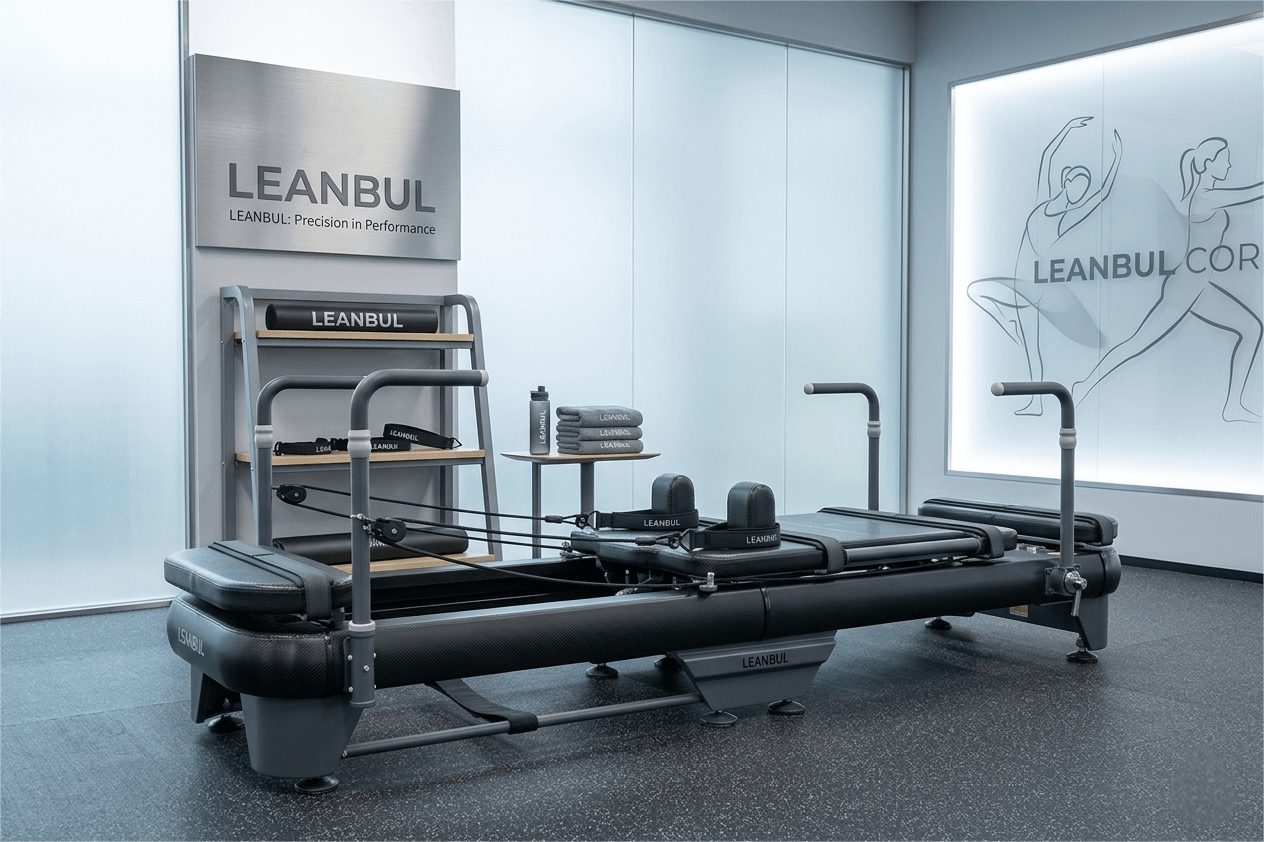
For a first room, a compact commercial reformer like the K10 suits a small footprint, the K30 is the workhorse multi-site operators standardise on, and the K38 premium reformer is built for high-spec boutique and hotel installations.
Step 6: Pricing, utilisation and break-even
French reformer pricing splits sharply. In central Paris, boutique classes run in the €25 to €35 range with memberships in the €150 to €250 a month band for regular training. Outside the big cities, and in gym-integrated formats, prices land lower, which is why a Paris rent and a Lyon rent produce two entirely different businesses.
Run the capacity sum with your own numbers: eight reformers, four sessions a day per machine, at €24 a place, five days a week, is about €3,840 a week at full utilisation. Year-one utilisation is realistically 50–60%, so roughly €2,100 a week, or about €9,000 a month before rent, wages, VAT and equipment finance. In Paris that number is tight; in Bordeaux with a modest rent it is comfortable. The rent decides the city, not the other way round.
Do this calculation before you choose a location, and refuse to use optimistic utilisation. The new-studio trap is planning for a mature studio’s diary.

Step 7: Staff, insurance and the practical warnings
Qualifications. France does not require a state diploma to teach Pilates or fitness, but insurance providers and franchisors often expect recognised training. Check what your insurer requires before you hire.
Insurance. You need responsabilité civile professionnelle covering the premises, the equipment and the public using it, plus multi-risk cover for the local. Your instructors need their own professional cover. Keep CE documentation and maintenance records accessible; an insurer asking for them after a claim is a bad time to start looking.
Faux indépendants. Hiring instructors as freelancers while controlling their schedule and treating them like employees is a recognised risk in France, as it is in Belgium. Set the working relationships up correctly from the start with an accountant.
Language and formality. Contracts, leases and compliance documents are in French. Budget for translation or a French-speaking adviser if you are coming from outside.
What the whole thing costs
| Item | Realistic range (excl. VAT) |
|---|---|
| Legal setup (micro to EURL/SASU) | €0–2,000 |
| Fit-out (flooring, mirrors, HVAC, signage, accessibility) | €15,000–35,000 |
| Reformers (6–10 units, fleet price) | €12,000–35,000 |
| Consumables, spare springs, small equipment | €1,000–3,000 |
| Rent deposit | ~3 months’ rent |
| Insurance, professional fees, opening marketing | €3,000–8,000 |
| Working capital buffer (6 months) | €10,000–25,000 |
| **Total** | **€40,000–120,000** |
The biggest lever is the unit and the lease terms. A secondary location with a few months of favourable entry terms can take tens of thousands off the total without changing the specification of the machines.
FAQ
Do I need a licence or diploma to open a pilates studio in France? France does not require a state diploma to teach fitness or Pilates, so there is no licence in that sense. But your studio is a public-facing establishment (ERP) with accessibility and fire-safety obligations, your activity must be declared, and your insurer and any franchisor will expect recognised training. The regulatory weight falls on the premises and the business, not the qualification.
How much does it cost to open a pilates studio in France? €40,000 to €120,000 for a boutique studio outside central Paris, depending on the lease, the fit-out and the fleet. A solo instructor on a micro-entreprise working from a rented room can start for a fraction of that.
Should I be a micro-entrepreneur or set up an EURL/SASU? Use the micro-entreprise if you teach alone and keep turnover modest. Incorporate as an EURL or SASU once you sign a bail commercial and hire staff, because limited liability and a clean structure matter more than the extra paperwork once you carry a multi-year lease.
Can I reclaim VAT on my reformers? Only if you are VAT-registered. Inside the franchise en base you do not charge TVA on classes and you cannot reclaim it on equipment. For a studio buying a fleet, registering for VAT is usually the better call — at €24,000 of equipment the TVA alone is around €4,800.
What kind of lease will I sign? Normally a bail commercial under the 3/6/9 formula: nine years with break options at years three and six, and a statutory right to renew. If you want less commitment, a bail dérogatoire is capped at three years but has no renewal right. Get any lease reviewed before signing.
Next step
If you are planning a French studio, tell us the city, the room size and how many reformers you need, and we will put together a layout and a fleet quote. We are a Spain-based manufacturer selling direct into France, so your machines arrive inside the EU with no customs and reverse-charge VAT, and the compliance file comes from the factory that built them.
Send the details through our contact page, look at our studio solutions, or start from the commercial reformer collection.
